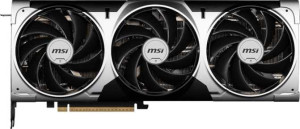
Both the MSI GeForce RTX 5070 Ti Ventus 3X and the MSI GeForce RTX 5080 Ventus 3X share an identical base GPU clock of 2295 MHz, which means neither card has an architectural head start at idle or low-load scenarios. The real divergence begins under sustained load: the RTX 5080 Ventus 3X boosts to 2617 MHz versus the 5070 Ti's 2452 MHz, a roughly 7% turbo advantage that compounds across every downstream metric.
That clock gap, combined with a significantly larger shader array — 10,752 shading units on the 5080 versus 8,960 on the 5070 Ti — drives a ~28% lead in raw compute throughput (56.28 TFLOPS vs 43.94 TFLOPS) and texture throughput (879.3 GTexels/s vs 686.6 GTexels/s). In practice, this translates to noticeably higher performance headroom in compute-heavy workloads like ray tracing, AI-accelerated rendering, and GPU simulation tasks. The 5080 also pairs a faster memory interface, running at 1875 MHz versus 1750 MHz, which reduces the chance of memory bandwidth becoming a bottleneck in high-resolution or high-asset-density scenes. The pixel fillrate edge (293.1 GPixel/s vs 235.4 GPixel/s) further means the 5080 can push more pixels per clock cycle, a direct benefit at 4K or in multi-monitor setups.
Both cards support Double Precision Floating Point, so neither has an exclusive edge there. Overall, the RTX 5080 Ventus 3X holds a clear and consistent performance advantage across every measured metric in this group — not marginal gains, but structural leads of 16–28% that stem from more execution units and faster clocks. For users whose workloads can saturate the 5070 Ti, the 5080 represents a meaningful step up rather than an incremental one.