MSI MAG B850 Tomahawk Max WiFi
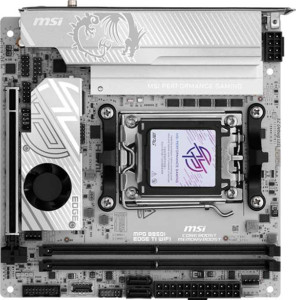
MSI MPG B850I Edge TI Wi-Fi

MSI MAG B850 Tomahawk Max WiFi MSI MPG B850I Edge TI Wi-Fi

Overview

Welcome to our detailed specification comparison between the MSI MAG B850 Tomahawk Max WiFi and the MSI MPG B850I Edge TI Wi-Fi. Both boards share the AM5 socket and B850 chipset, but they take very different approaches when it comes to form factor, expansion capabilities, and memory configuration. Read on to discover which board best fits your build requirements.

Common Features

  • Both boards use the AM5 CPU socket.
  • Both boards feature the B850 chipset.
  • Wi-Fi is supported on both products.
  • Both support the same Wi-Fi versions: Wi-Fi 4 (802.11n), Wi-Fi 5 (802.11ac), Wi-Fi 6 (802.11ax), Wi-Fi 6E (802.11ax), and Wi-Fi 7 (802.11be).
  • Bluetooth is available on both products, with version 5.4.
  • Both boards include an HDMI 2.1 output.
  • Overclocking is supported on both products.
  • Both boards support DDR5 memory.
  • Maximum RAM speed is 5600 MHz on both products.
  • Both boards feature 2 memory channels.
  • ECC memory is not supported on either product.
  • Neither board has USB 3.2 Gen 1 USB-C ports.
  • Neither board has USB 4 40Gbps or USB 4 20Gbps ports.
  • Neither board has Thunderbolt 3 or Thunderbolt 4 ports.
  • Both boards have 1 RJ45 port.
  • Neither board has DisplayPort outputs.
  • Neither board has U.2 sockets or mSATA connectors.
  • Both boards offer a 120 dB signal-to-noise ratio on the DAC.
  • Both boards support 7.1 audio channels.
  • S/PDIF Out is present on both products.
  • Both boards have 2 audio connectors.
  • Both boards feature 1 PCIe 5.0 x16 slot.
  • Neither board has PCIe 3.0 x16, PCIe 2.0 x16, PCIe x4, PCIe x8, or PCI slots.
  • Both boards support RAID 0 and RAID 1.
  • RAID 5 and RAID 0+1 are not supported on either product.

Main Differences

  • The form factor is ATX on MSI MAG B850 Tomahawk Max WiFi and Mini-ITX on MSI MPG B850I Edge TI Wi-Fi.
  • The board height is 243.8 mm on MSI MAG B850 Tomahawk Max WiFi and 170 mm on MSI MPG B850I Edge TI Wi-Fi.
  • The board width is 304.8 mm on MSI MAG B850 Tomahawk Max WiFi and 170 mm on MSI MPG B850I Edge TI Wi-Fi.
  • Maximum memory capacity is 256 GB on MSI MAG B850 Tomahawk Max WiFi and 128 GB on MSI MPG B850I Edge TI Wi-Fi.
  • Overclocked RAM speed reaches 8400 MHz on MSI MAG B850 Tomahawk Max WiFi and 10000 MHz on MSI MPG B850I Edge TI Wi-Fi.
  • The number of memory slots is 4 on MSI MAG B850 Tomahawk Max WiFi and 2 on MSI MPG B850I Edge TI Wi-Fi.
  • USB 3.2 Gen 2 USB-A ports number 2 on MSI MAG B850 Tomahawk Max WiFi and 3 on MSI MPG B850I Edge TI Wi-Fi.
  • USB 3.2 Gen 1 USB-A ports number 1 on MSI MAG B850 Tomahawk Max WiFi and 2 on MSI MPG B850I Edge TI Wi-Fi.
  • USB 3.2 Gen 2 USB-C ports number 3 on MSI MAG B850 Tomahawk Max WiFi and 0 on MSI MPG B850I Edge TI Wi-Fi.
  • USB 2.0 ports number 4 on MSI MAG B850 Tomahawk Max WiFi and 0 on MSI MPG B850I Edge TI Wi-Fi.
  • USB 3.2 Gen 2x2 ports are absent on MSI MAG B850 Tomahawk Max WiFi but 1 is present on MSI MPG B850I Edge TI Wi-Fi.
  • USB 3.2 Gen 1 expansion ports number 4 on MSI MAG B850 Tomahawk Max WiFi and 2 on MSI MPG B850I Edge TI Wi-Fi.
  • USB 2.0 expansion ports number 4 on MSI MAG B850 Tomahawk Max WiFi and 2 on MSI MPG B850I Edge TI Wi-Fi.
  • USB 3.0 expansion ports number 4 on MSI MAG B850 Tomahawk Max WiFi and 2 on MSI MPG B850I Edge TI Wi-Fi.
  • SATA 3 connectors number 4 on MSI MAG B850 Tomahawk Max WiFi and 2 on MSI MPG B850I Edge TI Wi-Fi.
  • Fan headers number 8 on MSI MAG B850 Tomahawk Max WiFi and 3 on MSI MPG B850I Edge TI Wi-Fi.
  • M.2 sockets number 4 on MSI MAG B850 Tomahawk Max WiFi and 2 on MSI MPG B850I Edge TI Wi-Fi.
  • A TPM connector is present on MSI MAG B850 Tomahawk Max WiFi but not available on MSI MPG B850I Edge TI Wi-Fi.
  • A PCIe 4.0 x16 slot is present on MSI MAG B850 Tomahawk Max WiFi but not available on MSI MPG B850I Edge TI Wi-Fi.
  • A PCIe x1 slot is present on MSI MAG B850 Tomahawk Max WiFi but not available on MSI MPG B850I Edge TI Wi-Fi.
  • RAID 10 (1+0) support is available on MSI MAG B850 Tomahawk Max WiFi but not on MSI MPG B850I Edge TI Wi-Fi.
Specs Comparison
MSI MAG B850 Tomahawk Max WiFi

MSI MAG B850 Tomahawk Max WiFi

MSI MPG B850I Edge TI Wi-Fi

MSI MPG B850I Edge TI Wi-Fi

General info:
CPU socket AM5 AM5
chipset B850 B850
form factor ATX Mini-ITX
release date January 2025 May 2025
supports Wi-Fi
Wi-Fi version Wi-Fi 4 (802.11n), Wi-Fi 5 (802.11ac), Wi-Fi 6 (802.11ax), Wi-Fi 6E (802.11ax), Wi-Fi 7 (802.11be) Wi-Fi 4 (802.11n), Wi-Fi 5 (802.11ac), Wi-Fi 6 (802.11ax), Wi-Fi 6E (802.11ax), Wi-Fi 7 (802.11be)
Has Bluetooth
Bluetooth version 5.4 5.4
HDMI version HDMI 2.1 HDMI 2.1
Easy to overclock
has RGB lighting
Easy to reset BIOS
Has dual BIOS
has aptX
CPU sockets 1 1
Has integrated graphics
warranty period 3 years 3 years
height 243.8 mm 170 mm
width 304.8 mm 170 mm
Has integrated CPU

Both the MAG B850 Tomahawk Max WiFi and the MPG B850I Edge TI Wi-Fi share the same core platform: the AM5 socket with a B850 chipset, meaning they support the same range of AMD processors and offer identical overclocking capability. Connectivity parity is also complete — both carry Wi-Fi 7 (backward-compatible through Wi-Fi 4), Bluetooth 5.4, and HDMI 2.1, so neither board gives up anything on the wireless or display-output front. Quality-of-life features like dual BIOS, easy BIOS reset, and RGB lighting are present on both, and both are backed by a 3-year warranty.

The defining — and only — meaningful difference in this group is form factor. The Tomahawk Max is a full-size ATX board (304.8 × 243.8 mm), while the B850I Edge TI is a compact Mini-ITX board (170 × 170 mm). In practice this is a system-level decision: ATX fits standard mid-tower and full-tower cases and typically allows more expansion slots and easier cable routing, whereas Mini-ITX is designed for small-form-factor builds where desk space or case volume is at a premium. The smaller PCB of the B850I inevitably limits the number of slots and headers it can physically carry — a trade-off that will become clearer in other spec groups.

For this group specifically, neither board is objectively superior in features or platform capability — they are essentially tied on every shared spec. The edge goes to the Tomahawk Max if build flexibility and expandability within a standard case matter to you, while the B850I Edge TI holds the advantage for anyone prioritizing a compact, space-efficient system without sacrificing platform or connectivity features.

Memory:
maximum memory amount 256GB 128GB
RAM speed (max) 5600 MHz 5600 MHz
overclocked RAM speed 8400 MHz 10000 MHz
memory slots 4 2
DDR memory version 5 5
memory channels 2 2
Supports ECC memory

Both boards run DDR5 in a dual-channel configuration with a native rated speed of 5600 MHz, so out of the box the memory experience is identical. The divergence starts the moment you look at slot count and capacity ceiling: the Tomahawk Max offers 4 DIMM slots and supports up to 256 GB, while the B850I Edge TI is limited to 2 slots and a 128 GB maximum — a direct consequence of its Mini-ITX footprint.

In day-to-day use, 2 slots versus 4 rarely matters if you populate both with adequately sized sticks, since dual-channel is maintained either way. However, the Tomahawk Max's four-slot design gives it a meaningful upgrade path: you can start with two sticks and add two more later without replacing anything, whereas the B850I forces you to swap out modules entirely if you ever want to expand. The 256 GB ceiling also makes the Tomahawk Max more viable for memory-intensive workloads like large virtual machines or professional content creation, where 128 GB can become a hard constraint over time.

The one area where the B850I edges ahead is overclocked RAM headroom: its maximum XMP/EXPO speed reaches a remarkable 10000 MHz, compared to 8400 MHz on the Tomahawk Max. Whether that extra headroom translates to tangible real-world gains depends heavily on the specific memory kit used, but it signals that the B850I is tuned for enthusiast-level memory overclocking despite its small size. Overall though, the Tomahawk Max holds the broader advantage in this group — more slots, double the maximum capacity, and a more flexible upgrade path outweigh the B850I's higher overclocking ceiling for most users.

Ports:
USB 3.2 Gen 2 ports (USB-A) 2 3
USB 3.2 Gen 1 ports (USB-A) 1 2
USB 3.2 Gen 2 ports (USB-C) 3 0
USB 3.2 Gen 1 ports (USB-C) 0 0
USB 2.0 ports 4 0
USB 3.2 Gen 2x2 ports 0 1
USB 4 40Gbps ports 0 0
USB 4 20Gbps ports 0 0
Thunderbolt 4 ports 0 0
Thunderbolt 3 ports 0 0
has an HDMI output
DisplayPort outputs 0 0
RJ45 ports 1 1
Has USB Type-C
eSATA ports 0 0
DVI outputs 0 0
has a VGA connector
PS/2 ports 0 0

The rear I/O layouts of these two boards take noticeably different philosophies. The Tomahawk Max leans heavily into USB-C connectivity, offering 3 × USB 3.2 Gen 2 Type-C ports — a strong choice for modern peripherals, fast external drives, and daisy-chaining displays or docks. The B850I Edge TI, by contrast, ships with zero USB-C ports on the rear panel, which is a surprising omission for a premium Mini-ITX board and could be a friction point for users with a USB-C-centric desk setup.

Where the B850I punches back is with its single USB 3.2 Gen 2x2 port, delivering up to 20 Gbps — double the 10 Gbps ceiling of standard Gen 2. That matters if you own a high-speed NVMe enclosure or a compatible external SSD, as it removes a bandwidth bottleneck that the Tomahawk Max cannot address at all from its rear panel. The Tomahawk Max also carries 4 USB 2.0 ports, which add useful low-bandwidth connections for keyboards, mice, or dongles, whereas the B850I omits USB 2.0 entirely — a reasonable trade-off given space constraints but worth noting if you rely on legacy peripherals.

In raw port count and day-to-day versatility, the Tomahawk Max holds a clear edge: more total ports, a modern USB-C-first rear panel, and legacy USB 2.0 coverage give it greater flexibility across a wider range of devices. The B850I's Gen 2x2 port is a meaningful specialty advantage, but the absence of any USB-C output makes it harder to recommend for users building around today's connector ecosystem.

Connectors:
USB 3.2 Gen 1 ports (through expansion) 4 2
USB 2.0 ports (through expansion) 4 2
SATA 3 connectors 4 2
fan headers 8 3
USB 3.0 ports (through expansion) 4 2
M.2 sockets 4 2
Has TPM connector
U.2 sockets 0 0
Has mSATA connector
SATA 2 connectors 0 0

Internal connector counts tell a familiar story shaped by form factor. The Tomahawk Max offers 4 M.2 sockets and 4 SATA 3 connectors, giving builders substantial storage flexibility — you could populate all four M.2 slots with NVMe drives and still have SATA ports free for additional SSDs or HDDs. The B850I Edge TI is limited to 2 M.2 sockets and 2 SATA 3 connectors, which is workable for a compact build but leaves little room to grow a multi-drive array.

Thermal management is where the gap becomes most consequential. The Tomahawk Max includes 8 fan headers, providing fine-grained control over a full tower's worth of cooling hardware — CPU coolers, case fans, and AIO pumps can each get dedicated headers. The B850I manages only 3 fan headers, which is tight even for a Mini-ITX case where airflow options are already constrained by physical space. Builders pairing the B850I with an all-in-one liquid cooler and multiple chassis fans may find themselves relying on a fan splitter to make it work. The Tomahawk Max also includes a TPM connector, which the B850I lacks — relevant for enterprise environments or users who require hardware-based security features like BitLocker at its most robust.

Across every internal connector category, the Tomahawk Max holds a decisive advantage. The B850I's reduced counts are an expected Mini-ITX trade-off rather than a design flaw, but users planning storage-heavy or cooling-intensive builds should weigh these limitations carefully before committing to the smaller board.

Expansion slots:
PCIe 4.0 x16 slots 1 0
PCIe 5.0 x16 slots 1 1
PCIe 3.0 x16 slots 0 0
PCIe x1 slots 1 0
PCI slots 0 0
PCIe 2.0 x16 slots 0 0
PCIe x4 slots 0 0
PCIe x8 slots 0 0

For GPU installation — the primary use case for x16 slots — both boards deliver a PCIe 5.0 x16 slot, ensuring full bandwidth compatibility with current and next-generation graphics cards. Neither board is at a disadvantage when it comes to feeding a discrete GPU, and the 5.0 interface provides double the throughput of PCIe 4.0, future-proofing both platforms for high-bandwidth cards to come.

The meaningful separation appears in secondary slots. The Tomahawk Max adds a PCIe 4.0 x16 slot (likely wired at x4 electrically, as is common on B-series boards) and a PCIe x1 slot, opening the door for add-in cards such as capture cards, additional networking adapters, or PCIe storage controllers. The B850I Edge TI, constrained by its Mini-ITX dimensions, offers no secondary slots whatsoever — once the GPU occupies the single x16 slot, there is no room for any further PCIe expansion on the board itself.

The Tomahawk Max has a clear edge here. For users who only ever need a single GPU, the difference is largely academic. But anyone planning to add a dedicated capture card, a 10GbE NIC, or any other expansion card will find the B850I's single-slot layout a hard stop. The Tomahawk Max's additional slots preserve meaningful flexibility that the B850I simply cannot match by design.

Audio:
Signal-to-Noise ratio (DAC) 120 dB 120 dB
audio channels 7.1 7.1
Has S/PDIF Out port
audio connectors 2 2

Audio is the one spec group where these two boards are in complete lockstep. Both deliver a 120 dB signal-to-noise ratio from their onboard DAC — a figure that sits comfortably in the high-fidelity range for integrated audio, meaning listeners using quality headphones or powered speakers should hear clean, low-noise output without needing a discrete sound card. Both also support 7.1 surround channels, cover digital output via S/PDIF, and offer the same number of analog audio connectors.

This is a straightforward tie. Based strictly on the provided specifications, neither the Tomahawk Max nor the B850I Edge TI offers any audio advantage over the other — every measurable parameter is identical. Choosing between them on audio grounds alone is not possible, and users with particularly demanding audio requirements would be equally served — or equally pushed toward a dedicated sound card — by either board.

Storage:
Supports RAID 1
Supports RAID 10 (1+0)
Supports RAID 5
Supports RAID 0
Supports RAID 0+1

RAID support between these two boards is nearly identical, with both handling the most common configurations: RAID 0 for striped performance and RAID 1 for mirrored redundancy. The only point of divergence is RAID 10, which the Tomahawk Max supports and the B850I Edge TI does not.

RAID 10 combines striping and mirroring across a minimum of four drives, offering both the speed benefits of RAID 0 and the fault tolerance of RAID 1 simultaneously. It is the configuration of choice for users who need high throughput without sacrificing data protection — common in small workstation or home server setups. The B850I's lack of RAID 10 support, combined with its physical limit of only two SATA connectors and two M.2 slots noted earlier, means it is practically constrained from running RAID 10 on hardware grounds anyway, making this a largely consistent limitation rather than an isolated one.

The Tomahawk Max takes a narrow edge here solely on the basis of RAID 10 support. For the majority of desktop users who stick to RAID 0 or RAID 1, the two boards are effectively tied. Only those specifically planning a four-drive redundant array will find this distinction meaningful — and for them, the Tomahawk Max is the only viable option of the two.

Comparison Summary & Verdict

After examining all the evidence, both boards serve distinct audiences. The MSI MAG B850 Tomahawk Max WiFi stands out for builders who need maximum expandability, offering 4 memory slots, 4 M.2 sockets, 8 fan headers, a TPM connector, and additional PCIe slots — making it ideal for full-size ATX builds with complex storage and cooling setups. The MSI MPG B850I Edge TI Wi-Fi, by contrast, is purpose-built for compact Mini-ITX systems, and compensates for its smaller footprint with an impressive 10000 MHz overclocked RAM speed and a USB 3.2 Gen 2x2 port. Both boards deliver identical audio quality, Wi-Fi 7, and Bluetooth 5.4, so your choice ultimately comes down to build size and expandability needs.

MSI MAG B850 Tomahawk Max WiFi
Buy MSI MAG B850 Tomahawk Max WiFi if...

Buy the MSI MAG B850 Tomahawk Max WiFi if you are building a full-size ATX system and need maximum expandability, including 4 memory slots, 4 M.2 sockets, 8 fan headers, and broader PCIe and USB connectivity.

MSI MPG B850I Edge TI Wi-Fi
Buy MSI MPG B850I Edge TI Wi-Fi if...

Buy the MSI MPG B850I Edge TI Wi-Fi if you are building a compact Mini-ITX system and want the highest overclocked RAM speeds of up to 10000 MHz along with a USB 3.2 Gen 2x2 port.