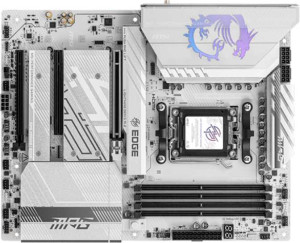
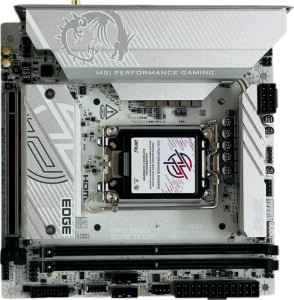
The most fundamental distinction between these two boards is their CPU platform: the MPG B850 Edge Ti WiFi targets AMD AM5 processors, while the MPG B860I Edge Ti Wi-Fi is built for Intel LGA 1851 (Arrow Lake). This alone makes them mutually exclusive choices — your CPU pick determines which board is relevant to you. Beyond the platform split, form factor is the second major divide: the B850 is a full-size ATX board (304.8 × 243.8 mm), offering more physical room for expansion slots, VRM phases, and cooling headers, whereas the B860I is a compact Mini-ITX (170 × 170 mm), designed for small-form-factor builds where space is at a premium.
Where the Intel-based B860I quietly pulls ahead is its inclusion of dual BIOS, a hardware-level redundancy feature absent on the B850. In practice, dual BIOS means a corrupted or failed firmware update won't brick the board — the backup chip takes over automatically. For enthusiasts who push BIOS updates aggressively or overclock, this is a meaningful safety net. Both boards otherwise share a strong common baseline: Wi-Fi 7 (802.11be), Bluetooth 5.4, HDMI 2.1, RGB lighting, easy BIOS reset, and an identical 3-year warranty — so neither cuts corners on connectivity or support.
In summary, these boards serve genuinely different use cases rather than competing head-to-head. The B850 ATX is the pick for AMD platform users who want a spacious, full-featured build. The B860I Mini-ITX is for Intel users prioritizing a small footprint, and it gains a practical edge with dual BIOS. There is no universal winner — platform choice is the deciding factor, and within that constraint, the B860I's dual BIOS is a notable bonus for its form-factor audience.