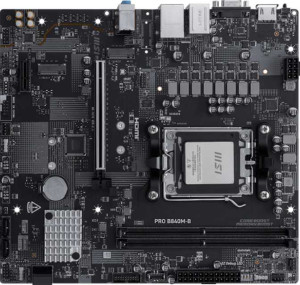
MSI Pro B840M-B
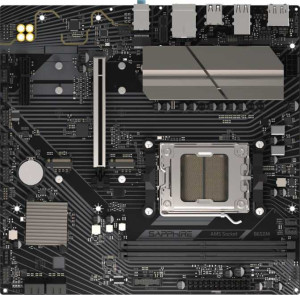
Sapphire B650M-E

MSI Pro B840M-B Sapphire B650M-E

Overview

Welcome to our in-depth specification comparison between the MSI Pro B840M-B and the Sapphire B650M-E, two Micro-ATX motherboards built on the AM5 platform targeting budget-conscious builders. While they share a surprising amount of common ground, key differences emerge around memory capacity, connectivity options, and audio capabilities that could meaningfully influence your next build decision.

Common Features

  • Both boards use the AM5 CPU socket.
  • Both boards have a Micro-ATX form factor.
  • Neither board supports Wi-Fi.
  • Neither board has Bluetooth.
  • Both boards support overclocking.
  • Neither board has a dual BIOS.
  • Both boards have a single CPU socket.
  • Neither board has integrated graphics.
  • Both boards have 2 memory slots.
  • Both boards use DDR5 memory.
  • Both boards support 2 memory channels.
  • Neither board supports ECC memory.
  • Neither board has USB 3.2 Gen 2 ports (USB-A), USB 3.2 Gen 2 ports (USB-C), USB 3.2 Gen 1 ports (USB-C), USB 3.2 Gen 2x2 ports, USB 4 ports, Thunderbolt 4, or Thunderbolt 3 ports.
  • Both boards provide 2 USB 3.2 Gen 1 ports through expansion and 4 USB 2.0 ports through expansion.
  • Both boards have 4 SATA 3 connectors and 2 M.2 sockets.
  • Neither board has an mSATA connector or SATA 2 connectors.
  • Both boards have 1 PCIe 4.0 x16 slot and no PCIe 5.0 x16 or PCIe 3.0 x16 slots.
  • Neither board has an S/PDIF Out port, and both have 3 audio connectors.
  • Neither board supports RAID 0+1.

Main Differences

  • The chipset is B840 on MSI Pro B840M-B and B650 on Sapphire B650M-E.
  • RGB lighting is present on MSI Pro B840M-B but not available on Sapphire B650M-E.
  • Easy BIOS reset is supported on MSI Pro B840M-B but not on Sapphire B650M-E.
  • The board height is 226 mm on MSI Pro B840M-B and 235 mm on Sapphire B650M-E.
  • The board width is 243.8 mm on MSI Pro B840M-B and 244 mm on Sapphire B650M-E.
  • Maximum memory capacity is 128 GB on MSI Pro B840M-B and 96 GB on Sapphire B650M-E.
  • Overclocked RAM speed reaches 8000 MHz on MSI Pro B840M-B and 7600 MHz on Sapphire B650M-E.
  • USB 3.2 Gen 1 ports (USB-A) count is 4 on MSI Pro B840M-B and 2 on Sapphire B650M-E.
  • USB 2.0 port count is 2 on MSI Pro B840M-B and 6 on Sapphire B650M-E.
  • A DisplayPort output is absent on MSI Pro B840M-B but present on Sapphire B650M-E.
  • A USB Type-C port is present on MSI Pro B840M-B but not available on Sapphire B650M-E.
  • A VGA connector is present on MSI Pro B840M-B but not available on Sapphire B650M-E.
  • PCIe x1 slot count is 1 on MSI Pro B840M-B and 0 on Sapphire B650M-E.
  • PCIe x4 slot count is 0 on MSI Pro B840M-B and 1 on Sapphire B650M-E.
  • Audio channel support is 7.1 on MSI Pro B840M-B and 5.1 on Sapphire B650M-E.
Specs Comparison
MSI Pro B840M-B

MSI Pro B840M-B

Sapphire B650M-E

Sapphire B650M-E

General info:
CPU socket AM5 AM5
chipset B840 B650
form factor Micro-ATX Micro-ATX
release date May 2025 September 2025
supports Wi-Fi
Has Bluetooth
Easy to overclock
has RGB lighting
Easy to reset BIOS
Has dual BIOS
CPU sockets 1 1
Has integrated graphics
warranty period 3 years 3 years
height 226 mm 235 mm
width 243.8 mm 244 mm
Has integrated CPU

Both the MSI Pro B840M-B and the Sapphire B650M-E share the same fundamental platform: the AM5 socket in a Micro-ATX form factor, with a single CPU socket, no integrated graphics, and an identical 3-year warranty. Neither board includes Wi-Fi or Bluetooth, so users planning a wireless setup will need to budget for an add-in card or adapter regardless of which they choose. Both also support overclocking, which is a welcome inclusion at this price tier.

The most significant structural difference lies in the chipset. The Sapphire uses the B650, a more established and feature-rich chipset that generally offers broader PCIe lane allocation and wider compatibility with the AM5 ecosystem. The MSI relies on the B840, a newer but more constrained budget chipset with reduced I/O flexibility. In practical terms, this can matter when populating multiple M.2 slots or high-bandwidth expansion cards simultaneously. On the usability front, the MSI counters with two meaningful conveniences: RGB lighting for aesthetics and, more importantly, an easy BIOS reset mechanism — a genuinely useful feature during initial builds or troubleshooting. The Sapphire offers neither.

Overall, the Sapphire B650M-E holds a platform-level edge thanks to its superior chipset, which translates to more headroom for storage and expansion configurations. However, the MSI Pro B840M-B compensates with friendlier build-time ergonomics via its BIOS reset feature. For builders prioritizing long-term expandability, the Sapphire has the advantage; for those who value ease of setup and a cleaner aesthetic, the MSI is the more approachable choice.
Memory:
maximum memory amount 128GB 96GB
overclocked RAM speed 8000 MHz 7600 MHz
memory slots 2 2
DDR memory version 5 5
memory channels 2 2
Supports ECC memory

Both boards run DDR5 memory in a dual-channel configuration across two slots — a shared baseline that puts them on equal footing for everyday and gaming workloads. Where they diverge is in their respective ceilings. The MSI Pro B840M-B supports up to 128GB of maximum RAM, while the Sapphire B650M-E caps out at 96GB. With only two slots on each board, hitting those limits requires high-density DIMMs, so the MSI's higher ceiling is a meaningful differentiator for users running memory-hungry applications like virtual machines, video editing pipelines, or large dataset workloads.

The overclocked speed headroom tells a similar story. The MSI tops out at 8000 MHz versus the Sapphire's 7600 MHz — a gap of 400 MHz that, in practice, translates to marginally better memory bandwidth for latency-sensitive tasks and is particularly relevant for AMD's Ryzen processors, which have historically benefited from tighter memory tuning. Neither difference is transformative for general use, but for users who intend to push XMP or EXPO profiles aggressively, the MSI offers more runway.

On memory, the MSI Pro B840M-B holds a clear advantage on both capacity and speed headroom. The Sapphire's 96GB limit and lower overclocking ceiling make it the more constrained option, though for mainstream builds that will realistically use 32GB or 64GB, neither board will feel limiting in day-to-day use.

Ports:
USB 3.2 Gen 2 ports (USB-A) 0 0
USB 3.2 Gen 1 ports (USB-A) 4 2
USB 3.2 Gen 2 ports (USB-C) 0 0
USB 3.2 Gen 1 ports (USB-C) 0 0
USB 2.0 ports 2 6
USB 3.2 Gen 2x2 ports 0 0
USB 4 40Gbps ports 0 0
USB 4 20Gbps ports 0 0
Thunderbolt 4 ports 0 0
Thunderbolt 3 ports 0 0
has an HDMI output
DisplayPort outputs 0 1
RJ45 ports 1 1
Has USB Type-C
eSATA ports 0 0
DVI outputs 0 0
has a VGA connector
PS/2 ports 0 0

The rear I/O layouts of these two boards reflect notably different design philosophies. The MSI Pro B840M-B leans toward modern connectivity: it offers 4 USB 3.2 Gen 1 Type-A ports alongside a USB Type-C port — a meaningful inclusion for users with newer peripherals, external drives, or smartphones that rely on USB-C. The Sapphire B650M-E, by contrast, skips USB-C entirely and instead provides only 2 USB 3.2 Gen 1 ports, compensating with 6 USB 2.0 ports. While that raises the raw port count, USB 2.0 is a significant step down in transfer speed and is better suited for low-bandwidth devices like keyboards and mice than for storage or high-speed peripherals.

On the display output side, the two boards split the advantage. The MSI includes a VGA output alongside HDMI — a legacy connector that retains value in office environments with older monitors — but has no DisplayPort. The Sapphire swaps VGA for a DisplayPort output, which supports higher refresh rates and resolutions more reliably than HDMI on many modern monitors, making it the stronger choice for current display hardware. Both boards share a single HDMI output and one RJ45 ethernet port.

Neither board dominates cleanly across the entire port category. The MSI has the edge in USB versatility thanks to its Type-C port and faster USB 3.2 Gen 1 count, while the Sapphire wins on display output quality with its DisplayPort. For users prioritizing peripheral connectivity, the MSI is the more practical pick; for those focused on monitor compatibility, the Sapphire's output selection is more future-proof.

Connectors:
USB 3.2 Gen 1 ports (through expansion) 2 2
USB 2.0 ports (through expansion) 4 4
SATA 3 connectors 4 4
USB 3.0 ports (through expansion) 2 2
M.2 sockets 2 2
U.2 sockets 0 0
Has mSATA connector
SATA 2 connectors 0 0

Across every internal connector specification in this group, the MSI Pro B840M-B and Sapphire B650M-E are a perfect match. Both provide 2 M.2 sockets for NVMe storage, 4 SATA 3 ports for traditional drives, and identical expansion header counts for additional USB connectivity. There is no differentiator to speak of here.

In practical terms, both boards can comfortably support a typical enthusiast storage setup — one NVMe boot drive plus a second M.2 for bulk storage, with four SATA ports left available for HDDs or SSDs. That is a well-rounded configuration for a Micro-ATX board, and neither product shortchanges the user on internal expansion relative to its size class.

This category is a clear tie. Buyers making a decision between these two boards should place no weight on internal connectors, as the storage and expansion options are functionally identical. The differentiating factors lie in the other specification groups.

Expansion slots:
PCIe 4.0 x16 slots 1 1
PCIe 5.0 x16 slots 0 0
PCIe 3.0 x16 slots 0 0
PCIe x1 slots 1 0
PCI slots 0 0
PCIe 2.0 x16 slots 0 0
PCIe x4 slots 0 1
PCIe x8 slots 0 0

The primary GPU slot is identical on both boards: a single PCIe 4.0 x16 slot, which is the current standard for discrete graphics cards and poses no bottleneck for any modern GPU. Neither board offers a PCIe 5.0 x16 slot, so users chasing the absolute cutting edge of GPU bandwidth will find both equally constrained — though in practice, PCIe 4.0 x16 remains more than sufficient for current-generation graphics workloads.

The real distinction lies in the secondary slot. The MSI Pro B840M-B includes a PCIe x1 slot, which is ideal for compact add-in cards such as sound cards, Wi-Fi adapters, or capture cards — low-bandwidth accessories that fit neatly into an x1 lane. The Sapphire B650M-E instead provides a PCIe x4 slot, which carries four times the lane bandwidth of an x1. This makes it better suited for higher-throughput expansion cards, such as an add-in NVMe controller or a multi-port USB expansion card, while still accommodating the same low-bandwidth accessories the MSI's x1 handles.

For secondary expansion, the Sapphire B650M-E holds a practical edge. A PCIe x4 slot is strictly more capable than an x1 — it can host everything an x1 card can, plus devices that actually benefit from the additional bandwidth. Users planning to populate that second slot with anything beyond a basic peripheral adapter will find the Sapphire's configuration more versatile.

Audio:
audio channels 7.1 5.1
Has S/PDIF Out port
audio connectors 3 3

Audio connectivity is nearly identical between these two boards — both offer 3 analog audio connectors and neither includes an S/PDIF optical output, which rules out direct digital passthrough to external DACs or AV receivers for both. The meaningful difference is in channel support: the MSI Pro B840M-B supports 7.1-channel surround audio, while the Sapphire B650M-E tops out at 5.1-channel.

In practice, 7.1 support allows the MSI to drive a full eight-speaker surround setup — front, center, rear, and side channels — which is relevant for dedicated home theater PC builds or users with high-end multi-speaker audio systems. The Sapphire's 5.1 limitation means it can handle the more common six-speaker configuration but cannot natively support side channel speakers in a true 7.1 arrangement. For the majority of users running stereo headphones or a basic speaker pair, neither limitation will ever surface.

The MSI Pro B840M-B takes a clear edge here for audio enthusiasts with surround speaker setups. That said, the gap is irrelevant for anyone not actively running a 7.1 speaker array — and users with serious audio demands would typically invest in a dedicated sound card regardless of onboard channel support.

Storage:
Supports RAID 0+1

The only storage-specific spec provided for this group is RAID 0+1 support, and both the MSI Pro B840M-B and the Sapphire B650M-E are identical: neither board supports it. This means hardware-level RAID configurations that combine striping and mirroring simultaneously are off the table for both, which is a typical limitation at this chipset tier and not a surprising omission for consumer-oriented Micro-ATX boards.

For the vast majority of desktop users, this is a non-issue — RAID 0+1 is primarily relevant in workstation or server contexts where data redundancy and performance must be maintained across multiple drives simultaneously. Home users, gamers, and even most content creators running independent drives will never encounter this limitation in practice.

This category is a straightforward tie. With both boards sharing the same constraint, storage configuration should not influence the buying decision here. Users with a genuine need for hardware RAID would be looking at a different product class entirely.

Comparison Summary & Verdict

Both the MSI Pro B840M-B and the Sapphire B650M-E are competent Micro-ATX AM5 boards, but they cater to slightly different builder profiles. The MSI Pro B840M-B stands out with its higher maximum memory capacity of 128 GB, faster overclocked RAM support at 8000 MHz, 7.1 audio, RGB lighting, and a broader rear USB layout including a USB Type-C port, making it the stronger pick for enthusiasts who want more headroom. The Sapphire B650M-E, built on the more capable B650 chipset, counters with a DisplayPort output for integrated graphics users and more USB 2.0 ports, making it a pragmatic choice for home office or media-oriented builds. Choose the MSI if raw memory performance and connectivity flexibility are priorities; opt for the Sapphire if display output and chipset pedigree matter more to your use case.

MSI Pro B840M-B
Buy MSI Pro B840M-B if...

Buy the MSI Pro B840M-B if you want higher maximum memory capacity, faster overclocked RAM support, 7.1 audio, RGB lighting, and a USB Type-C rear port for a more feature-rich AM5 build.

Sapphire B650M-E
Buy Sapphire B650M-E if...

Buy the Sapphire B650M-E if you need a DisplayPort output for display connectivity and prefer the more capable B650 chipset for your AM5 platform build.