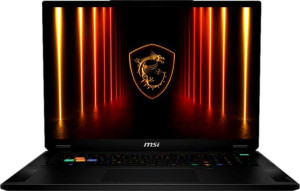
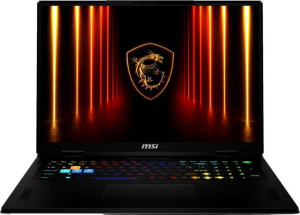
Under the hood, both laptops share the same Blackwell GPU generation, identical memory bus width, bandwidth ceiling, and graphics API support — a common foundation that confirms their positioning in the same product tier. The divergence, however, lies in how aggressively each machine is configured within that tier. The Stealth 18 HX AI A2XW operates at a 95W TDP versus the Vector A18's 80W, giving its GPU a larger sustained power envelope. This directly feeds into the Stealth's higher shading unit count (10,496 vs 7,680), more ROPs, and more TMUs — reinforcing the GPU performance gap already established in the specifications and benchmark groups.
On the CPU side, the contrast is equally revealing. The Stealth employs big.LITTLE hybrid architecture with an unlocked clock multiplier and supports RAM up to 6,400 MHz, while the Vector uses a uniform core design, a locked multiplier, and caps RAM support at 5,600 MHz. The unlocked multiplier on the Stealth opens the door to overclocking for users willing to push the hardware, a meaningful headroom advantage the Vector simply does not offer. The Vector counters with a substantially larger L3 cache of 64MB versus the Stealth's 36MB — a genuine asset for CPU workloads that benefit from keeping large datasets close to the processor, such as simulations or database operations — though its smaller L2 cache of 16MB versus the Stealth's 40MB partially offsets that advantage at lower latency tiers.
Synthesizing these details, the Stealth holds a meaningful overall edge in this category: higher TDP, more GPU compute units, an unlocked multiplier, hybrid CPU architecture, and greater RAM speed headroom collectively paint the picture of a more performance-oriented configuration. The Vector's larger L3 cache is a legitimate strength for specific CPU-bound workloads, but it is not enough to tip the balance of this category in its favor.