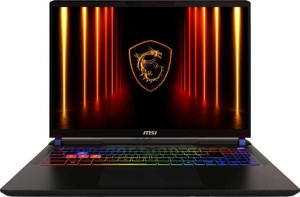
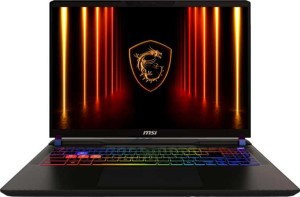
MSI Vector 16 HX AI A2XW (2025) 16"
MSI Vector 16 HX AI A2XW (2025) 16" (Ultra 7 255HX / RTX 5070 Ti Laptop / 16GB RAM / 512GB)

MSI Vector 16 HX AI A2XW (2025) 16" MSI Vector 16 HX AI A2XW (2025) 16" (Ultra 7 255HX / RTX 5070 Ti Laptop / 16GB RAM / 512GB)

Overview

Welcome to our in-depth spec comparison between the MSI Vector 16 HX AI A2XW (2025) 16″ and the MSI Vector 16 HX AI A2XW (2025) 16″ (Ultra 7 255HX / RTX 5070 Ti Laptop / 16GB RAM / 512GB). While both machines share the same gaming-focused chassis, display, and connectivity foundation, they diverge significantly in GPU power, CPU configuration, and memory capacity — factors that can make a decisive difference depending on your workload and budget.

Common Features

  • Both products are classified as Gaming type laptops.
  • Both products weigh 2700 g.
  • Neither product uses a fanless design.
  • Both products have a backlit keyboard.
  • Both products share the same volume of 2230.536 cm³.
  • Both products measure 357 mm in width, 284 mm in height, and 22 mm in thickness.
  • Both products have a 16″ screen size with a resolution of 2560 x 1600 px.
  • Both products have a pixel density of 188 ppi.
  • Both products feature an LCD, LED-backlit, IPS display type.
  • Neither product has a touch screen.
  • Both products have a typical brightness of 305 nits.
  • Both products have a 240Hz refresh rate.
  • Neither product has an anti-reflection coating.
  • Both products have a RAM speed of 6400 MHz.
  • Both products use flash storage.
  • Both products use GDDR7 graphics memory.
  • Both products use an NVMe SSD.
  • Both products support DirectX 12 Ultimate.
  • Both products support multithreading.
  • Both products support a maximum memory amount of 96GB.
  • Both products use DDR5 memory.
  • Both products have 2 USB 3.2 Gen 2 ports (USB-A) and 2 USB 4 40Gbps ports.
  • Both products have a battery life of 7 hours and a battery size of 90 Wh.
  • Both products have sleep-and-charge USB ports.
  • Neither product has a MagSafe power adapter.
  • Both products have stereo speakers and a 3.5 mm audio jack socket.
  • Both products support ray tracing and DLSS.
  • Neither product has Dolby Atmos.
  • Neither product includes a stylus or a fingerprint scanner.
  • Both products have 1 microphone.
  • Both products have 4 USB ports and 2 Thunderbolt ports.
  • Both products feature Intel Resizable BAR.
  • Both products use the Blackwell GPU architecture.
  • Neither product has LHR.
  • Both products support 3D and multi-display technology.

Main Differences

  • RAM is 32GB on MSI Vector 16 HX AI A2XW (2025) 16″ and 16GB on MSI Vector 16 HX AI A2XW (2025) 16″ (Ultra 7 255HX / RTX 5070 Ti Laptop / 16GB RAM / 512GB).
  • Internal storage is 1024GB on MSI Vector 16 HX AI A2XW (2025) 16″ and 512GB on MSI Vector 16 HX AI A2XW (2025) 16″ (Ultra 7 255HX / RTX 5070 Ti Laptop / 16GB RAM / 512GB).
  • CPU speed is 8 x 2.7 & 16 x 2.1 GHz on MSI Vector 16 HX AI A2XW (2025) 16″ and 8 x 2.4 & 12 x 1.8 GHz on MSI Vector 16 HX AI A2XW (2025) 16″ (Ultra 7 255HX / RTX 5070 Ti Laptop / 16GB RAM / 512GB).
  • CPU threads count is 24 on MSI Vector 16 HX AI A2XW (2025) 16″ and 20 on MSI Vector 16 HX AI A2XW (2025) 16″ (Ultra 7 255HX / RTX 5070 Ti Laptop / 16GB RAM / 512GB).
  • VRAM is 24GB on MSI Vector 16 HX AI A2XW (2025) 16″ and 12GB on MSI Vector 16 HX AI A2XW (2025) 16″ (Ultra 7 255HX / RTX 5070 Ti Laptop / 16GB RAM / 512GB).
  • Floating-point performance is 31.8 TFLOPS on MSI Vector 16 HX AI A2XW (2025) 16″ and 17.04 TFLOPS on MSI Vector 16 HX AI A2XW (2025) 16″ (Ultra 7 255HX / RTX 5070 Ti Laptop / 16GB RAM / 512GB).
  • Texture rate is 496.9 GTexels/s on MSI Vector 16 HX AI A2XW (2025) 16″ and 266.2 GTexels/s on MSI Vector 16 HX AI A2XW (2025) 16″ (Ultra 7 255HX / RTX 5070 Ti Laptop / 16GB RAM / 512GB).
  • Pixel rate is 193.9 GPixel/s on MSI Vector 16 HX AI A2XW (2025) 16″ and 115.8 GPixel/s on MSI Vector 16 HX AI A2XW (2025) 16″ (Ultra 7 255HX / RTX 5070 Ti Laptop / 16GB RAM / 512GB).
  • GPU clock speed is 990 MHz on MSI Vector 16 HX AI A2XW (2025) 16″ and 847 MHz on MSI Vector 16 HX AI A2XW (2025) 16″ (Ultra 7 255HX / RTX 5070 Ti Laptop / 16GB RAM / 512GB).
  • Turbo clock speed is 5.4GHz on MSI Vector 16 HX AI A2XW (2025) 16″ and 5.2GHz on MSI Vector 16 HX AI A2XW (2025) 16″ (Ultra 7 255HX / RTX 5070 Ti Laptop / 16GB RAM / 512GB).
  • GPU turbo speed is 1515 MHz on MSI Vector 16 HX AI A2XW (2025) 16″ and 1447 MHz on MSI Vector 16 HX AI A2XW (2025) 16″ (Ultra 7 255HX / RTX 5070 Ti Laptop / 16GB RAM / 512GB).
  • PassMark result is 56426 on MSI Vector 16 HX AI A2XW (2025) 16″ and 50739 on MSI Vector 16 HX AI A2XW (2025) 16″ (Ultra 7 255HX / RTX 5070 Ti Laptop / 16GB RAM / 512GB).
  • PassMark single-core result is 4723 on MSI Vector 16 HX AI A2XW (2025) 16″ and 4645 on MSI Vector 16 HX AI A2XW (2025) 16″ (Ultra 7 255HX / RTX 5070 Ti Laptop / 16GB RAM / 512GB).
  • Clock multiplier is 27 on MSI Vector 16 HX AI A2XW (2025) 16″ and 24 on MSI Vector 16 HX AI A2XW (2025) 16″ (Ultra 7 255HX / RTX 5070 Ti Laptop / 16GB RAM / 512GB).
  • Thermal Design Power (TDP) is 95W on MSI Vector 16 HX AI A2XW (2025) 16″ and 60W on MSI Vector 16 HX AI A2XW (2025) 16″ (Ultra 7 255HX / RTX 5070 Ti Laptop / 16GB RAM / 512GB).
  • Memory bus width is 256-bit on MSI Vector 16 HX AI A2XW (2025) 16″ and 192-bit on MSI Vector 16 HX AI A2XW (2025) 16″ (Ultra 7 255HX / RTX 5070 Ti Laptop / 16GB RAM / 512GB).
  • Maximum memory bandwidth is 811.5 GB/s on MSI Vector 16 HX AI A2XW (2025) 16″ and 608.6 GB/s on MSI Vector 16 HX AI A2XW (2025) 16″ (Ultra 7 255HX / RTX 5070 Ti Laptop / 16GB RAM / 512GB).
  • Render output units (ROPs) count is 128 on MSI Vector 16 HX AI A2XW (2025) 16″ and 80 on MSI Vector 16 HX AI A2XW (2025) 16″ (Ultra 7 255HX / RTX 5070 Ti Laptop / 16GB RAM / 512GB).
  • Texture mapping units (TMUs) count is 328 on MSI Vector 16 HX AI A2XW (2025) 16″ and 184 on MSI Vector 16 HX AI A2XW (2025) 16″ (Ultra 7 255HX / RTX 5070 Ti Laptop / 16GB RAM / 512GB).
  • Shading units count is 10496 on MSI Vector 16 HX AI A2XW (2025) 16″ and 5888 on MSI Vector 16 HX AI A2XW (2025) 16″ (Ultra 7 255HX / RTX 5070 Ti Laptop / 16GB RAM / 512GB).
  • GPU memory speed is 2000 MHz on MSI Vector 16 HX AI A2XW (2025) 16″ and 1750 MHz on MSI Vector 16 HX AI A2XW (2025) 16″ (Ultra 7 255HX / RTX 5070 Ti Laptop / 16GB RAM / 512GB).
  • L2 cache is 40 MB on MSI Vector 16 HX AI A2XW (2025) 16″ and 36 MB on MSI Vector 16 HX AI A2XW (2025) 16″ (Ultra 7 255HX / RTX 5070 Ti Laptop / 16GB RAM / 512GB).
Specs Comparison
MSI Vector 16 HX AI A2XW (2025) 16"

MSI Vector 16 HX AI A2XW (2025) 16"

MSI Vector 16 HX AI A2XW (2025) 16" (Ultra 7 255HX / RTX 5070 Ti Laptop / 16GB RAM / 512GB)

MSI Vector 16 HX AI A2XW (2025) 16" (Ultra 7 255HX / RTX 5070 Ti Laptop / 16GB RAM / 512GB)

Design:
Type Gaming Gaming
weight 2700 g 2700 g
Uses a fanless design
Has a backlit keyboard
volume 2230.536 cm³ 2230.536 cm³
width 357 mm 357 mm
height 284 mm 284 mm
thickness 22 mm 22 mm
is weather-sealed (splashproof)
has a rugged build

In terms of design, the MSI Vector 16 HX AI A2XW (2025) and its Ultra 7 255HX variant are, by every measurable dimension, identical. Both weigh 2700 g, share the same footprint of 357 × 284 mm with a 22 mm thickness, and occupy the same volume of 2230.536 cm³. This is not a coincidence — these are configurations of the same chassis, meaning buyers get no physical trade-off between the two when it comes to portability or desk presence.

At 2.7 kg, this is a substantial gaming laptop, consistent with the expectations of a high-performance 16-inch machine housing powerful cooling infrastructure. It is portable enough to move between locations but is not designed for daily commuting. Both models use active cooling (no fanless design), feature a backlit keyboard, and lack weather sealing or rugged certification — all typical traits for a gaming-focused product prioritizing performance over durability in harsh conditions.

Since every design specification is perfectly matched across both configurations, this category is a complete tie. A buyer choosing between these two variants should base their decision entirely on internal hardware differences — the chassis itself offers no distinguishing factor whatsoever.

Display:
screen size 16" 16"
resolution 2560 x 1600 px 2560 x 1600 px
pixel density 188 ppi 188 ppi
Display type LCD, LED-backlit, IPS LCD, LED-backlit, IPS
has a touch screen
brightness (typical) 305 nits 305 nits
refresh rate 240Hz 240Hz
has anti-reflection coating
supported displays 4 4

Both configurations of the MSI Vector 16 HX AI A2XW (2025) feature an identical 16-inch IPS LCD panel running at 2560 × 1600 resolution — a 16:10 aspect ratio that provides meaningfully more vertical screen real estate than the standard 16:9, which is genuinely useful for both gaming and productivity tasks. At 188 ppi, sharpness is solid for a 16-inch display, rendering text and textures crisply without the need for aggressive scaling.

The standout shared specification is the 240Hz refresh rate, which ensures exceptionally smooth motion in fast-paced games — a clear priority for this gaming-oriented machine. The 305 nits typical brightness is adequate for indoor use but may struggle in brightly lit environments, and the absence of an anti-reflection coating compounds this limitation slightly. Support for up to 4 external displays is a notable capability, making either configuration viable as the hub of a serious multi-monitor workstation setup.

As with the Design category, there is no distinction whatsoever between the two variants here — every display specification is a perfect match. This is another category where the hardware configuration (CPU, GPU, RAM) must drive the purchasing decision, as the screen experience will be entirely identical across both models.

Performance:
RAM 32GB 16GB
RAM speed 6400 MHz 6400 MHz
Uses flash storage
internal storage 1024GB 512GB
CPU speed 8 x 2.7 & 16 x 2.1 GHz 8 x 2.4 & 12 x 1.8 GHz
CPU threads 24 threads 20 threads
VRAM 24GB 12GB
floating-point performance 31.8 TFLOPS 17.04 TFLOPS
GDDR version GDDR7 GDDR7
texture rate 496.9 GTexels/s 266.2 GTexels/s
pixel rate 193.9 GPixel/s 115.8 GPixel/s
Is an NVMe SSD
DirectX version DirectX 12 Ultimate DirectX 12 Ultimate
GPU clock speed 990 MHz 847 MHz
uses multithreading
maximum memory amount 96GB 96GB
DDR memory version 5 5
turbo clock speed 5.4GHz 5.2GHz
GPU turbo 1515 MHz 1447 MHz
memory slots 2 2
PCI Express (PCIe) version 4 4
semiconductor size 4 nm 4 nm
has XeSS (XMX)
Supports 64-bit

This is the category where the two configurations finally diverge — and diverge substantially. The base MSI Vector 16 HX AI A2XW (2025) arrives with 32GB of RAM and a 1TB NVMe SSD, while the Ultra 7 255HX variant is equipped with just 16GB of RAM and a 512GB SSD. In practical terms, 16GB is increasingly a constraint for modern gaming combined with background workloads, while 32GB provides meaningful headroom for game streaming, video editing, or running multiple demanding applications simultaneously. The storage gap is equally impactful — 512GB fills up quickly on a gaming machine where individual titles can exceed 100GB.

The GPU gap is even more decisive. The base model's GPU delivers 31.8 TFLOPS of floating-point performance with 24GB of VRAM, versus 17.04 TFLOPS and only 12GB of VRAM in the Ultra 7 variant — roughly a 47% lead in raw compute throughput. This translates directly to higher sustainable frame rates at the display's native 2560 × 1600 resolution, and the larger VRAM pool becomes critical when running texture-heavy titles or AI-accelerated workloads at high settings. The base model's GPU also runs at higher clock speeds, both at base (990 MHz vs 847 MHz) and boost (1515 MHz vs 1447 MHz), reinforcing its advantage under sustained load. The CPU picture mirrors this trend, with the base model offering more cores, more threads (24 vs 20), and a higher turbo ceiling (5.4 GHz vs 5.2 GHz).

The Performance category has a clear winner: the base MSI Vector 16 HX AI A2XW (2025) outclasses the Ultra 7 255HX variant across every meaningful metric — GPU throughput, VRAM, CPU configuration, RAM capacity, and storage. Buyers prioritizing raw performance should strongly favor it, while the Ultra 7 variant may only make sense if it carries a significantly lower price point.

Benchmarks:
PassMark result 56426 50739
PassMark result (single) 4723 4645

PassMark scores provide a standardized, reproducible measure of CPU throughput, and the gap here reinforces the pattern established in the Performance category. The base MSI Vector 16 HX AI A2XW (2025) scores 56,426 in the multi-core test versus 50,739 for the Ultra 7 255HX variant — an approximately 11% lead that reflects its higher core and thread count in real, tested conditions rather than just on paper.

The single-core scores tell a similar story, though the margin narrows considerably: 4,723 versus 4,645, a difference of under 2%. Single-core performance governs how well a system handles lightly threaded tasks — many game engines, legacy applications, and everyday productivity workloads rely heavily on single-core speed. The near-parity here means users of either variant will experience largely equivalent responsiveness in those scenarios. The base model's multi-core advantage, however, becomes meaningful in workloads that scale across threads, such as video rendering, compilation, or running multiple demanding processes simultaneously.

The Benchmarks category edges in favor of the base MSI Vector 16 HX AI A2XW (2025), with a tangible multi-core lead and a marginal single-core advantage. The results are consistent with the raw spec differences identified earlier, and lend objective validation to the performance hierarchy between these two configurations.

Connectivity:
USB 3.2 Gen 2 ports (USB-C) 0 0
USB 3.2 Gen 2 ports (USB-A) 2 2
USB 4 20Gbps ports 0 0
USB 4 40Gbps ports 2 2
Thunderbolt 4 ports 0 0
USB 3.2 Gen 1 ports (USB-C) 0 0
USB 3.2 Gen 1 ports (USB-A) 0 0
Thunderbolt 3 ports 0 0
has an HDMI output
Has USB Type-C
supports Wi-Fi
Wi-Fi version Wi-Fi 7 (802.11be), Wi-Fi 6E (802.11ax), Wi-Fi 6 (802.11ax), Wi-Fi 5 (802.11ac), Wi-Fi 4 (802.11n) Wi-Fi 7 (802.11be), Wi-Fi 6E (802.11ax), Wi-Fi 6 (802.11ax), Wi-Fi 5 (802.11ac), Wi-Fi 4 (802.11n)
has an external memory slot
Bluetooth version 5.4 5.4
RJ45 ports 0 0
HDMI ports 1 1
HDMI version HDMI 2.1 HDMI 2.1
DisplayPort outputs 0 0
USB 2.0 ports 0 0
has AirPlay
mini DisplayPort outputs 0 0
has a VGA connector

Connectivity is another area where the two configurations are completely identical, sharing the same port layout and wireless capabilities. The most notable wired features are the two USB 4 40Gbps ports — a forward-looking inclusion that supports extremely fast peripheral and storage throughput, and can also drive external displays or function as a dock connection. Paired with two USB 3.2 Gen 2 Type-A ports, the selection covers most practical use cases, though the absence of a dedicated RJ45 ethernet port is worth flagging for gamers who prefer a wired network connection for lower latency.

On the wireless front, Wi-Fi 7 support is a genuine highlight, offering significantly higher theoretical throughput and lower latency than Wi-Fi 6E — provided the user has a compatible router. Bluetooth 5.4 rounds out the wireless stack, ensuring stable and efficient connections to peripherals like headsets and controllers. The single HDMI 2.1 output enables connection to 4K displays at high refresh rates, complementing the four total external display support noted in the Display category.

With no differences across any connectivity specification, this category is a complete tie. Both variants offer a well-equipped, modern connectivity suite — the USB 4 ports and Wi-Fi 7 support in particular are premium inclusions that add longevity to the platform. The choice between these two models remains, as in every prior category, a matter of internal hardware configuration rather than I/O capability.

Battery:
Battery life 7 hours 7 hours
battery size 90 Wh 90 Wh
Has sleep-and-charge USB ports
Has a MagSafe power adapter

A 90 Wh battery is a meaningful capacity for a gaming laptop — close to the practical ceiling that airline regulations permit for carry-on devices — and both configurations share it identically. The rated 7-hour battery life is a reasonable estimate for light to moderate use, though real-world gaming sessions will drain the pack considerably faster given the power demands of high-end GPUs. Users should treat the 7-hour figure as a ceiling achieved under productivity or video playback conditions, not during active gaming.

The inclusion of sleep-and-charge USB ports on both models is a user-friendly touch, allowing connected devices like phones to charge even when the laptop is powered off. Neither variant supports a MagSafe-style magnetic power connector, which is expected for a Windows gaming laptop in this segment.

Battery is yet another category where no distinction exists between the two variants — this is a complete tie. Given that the base model houses considerably more powerful hardware, one might intuitively expect its battery to deplete faster under load, but that inference goes beyond what the provided data supports. Based solely on the specs here, both machines offer an equivalent on-paper battery experience.

Features:
release date August 2025 February 2025
has stereo speakers
has a socket for a 3.5 mm audio jack
supports ray tracing
supports DLSS
has Dolby Atmos
Stylus included
Has a fingerprint scanner
number of microphones 1 1
Uses 3D facial recognition
video recording (main camera) 1080 x 30 fps 1080 x 30 fps
has voice commands
has a front camera
Has S/PDIF Out port
has a gyroscope
has GPS
has an accelerometer
has a compass
Has an optical disc drive

From a features standpoint, the two MSI Vector 16 HX AI A2XW (2025) configurations are once again identical. The gaming-relevant highlights are ray tracing and DLSS support, both of which are present on either variant — meaning users can take advantage of realistic lighting rendering and AI-driven upscaling to balance visual fidelity with frame rate performance. These are table-stakes features for a modern gaming laptop in this tier.

On the security and usability front, 3D facial recognition is a welcome inclusion, offering a more secure and convenient login method than a standard 2D camera. The front camera records at 1080p at 30fps, which is adequate for video calls. The absence of a fingerprint scanner is a minor omission, but with facial recognition available it is not a meaningful gap. Stereo speakers and a 3.5mm audio jack cover the audio basics without Dolby Atmos certification, which some competitors in this segment do offer — though that falls outside the provided data to evaluate further.

Features, like every non-performance category in this comparison, results in a complete tie. Neither variant holds any advantage here. The feature set is well-suited to a gaming-primary audience, with the GPU-side capabilities of ray tracing and DLSS being the most impactful inclusions — and the degree to which those features shine in practice circles back to the GPU horsepower gap identified in the Performance category.

Miscellaneous:
USB 3.0 ports 0 0
USB ports 4 4
Thunderbolt ports 2 2
clock multiplier 27 24
AMD SAM / Intel Resizable BAR Intel Resizable BAR Intel Resizable BAR
GPU architecture Blackwell Blackwell
has LHR
Thermal Design Power (TDP) 95W 60W
Supports 3D
Supports multi-display technology
OpenCL version 3 3
OpenGL version 4.6 4.6
Supports ECC memory
memory bus width 256-bit 192-bit
effective memory speed 25400 MHz 25400 MHz
maximum memory bandwidth 811.5 GB/s 608.6 GB/s
render output units (ROPs) 128 80
texture mapping units (TMUs) 328 184
shading units 10496 5888
Has Double Precision Floating Point (DPFP)
GPU memory speed 2000 MHz 1750 MHz
Type Laptop Laptop
CPU socket BGA 2114 BGA 2114
instruction sets MMX, F16C, FMA3, AES, AVX, AVX2, SSE 4.1, SSE 4.2 MMX, F16C, FMA3, AES, AVX, AVX2, SSE 4.1, SSE 4.2
Has an unlocked multiplier
L3 cache 36 MB 36 MB
L2 cache 40 MB 36 MB
Has NX bit
Turbo Boost version 2 2
CPU temperature 105 °C 105 °C
Has integrated graphics
memory channels 2 2
RAM speed (max) 6400 MHz 6400 MHz
Uses big.LITTLE technology

The Miscellaneous category surfaces some of the most technically revealing differences between these two configurations, particularly at the GPU level. The base MSI Vector 16 HX AI A2XW (2025) operates with a 256-bit memory bus and 10,496 shading units, compared to a 192-bit bus and just 5,888 shading units in the Ultra 7 255HX variant. The wider memory bus directly enables the base model's substantially higher peak memory bandwidth of 811.5 GB/s versus 608.6 GB/s — a 33% advantage that feeds the GPU's compute units with data faster, reducing bottlenecks in bandwidth-hungry scenarios like high-resolution texturing and ray-traced rendering.

The TDP gap is equally telling: 95W for the base model versus 60W for the Ultra 7 variant. A higher TDP ceiling means the base model's GPU can sustain greater power draw under load, translating to more consistent peak performance over extended gaming sessions rather than throttling back. The base model also carries a slight edge in L2 cache (40 MB vs 36 MB) and a higher clock multiplier (27 vs 24), both of which contribute incrementally to its overall compute throughput advantage. Both GPUs share the same Blackwell architecture, confirming they belong to the same generation but occupy different tiers within it.

The Miscellaneous data conclusively reinforces the performance hierarchy established earlier. The base MSI Vector 16 HX AI A2XW (2025) holds a clear and multi-dimensional advantage — broader memory bus, more shading units, higher bandwidth, and a greater power envelope — all of which compound into a meaningfully more capable GPU in real-world rendering workloads.

Comparison Summary & Verdict

Both laptops deliver the same premium 16″ IPS display, identical build dimensions, and a shared Blackwell GPU architecture, making them equally strong on core design and visual output. However, the differences run deep under the hood. The MSI Vector 16 HX AI A2XW (2025) 16″ pulls ahead with 24GB VRAM, 32GB RAM, a 1TB SSD, and a dramatically higher floating-point performance of 31.8 TFLOPS, backed by a 95W TDP — making it the clear choice for demanding creative workloads, AI tasks, and enthusiast-level gaming. Meanwhile, the Ultra 7 255HX / RTX 5070 Ti variant offers a more accessible entry point with 12GB VRAM, 16GB RAM, and 512GB storage, suitable for users who want capable gaming performance at a lower configuration tier. Choose the base model if raw GPU and CPU headroom matter most; opt for the second variant if you need solid performance with a lighter spec — and potentially lighter price tag.

MSI Vector 16 HX AI A2XW (2025) 16
Buy MSI Vector 16 HX AI A2XW (2025) 16" if...

Buy the MSI Vector 16 HX AI A2XW (2025) 16″ if you need maximum GPU and CPU performance, with 24GB VRAM, 32GB RAM, a 1TB SSD, and 31.8 TFLOPS of floating-point power for demanding gaming or creative workloads.

MSI Vector 16 HX AI A2XW (2025) 16
Buy MSI Vector 16 HX AI A2XW (2025) 16" (Ultra 7 255HX / RTX 5070 Ti Laptop / 16GB RAM / 512GB) if...

Buy the MSI Vector 16 HX AI A2XW (2025) 16″ (Ultra 7 255HX / RTX 5070 Ti Laptop / 16GB RAM / 512GB) if you want a capable gaming laptop at a lower configuration tier, with solid RTX 5070 Ti performance, 16GB RAM, and 512GB of storage.