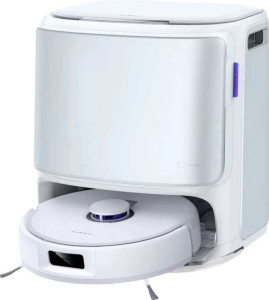
Narwal Flow
Narwal Freo Z10

Narwal Flow Narwal Freo Z10

Overview

Welcome to our in-depth specification comparison between the Narwal Flow and the Narwal Freo Z10. Both robots share an impressive foundation of smart home features, self-emptying capability, and multi-floor cleaning, yet they diverge in some meaningful ways. In this head-to-head, we examine the key battlegrounds of suction power, battery performance, physical dimensions, and wireless connectivity to help you decide which model best fits your home and lifestyle.

Common Features

  • Both products include a HEPA filter.
  • Both products include an allergy filter.
  • Both products are compatible with Google Assistant.
  • Both products work with Alexa.
  • Both products weigh 4600 g.
  • Both products come with a 1-year warranty.
  • The estimated empty time is 120 days on both products.
  • The docking station size is 84893.2942 cm³ on both products.
  • Both products have mapping capability.
  • Both products support no-go zones.
  • Both products support remote smartphone control.
  • Both products have an obstacle sensor.
  • Both products support problem area cleaning.
  • Both products are self-emptying.
  • Both products have carpet detection.
  • Both products do not get stuck.
  • Both products have a dustbin capacity of 0.8 l.
  • Neither product has a display.
  • Both products have twin side brushes.
  • Both products include washable filters.
  • Both products automatically adjust their height.
  • Both products indicate when the dustbin is full.
  • Neither product uses bags.
  • Both products clean all floor types.
  • Both products have 5 cleaning modes.
  • Both products can mop.
  • Both products have a dirt sensor.
  • Neither product has UV light.
  • Both products have a charge time of 3.5 hours.
  • Both products have a removable battery.
  • Both products have auto-off functionality.

Main Differences

  • Audible noise is 57 dB on Narwal Flow and 58 dB on Narwal Freo Z10.
  • Width is 351.2 mm on Narwal Flow and 355 mm on Narwal Freo Z10.
  • Height is 95 mm on Narwal Flow and 107.7 mm on Narwal Freo Z10.
  • Thickness is 363.5 mm on Narwal Flow and 350 mm on Narwal Freo Z10.
  • Volume is 12127.814 cm³ on Narwal Flow and 13381.725 cm³ on Narwal Freo Z10.
  • Wi-Fi version is Wi-Fi 4 (802.11n) on Narwal Flow, while Narwal Freo Z10 supports both Wi-Fi 5 (802.11ac) and Wi-Fi 4 (802.11n).
  • Suction power is 22000 Pa on Narwal Flow and 15000 Pa on Narwal Freo Z10.
  • Battery power is 6400 mAh on Narwal Flow and 5000 mAh on Narwal Freo Z10.
  • Runtime is 190 min on Narwal Flow and 210 min on Narwal Freo Z10.
Specs Comparison
Narwal Flow

Narwal Flow

Narwal Freo Z10

Narwal Freo Z10

General info:
has HEPA filter
audible noise 57 dB 58 dB
has an allergy filter
compatible with Google Assistant
works with Alexa
release date August 2025 April 2025
weight 4600 g 4600 g
width 351.2 mm 355 mm
height 95 mm 107.7 mm
thickness 363.5 mm 350 mm
volume 12127.814 cm³ 13381.725 cm³
warranty period 1 years 1 years
estimated empty time 120 days 120 days
docking station size 84893.2942 cm³ 84893.2942 cm³

At a high level, the Narwal Flow and the Narwal Freo Z10 are remarkably evenly matched on general specs. Both carry HEPA and allergy filtration, support Google Assistant and Alexa, share an identical 4,600 g weight, a 1-year warranty, and an estimated 120-day dust bin cycle — meaning neither robot will demand more frequent maintenance attention than the other. Their docking stations are also exactly the same footprint, so neither has a storage advantage.

The most meaningful real-world difference in this group is robot height: the Flow stands at 95 mm tall, while the Freo Z10 is notably taller at 107.7 mm. That 12.7 mm gap directly determines how many sofas, bed frames, and low-clearance furniture the robot can slip under autonomously — a critical factor in coverage completeness. The Flow also has a smaller overall body volume (12,128 cm³ vs 13,382 cm³), making it the more compact unit on the floor. The Freo Z10 is slightly wider (355 mm) but shallower front-to-back (350 mm), a difference too marginal to affect navigation in practice.

On noise, both units are virtually identical — 57 dB for the Flow versus 58 dB for the Freo Z10 — a gap imperceptible in daily use. The clear edge in this group goes to the Narwal Flow, solely due to its lower profile, which gives it a practical advantage in homes with furniture under roughly 10 cm from the floor.

Features:
has mapping
supports no-go zones
supports a remote smartphone
has an obstacle sensor
has problem area cleaning
is self-emptying
has carpet detection
doesn't get stuck
supports virtual barriers
has route mapping
Has voice prompts
auto docking
has anti-fall sensor
can be scheduled
has a remote control
has water level adjustment
supports Wi-Fi
Wi-Fi version Wi-Fi 4 (802.11n) Wi-Fi 5 (802.11ac), Wi-Fi 4 (802.11n)
has mop cleaning
has mop raising
has mop drying

Across the full features checklist, the Narwal Flow and Narwal Freo Z10 are essentially identical — both deliver a comprehensive premium feature set including mapping, no-go zones, virtual barriers, obstacle and anti-fall sensors, scheduled cleaning, mop raising, mop drying, and self-emptying. For the vast majority of buyers, neither robot is functionally missing anything the other has.

The sole differentiator in this group is wireless connectivity. The Freo Z10 supports both Wi-Fi 5 (802.11ac) and Wi-Fi 4, while the Flow is limited to Wi-Fi 4 (802.11n) only. In practical terms, Wi-Fi 5 offers higher bandwidth and better performance in congested network environments — particularly relevant in apartments or homes with many connected devices competing for airtime. For a robot vacuum that primarily sends low-bandwidth commands and map data, this rarely becomes a bottleneck, but the Freo Z10′s dual-band Wi-Fi 5 support does provide a more future-proof and stable connection in demanding network conditions.

Given how marginal the Wi-Fi difference is for typical robot vacuum use, this group is effectively a near-tie, with a slight technical edge to the Narwal Freo Z10 for its broader wireless compatibility.

Design:
dustbin capacity 0.8 l 0.8 l
Has a display
has twin side brushes
has included washable filters
automatically adjusts its height
Indicates when full
uses bags

When it comes to design, the Narwal Flow and Narwal Freo Z10 are a perfect match — every single spec in this group is identical. Both pack an 0.8-liter bagless dustbin, include washable filters, feature twin side brushes, automatically adjust their height over different floor surfaces, and signal when the bin is full. Neither unit has an onboard display, which is typical for app-managed robots at this tier.

The shared bagless, washable-filter setup is worth noting for running costs: owners avoid ongoing consumable expenses tied to replacement bags or proprietary filter cartridges, and the full-bin indicator ensures cleaning efficiency doesn't silently degrade over time. Automatic height adjustment is also a meaningful shared convenience, allowing both robots to transition between hard floors and low-pile carpets without manual intervention.

This group is a complete tie — there is no design differentiator between these two models based on the available data, and neither holds any advantage over the other here.

Cleaning power:
suction power 22000 Pa 15000 Pa
cleans all floor types
cleaning modes 5 5
mops
has a dirt sensor
has UV light

Suction power is where these two models diverge most sharply. The Narwal Flow delivers 22,000 Pa of suction, compared to 15,000 Pa on the Freo Z10 — a difference of nearly 47%. In real-world terms, this gap is most felt on carpets, where higher Pascal ratings translate directly into deeper extraction of embedded dirt, pet hair, and fine debris that lower-powered units leave behind. For hard floors, both are more than sufficient, but households with medium-to-high pile carpets or pets will notice the Flow's advantage.

Everything else in this group is evenly matched: both robots cover all floor types, offer the same 5 cleaning modes, include mopping, and use a dirt sensor to concentrate effort in heavily soiled areas. Neither features UV sanitization, so hygiene-focused buyers won't find a differentiator there.

The clear winner in cleaning power is the Narwal Flow. Its substantially higher suction rating is the single most impactful performance spec in this category, and for anyone prioritizing deep-clean capability — especially in pet or high-traffic homes — it represents a meaningful practical advantage over the Freo Z10.

Power:
battery power 6400 mAh 5000 mAh
runtime 190 min 210 min
charge time 3.5 hours 3.5 hours
has a removable battery
has auto-off

The power specs here tell an interesting story. The Narwal Flow carries a larger 6,400 mAh battery, yet delivers a shorter 190-minute runtime than the Freo Z10, which squeezes 210 minutes from a smaller 5,000 mAh pack. The most logical explanation, consistent with the cleaning power data, is that the Flow's significantly higher suction motor draws considerably more current, consuming its larger battery faster. In practical terms, the Freo Z10 can cover more floor area on a single charge — a meaningful advantage in larger homes.

Where the two units converge: both require an identical 3.5 hours to fully recharge, and both feature a removable battery and auto-off. A removable battery is a noteworthy longevity perk — it means the power cell can be swapped out as it ages rather than retiring the entire robot, lowering long-term ownership costs for both models equally.

Runtime being the most operationally relevant metric for day-to-day use, the Narwal Freo Z10 holds the edge in this group. Its extra 20 minutes of runtime translates to meaningful additional coverage per cycle, making it the stronger choice for larger living spaces where uninterrupted cleaning runs matter most.

Comparison Summary & Verdict

After examining every specification, both the Narwal Flow and the Narwal Freo Z10 prove to be highly capable robot vacuum-mop combos sharing the same core strengths: self-emptying, carpet detection, obstacle avoidance, and a 120-day estimated empty cycle. Where they diverge is telling. The Narwal Flow pulls ahead with a formidable 22000 Pa suction power and a larger 6400 mAh battery, making it the stronger choice for deep cleaning performance. The Narwal Freo Z10, on the other hand, offers a slightly longer runtime of 210 minutes, a more compact thickness of 350 mm, and broader Wi-Fi 5 connectivity. If raw cleaning power is your priority, the Flow wins; if runtime and modern wireless support matter more, the Freo Z10 earns its place.

Narwal Flow
Buy Narwal Flow if...

Buy the Narwal Flow if you want maximum suction power at 22000 Pa and a larger 6400 mAh battery for demanding cleaning sessions.

Narwal Freo Z10
Buy Narwal Freo Z10 if...

Buy the Narwal Freo Z10 if you prioritize a longer 210-minute runtime, a slimmer profile, and the added reliability of Wi-Fi 5 connectivity.