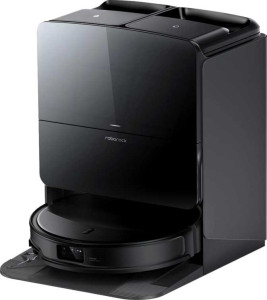
Both the Narwal Flow and the Roborock Saros 10R share a strong baseline of shared features: HEPA and allergy filtration, full smart home integration via both Google Assistant and Alexa, and a one-year warranty. For allergy sufferers or households with pets, neither robot compromises on air quality, so filtration is a wash between the two.
Where real differences emerge is in noise, form factor, and autonomy. The Narwal Flow operates at 57 dB versus the Saros 10R's 68 dB — an 11 dB gap that is perceptually significant, as decibels scale logarithmically; the Saros 10R will sound noticeably louder during cleaning cycles, which matters in open-plan homes or during nighttime runs. On physical footprint, the Saros 10R is meaningfully slimmer at 79.8 mm tall versus the Flow's 95 mm, giving it a real edge at fitting under low-clearance furniture like sofas and bed frames. The Flow, however, is lighter at 4,600 g versus 5,000 g, though this difference is rarely felt during normal use since both robots are self-docking.
The most striking divergence is the estimated empty time: the Narwal Flow can go 120 days between dust bin empties compared to just 49 days for the Saros 10R — more than twice as long. For users who prize a truly hands-off experience, this is a decisive advantage for the Flow. Overall, the Narwal Flow holds the edge in this group thanks to its dramatically quieter operation and far superior bin autonomy, while the Saros 10R counters primarily with its slimmer profile for under-furniture reach.