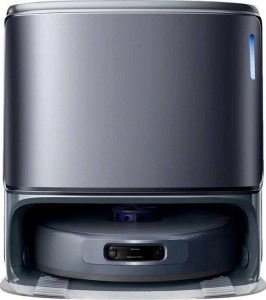
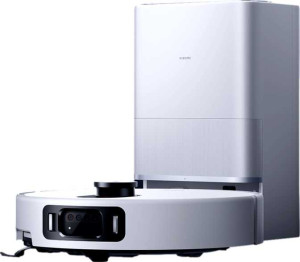
Both robots share a strong baseline for smart home integration and air filtration: each includes a HEPA and allergy filter, and both work with Google Assistant and Alexa, so neither has an edge on ecosystem compatibility or allergen capture. Where they begin to diverge is in physical footprint and acoustics. The Xiaomi Robot Vacuum 5 Pro is measurably slimmer at 88 mm tall versus 109.6 mm for the Narwal Freo Z10 Ultra, which translates directly into the ability to clean under lower-clearance furniture — a practical daily advantage in most homes. The Xiaomi unit is also lighter at 3970 g compared to 4500 g, making it easier to lift and reposition manually. On noise, the Xiaomi again edges ahead with 50 dB versus the Narwal's 55 dB — a 5 dB difference that, perceptually, makes the Xiaomi noticeably quieter during operation, especially in open-plan living spaces.
The dustbin autonomy picture is more nuanced. The Narwal Freo Z10 Ultra claims an estimated empty time of 120 days, versus 90 days for the Xiaomi — meaning the Narwal's auto-empty station can go significantly longer between manual interventions, a real convenience factor for low-maintenance households. However, the trade-off is dock size: the Narwal's station occupies roughly 77,223 cm³ while the Xiaomi's larger dock takes up 96,782 cm³, suggesting the Xiaomi's station may house additional functionality (such as water tanks for mopping) at the cost of more floor space.
On warranty, the Xiaomi holds a clear administrative edge with a 2-year coverage period versus just 1 year for the Narwal — an important consideration for a high-value appliance. Overall, for users prioritizing quieter operation, a slimmer profile, and longer warranty peace of mind, the Xiaomi Robot Vacuum 5 Pro has a meaningful advantage in this spec group. The Narwal counters primarily with its superior dustbin autonomy and a more compact docking station footprint.