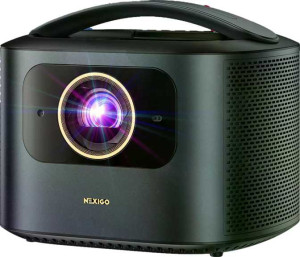
NexiGo TriVision Ultra
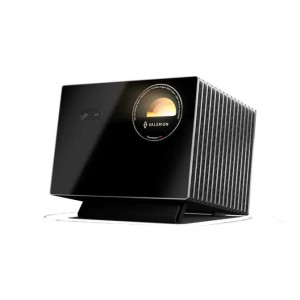
Valerion VisionMaster Max

NexiGo TriVision Ultra Valerion VisionMaster Max

Overview

Welcome to our in-depth specification face-off between the NexiGo TriVision Ultra and the Valerion VisionMaster Max. Both laser projectors deliver 4K resolution, 240Hz refresh rates, and Dolby Vision support, making them serious contenders in the premium projection space. Yet beneath their shared foundations lie meaningful differences in areas like contrast ratio, maximum projection size, and connectivity options that could make one a far better fit for your setup than the other.

Common Features

  • Both products use a laser light source.
  • Both products output at 4K resolution.
  • Both products feature motorized focus.
  • Both products support HDR10+.
  • Both products support Dolby Vision.
  • Both products support HDR10.
  • Both products have a 240Hz refresh rate.
  • Both products support AirPlay.
  • Both products have Bluetooth, version 5.2.
  • Both products support Wi-Fi.
  • Neither product has a VGA connector.
  • Neither product has a DVI connector.
  • Both products support Miracast.
  • Both products have 1 RJ45 port.
  • Both products have stereo speakers.
  • Both products include a remote control.
  • Both products have a built-in smart TV platform.
  • Both products have a built-in speaker.
  • Both products have a 3.5mm audio jack socket.
  • Both products support Dolby Atmos.
  • Neither product has an external memory slot.

Main Differences

  • Contrast ratio is 1500:1 on NexiGo TriVision Ultra and 15000:1 on Valerion VisionMaster Max.
  • Response time is 4.2ms on NexiGo TriVision Ultra and 4ms on Valerion VisionMaster Max.
  • Maximum projection size is 300″ on NexiGo TriVision Ultra and 150″ on Valerion VisionMaster Max.
  • HLG support is present on Valerion VisionMaster Max but not available on NexiGo TriVision Ultra.
  • HDMI ports number 3 on NexiGo TriVision Ultra and 2 on Valerion VisionMaster Max.
  • Wi-Fi versions supported are Wi-Fi 6 (802.11ax), Wi-Fi 5 (802.11ac), and Wi-Fi 4 (802.11n) on NexiGo TriVision Ultra, while Valerion VisionMaster Max also adds Wi-Fi 6E (802.11ax) on top of those.
  • USB ports number 1 on NexiGo TriVision Ultra and 2 on Valerion VisionMaster Max.
  • Audio output power is 2 x 15W on NexiGo TriVision Ultra and 2 x 12W on Valerion VisionMaster Max.
Specs Comparison
NexiGo TriVision Ultra

NexiGo TriVision Ultra

Valerion VisionMaster Max

Valerion VisionMaster Max

General info:
has laser light source
release date January 2025 January 2025

In the General Info category, both the NexiGo TriVision Ultra and the Valerion VisionMaster Max share one foundational technology: a laser light source. This is a meaningful distinction from lamp-based or LED projectors, as laser light sources deliver superior brightness consistency, significantly longer operational lifespans, and near-instant on/off capability without warm-up or cool-down periods.

From a real-world perspective, both projectors offer the core advantages that laser technology brings — stable color output over time, reduced maintenance costs since there is no bulb to replace, and the ability to maintain image quality across thousands of hours of use. These are not entry-level compromises; both products are positioned in a segment where laser is the expected foundation.

Based solely on the provided specs for this group, the two products are evenly matched — both utilize a laser light source with no differentiation between them on this dimension. Buyers cannot use this spec group alone to distinguish one from the other; the decision will hinge on specs from other categories.

Projection quality:
output resolution 4K 4K
contrast ratio 1500:1 15000:1
response time 4.2 ms 4 ms
has motorized focus
maximum projection size 300" 150"
supports HDR10+
refresh rate 240Hz 240Hz
supports Dolby Vision
supports HDR10
supports HLG

Both projectors output native 4K resolution and share a 240Hz refresh rate alongside a near-identical response time — making them equally capable for fast-motion content and gaming on paper. Where things diverge sharply is contrast ratio: the VisionMaster Max delivers a 15000:1 contrast ratio versus the TriVision Ultra's 1500:1 — a full 10x gap. In practice, this translates to dramatically deeper blacks, more visible shadow detail in dark scenes, and an overall image that feels more three-dimensional and cinematic. No amount of HDR processing fully compensates for a weak native contrast ratio.

Speaking of HDR, both units cover the major formats — HDR10, HDR10+, and Dolby Vision — which ensures broad compatibility with streaming platforms and physical media. The TriVision Ultra adds nothing unique here, and the VisionMaster Max edges it further by also supporting HLG, a format commonly used in live broadcast and some streaming content, giving it a marginally wider format coverage.

The most practically significant divergence, however, may be maximum projection size: the TriVision Ultra scales up to 300″ while the VisionMaster Max caps at 150″. For large dedicated home theaters or commercial spaces, this is a decisive advantage for the TriVision Ultra. Overall, the VisionMaster Max wins on image fidelity thanks to its contrast ratio, but the TriVision Ultra holds a clear edge for large-screen installations — making the right choice heavily dependent on the intended viewing environment.

Connectivity:
HDMI ports 3 2
has AirPlay
Has Bluetooth
supports Wi-Fi
Wi-Fi version Wi-Fi 6 (802.11ax), Wi-Fi 5 (802.11ac), Wi-Fi 4 (802.11n) Wi-Fi 6E (802.11ax), Wi-Fi 6 (802.11ax), Wi-Fi 5 (802.11ac), Wi-Fi 4 (802.11n)
USB ports 1 2
has a VGA connector
Bluetooth version 5.2 5.2
has a DVI connector
supports Miracast
RJ45 ports 1 1
Has S/PDIF Out port

Wired connectivity leans slightly in the TriVision Ultra's favor: it offers 3 HDMI ports compared to the VisionMaster Max's 2, which matters in setups with multiple source devices — a gaming console, a streaming stick, and a Blu-ray player can all stay plugged in simultaneously without swapping cables. The VisionMaster Max counters with 2 USB ports versus the TriVision Ultra's single USB port, which is more practical for connecting storage drives or powering accessories concurrently. Both share one RJ45 Ethernet port, ensuring a stable wired network fallback.

On the wireless side, the gap is more meaningful. Both support AirPlay, Miracast, and Bluetooth 5.2, but the VisionMaster Max goes further with Wi-Fi 6E support — access to the less congested 6GHz band, which translates to lower latency and more consistent throughput in environments crowded with competing wireless devices. The TriVision Ultra tops out at Wi-Fi 6, which is still capable but lacks that 6GHz headroom.

Taken together, the two projectors are closely matched in connectivity, each holding a distinct edge in one area. The TriVision Ultra suits users who prioritize wired multi-source setups, while the VisionMaster Max is the stronger choice for wireless-first installations where network congestion and streaming reliability are the primary concern — giving it a narrow overall advantage in this category for modern, cable-light home theater environments.
Features:
has stereo speakers
has a remote control
has built-in smart TV
has a built-in speaker
audio output power 2 x 15W 2 x 12W
has a socket for a 3.5 mm audio jack
has Dolby Atmos
has an external memory slot

The feature sets of these two projectors are remarkably aligned — both include a built-in smart TV platform, stereo speakers, Dolby Atmos support, a 3.5mm audio jack, and a remote control. For users who want a self-contained experience without external soundbars or streaming devices, either unit delivers that out of the box. The absence of an external memory slot on both means local media playback via removable storage is off the table for each.

The only measurable differentiator in this group is audio output power: the TriVision Ultra puts out 2 x 15W versus the VisionMaster Max's 2 x 12W. That 6W total difference gives the TriVision Ultra a modest headroom advantage — useful in larger rooms where the built-in speakers are expected to fill more space without an external audio system. That said, both units support Dolby Atmos, so the spatial audio processing quality is equivalent; the power gap affects raw loudness and dynamic range at higher volumes more than it does audio format capability.

The TriVision Ultra claims a narrow edge in this category purely on the strength of its higher speaker output. For most users in average-sized rooms the difference will be subtle, but for those relying solely on built-in audio in a large or open space, the extra wattage is a tangible advantage. In all other feature dimensions, these two projectors are functionally identical.

Comparison Summary & Verdict

After examining every specification, it is clear that these two projectors serve distinct audiences. The NexiGo TriVision Ultra stands out with its massive 300″ maximum projection size and three HDMI ports, making it the stronger choice for large-venue installs or dedicated home theater rooms where screen scale and source flexibility are paramount. Its 2 x 15W audio output also edges ahead for those who want more built-in sound power. The Valerion VisionMaster Max, on the other hand, counters with a dramatically superior 15000:1 contrast ratio, Wi-Fi 6E support, an extra USB port, and HLG compatibility, pointing to a product engineered for image fidelity and modern connectivity in living-room or smaller dedicated spaces. Neither projector is an outright winner; the right pick depends entirely on whether you prioritize sheer projection scale or image depth and connectivity versatility.

NexiGo TriVision Ultra
Buy NexiGo TriVision Ultra if...

Buy the NexiGo TriVision Ultra if you need an enormous projection size of up to 300″ and want three HDMI ports to connect multiple sources simultaneously.

Valerion VisionMaster Max
Buy Valerion VisionMaster Max if...

Buy the Valerion VisionMaster Max if outstanding contrast ratio, Wi-Fi 6E support, and HLG compatibility are your top priorities for a premium viewing experience.