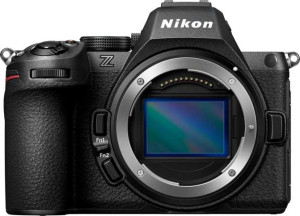
Nikon Z5 II
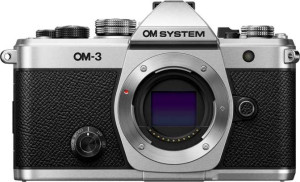
OM System OM-3

Nikon Z5 II OM System OM-3

Overview

When choosing between the Nikon Z5 II and the OM System OM-3, photographers face a fascinating clash of philosophies: a full-frame powerhouse versus a compact Micro Four Thirds specialist. These two mirrorless cameras share a surprising amount of common ground, from weather-sealing and sensor-shift stabilization to RAW shooting and wireless connectivity, yet they diverge sharply in areas like sensor size, portability, and advanced shooting capabilities. Read on to see how every specification stacks up.

Common Features

  • Both cameras are mirrorless system cameras with an electronic viewfinder offering 100% coverage.
  • Both cameras feature a flip-out touchscreen with a hot shoe.
  • Both cameras are weather-sealed against splashing.
  • Both cameras have sensor-shift image stabilization.
  • Both cameras support AF tracking, phase-detection autofocus for photos, touch autofocus, and manual focus.
  • Both cameras include a built-in HDR mode.
  • Both cameras use a BSI sensor.
  • Both cameras have a manual shutter speed option.
  • Both cameras support phase-detection autofocus during video recording and continuous autofocus while filming.
  • Both cameras include a stereo microphone with two microphones and a 3.5 mm audio jack input.
  • Both cameras feature a timelapse function and a 24p cinema mode.
  • Both cameras use a removable, rechargeable 2280 mAh battery with a battery level indicator.
  • Both cameras support Wi-Fi 5 (802.11ac) and Wi-Fi 4 (802.11n) as well as Bluetooth.
  • Both cameras can shoot RAW files including lossless compressed RAW.
  • Both cameras support remote smartphone control and have an HDMI output.
  • GPS is not available on either camera.

Main Differences

  • Screen resolution is 2100k dots on the Nikon Z5 II and 1620k dots on the OM System OM-3.
  • Screen size is 3.2″ on the Nikon Z5 II and 3″ on the OM System OM-3.
  • Weight is 700 g on the Nikon Z5 II and 496 g on the OM System OM-3.
  • Volume is 969.624 cm³ on the Nikon Z5 II and 567.176666 cm³ on the OM System OM-3.
  • Lowest potential operating temperature is 0 °C on the Nikon Z5 II and -10 °C on the OM System OM-3.
  • Width is 134 mm on the Nikon Z5 II and 139.3 mm on the OM System OM-3.
  • Height is 100.5 mm on the Nikon Z5 II and 88.9 mm on the OM System OM-3.
  • Thickness is 72 mm on the Nikon Z5 II and 45.8 mm on the OM System OM-3.
  • Sensor size is Full Frame on the Nikon Z5 II and Micro Four Thirds on the OM System OM-3.
  • Lens mount is Nikon Z on the Nikon Z5 II and Micro Four Thirds on the OM System OM-3.
  • Focus points number 299 on the Nikon Z5 II and 1053 on the OM System OM-3.
  • Resolution is 24.5 MP on the Nikon Z5 II and 20.4 MP on the OM System OM-3.
  • Maximum ISO is 64000 on the Nikon Z5 II and 25600 on the OM System OM-3.
  • Maximum expanded ISO is 204800 on the Nikon Z5 II and 102400 on the OM System OM-3.
  • Continuous shooting speed is 8 fps on the Nikon Z5 II and 6 fps on the OM System OM-3.
  • Fastest mechanical shutter speed is 0.0005 s on the Nikon Z5 II and 0.000125 s on the OM System OM-3.
  • Maximum electronic shutter speed is 0.000125 s on the Nikon Z5 II and 3.125E-5 s on the OM System OM-3.
  • Flash sync speed is 0.005 s on the Nikon Z5 II and 0.004 s on the OM System OM-3.
  • Maximum exposure time is 30 s on the Nikon Z5 II and 60 s on the OM System OM-3.
  • A stacked CMOS sensor is present on the OM System OM-3 but not available on the Nikon Z5 II.
  • Video recording resolution and frame rate is 2268 x 30 fps on the Nikon Z5 II and 2160 x 60 fps on the OM System OM-3.
  • Battery life (CIPA) is 330 shots on the Nikon Z5 II and 590 shots on the OM System OM-3.
  • The image processor is Expeed 7 on the Nikon Z5 II and TruePic X on the OM System OM-3.
  • Dual card slots are present on the Nikon Z5 II but not available on the OM System OM-3.
  • Pixel shift shooting is available on the OM System OM-3 but not present on the Nikon Z5 II.
Specs Comparison
Nikon Z5 II

Nikon Z5 II

OM System OM-3

OM System OM-3

Design:
Type Mirrorless Mirrorless
viewfinder Electronic viewfinder (EVF) Electronic viewfinder (EVF)
is weather-sealed (splashproof)
screen resolution 2100k dots 1620k dots
Has a flip-out screen
viewfinder coverage 100% 100%
screen size 3.2" 3"
weight 700 g 496 g
has a touch screen
Has a hot shoe
volume 969.624 cm³ 567.176666 cm³
is a system camera
has a flash
lowest potential operating temperature 0 °C -10 °C
maximum operating temperature 40 °C 40 °C
Has a tilting viewfinder
width 134 mm 139.3 mm
height 100.5 mm 88.9 mm
thickness 72 mm 45.8 mm

Both the Nikon Z5 II and the OM System OM-3 are mirrorless system cameras sharing a strong common foundation: electronic viewfinders with 100% coverage, fully articulating flip-out touchscreens, weather sealing, and hot shoes — with neither offering a built-in flash. For most shooters, these shared traits mean the real design choice comes down to form factor and environmental resilience rather than feature parity.

The most consequential difference is physical size and weight. The OM-3 is dramatically more compact, weighing just 496 g versus the Z5 II's 700 g, and its volume of 567 cm³ is nearly half the Z5 II's 970 cm³. The OM-3 achieves this mainly through a much thinner body (45.8 mm vs 72 mm), making it far easier to slip into a bag or shoot all day without fatigue. The Z5 II counters with a larger, higher-resolution rear screen — 3.2″ at 2100k dots versus the OM-3's 3.0″ at 1620k dots — which translates to a noticeably sharper, more comfortable live-view and menu experience. The Z5 II's screen advantage is real, but the OM-3's portability lead is arguably more impactful for travel and everyday carry.

One often-overlooked differentiator is cold-weather capability: the OM-3 operates down to -10 °C while the Z5 II is rated only to 0 °C, a meaningful edge for outdoor and winter photographers. Overall, the OM-3 holds a clear advantage in portability and environmental range, while the Z5 II offers a superior rear display. If compactness and ruggedness in the cold are priorities, the OM-3 wins this group; if screen quality and a larger, more traditional grip matter more, the Z5 II has the edge.

Optics:
sensor size Full frame Micro Four Thirds
lens mount Nikon Z Micro Four Thirds
focus points 299 1053
megapixels (main camera) 24.5 MP 20.4 MP
maximum ISO 64000 ISO 25600 ISO
maximum expanded ISO 204800 ISO 102400 ISO
has sensor shift stabilization
continuous shooting (mechanical) 8 fps 6 fps
has AF tracking
Has phase-detection autofocus for photos
fastest shutter speed 0.0005 s 0.000125 s
has manual focus
has touch autofocus
has manual shutter speed
has a built-in HDR mode
has a BSI sensor
has manual exposure
has a two-stage shutter
has a serial shot mode
has a CMOS sensor
has manual ISO
flash sync speed 0.005 s 0.004 s
has manual white balance
exposure time 30 s 60 s
Maximum electronic shutter speed 0.000125 s 3.125E-5 s
has a stacked CMOS sensor
image stabilization rating (CIPA) 7.5 stops 6.5 stops
can combine image stabilization

The sensor size gap is the defining story of this group. The Nikon Z5 II's full-frame sensor offers roughly four times the light-gathering area of the OM-3's Micro Four Thirds sensor, and the ISO specs reflect this directly: the Z5 II reaches 64,000 ISO natively (expandable to 204,800) versus the OM-3's 25,600 ISO (expandable to 102,400). In practice, the Z5 II will produce cleaner images in low light and retain more dynamic range under challenging conditions — a fundamental physics advantage that no amount of processing can fully close.

Yet the OM-3 pushes back in meaningful ways. Its stacked CMOS sensor — which the Z5 II lacks — enables faster data readout, and this shows up in the shutter specs: the OM-3's fastest mechanical shutter is 1/8000 s versus the Z5 II's 1/2000 s, and its maximum electronic shutter reaches 1/32000 s compared to the Z5 II's 1/8000 s. For sports, wildlife, or flash photography in bright conditions, the OM-3's shutter headroom is a genuine operational advantage. Its autofocus system also covers 1,053 focus points — more than three times the Z5 II's 299 points — offering denser subject tracking across the frame. Meanwhile, the Z5 II leads in in-body stabilization at 7.5 stops CIPA versus 6.5 stops, and both systems can combine with lens stabilization for even greater reach.

On balance, the Z5 II holds a clear optical edge for photographers who prioritize low-light performance and image quality at high ISOs, which is often the most critical capability for a primary camera. The OM-3 is a sharper tool for action and high-speed work, with a more sophisticated autofocus grid and faster shutter ceiling. Neither is a universal winner — the right choice depends on whether a shooter values absolute image quality in the dark or speed and tracking precision in good light.

Videography:
video recording (main camera) 2268 x 30 fps 2160 x 60 fps
Has phase-detection autofocus for videos
has continuous autofocus when recording movies
has a microphone input
has a socket for a 3.5 mm audio jack
has a stereo microphone
Has timelapse function
number of microphones 2 2
has a 24p cinema mode
supports slow-motion video recording

Videography is where these two cameras reveal starkly different priorities despite an otherwise near-identical feature set. Both offer phase-detection autofocus during recording, continuous AF, a 3.5 mm microphone input, dual built-in stereo mics, timelapse, slow-motion, and a 24p cinema mode — the foundational toolkit is the same. The single but significant split comes down to how each camera trades resolution against frame rate: the Z5 II records at a higher vertical resolution of 2268 lines at up to 30 fps, while the OM-3 caps resolution at 2160 lines but pushes to 60 fps.

In real-world terms, the Z5 II's higher-resolution output can yield more detail and more flexibility for cropping or downscaling in post — useful for documentary, cinematic, or interview-style work where image richness matters more than motion fluidity. The OM-3's 60 fps ceiling, by contrast, is the more versatile option for action, sports, or any content where smoother motion or 2x slow-motion at full 4K resolution is a priority. For most hybrid shooters, 60 fps at 4K is the more practically useful ceiling in a wider range of scenarios.

Given that every other videography spec is identical, the OM-3 holds a functional edge in this group — 60 fps at 4K unlocks creative and practical options that 30 fps simply cannot match, and the resolution difference between 2268 and 2160 lines is unlikely to be visible in typical delivery formats. Shooters whose work is strictly cinematic and resolution-critical may prefer the Z5 II's output, but for general hybrid use, the OM-3's frame rate advantage is the more broadly useful differentiator.

Battery:
Battery life (CIPA) 330 shots 590 shots
has a removable battery
has a rechargeable battery
has a battery level indicator
battery power 2280 mAh 2280 mAh

What makes this battery comparison genuinely surprising is that both cameras share an identical 2280 mAh battery capacity, yet their real-world endurance differs dramatically. The OM-3 is rated for 590 shots per charge under CIPA testing, while the Z5 II manages just 330 shots — a gap of nearly 80%. Same energy reservoir, radically different results.

This disparity almost certainly comes down to the power demands of each system: the Z5 II's larger full-frame sensor, more power-hungry processing pipeline, and bigger body electronics draw significantly more current per shot. The OM-3's smaller Micro Four Thirds sensor is inherently less power-intensive, allowing it to stretch the same charge much further. In practical terms, the difference between 330 and 590 shots can be the difference between needing a spare battery for a half-day shoot or comfortably clearing a full day without one.

Both cameras use removable, rechargeable batteries with a charge indicator — so carrying a spare is always an option — but the OM-3 holds a clear and meaningful advantage in this group. Its ability to extract nearly twice the shot count from identical hardware is a real operational benefit, particularly for travel and event photographers who want to minimize battery management. The Z5 II's endurance is not unusable, but it will demand more attention in the field.

Features:
release date April 2025 February 2025
processor Expeed 7 TruePic X
supports Wi-Fi
Has Bluetooth
Has dual card slots
has pixel shift shot
shoots raw
supports lossless compressed raw
Wi-Fi version Wi-Fi 5 (802.11ac), Wi-Fi 4 (802.11n) Wi-Fi 5 (802.11ac), Wi-Fi 4 (802.11n)
supports a remote smartphone
has an HDMI output
has GPS
has an advanced hot shoe
has NFC
has an external memory slot
Has USB Type-C

Across connectivity and I/O, these two cameras are remarkably well-matched — identical Wi-Fi standards, Bluetooth, USB-C, HDMI output, smartphone remote control, lossless compressed RAW support, and external memory slots. Neither includes GPS, NFC, or an advanced hot shoe. For most users, the shared feature floor is more than capable, and the meaningful differences narrow down to just two specs.

The Z5 II's dual card slots is a practical advantage that working professionals will value highly — it enables simultaneous backup, overflow shooting, or separating RAW and JPEG files across cards, providing a safety net that single-slot cameras simply cannot offer. The OM-3 counters with pixel shift shooting, a computational technique that moves the sensor in precise increments to capture multiple exposures and combine them into a single image with dramatically increased resolution and color accuracy. This is a genuinely powerful tool for landscape, product, and studio photographers, but it requires a static subject and a tripod, limiting its applicability compared to the Z5 II's always-available dual-slot redundancy.

Which advantage matters more depends entirely on the shooter's use case. For event, wedding, or commercial photographers where data loss is unacceptable, the Z5 II's dual card slots deliver irreplaceable peace of mind. For controlled, deliberate shooting where maximum image fidelity is the goal, the OM-3's pixel shift capability is a compelling differentiator unavailable on the Z5 II. Neither camera dominates outright — this group is essentially a trade-off between workflow security and creative resolution power.
Comparison Summary & Verdict

After examining every specification, both cameras reveal clearly distinct strengths. The Nikon Z5 II stands out with its full-frame sensor, higher 24.5 MP resolution, wider ISO range up to 64000 (expandable to 204800), dual card slots, and a larger, sharper 3.2″ screen — making it the stronger choice for photographers who demand maximum image quality and professional workflow flexibility. The OM System OM-3, on the other hand, wins on portability and versatility: it is significantly lighter at 496 g, far more compact, operates in temperatures as low as -10 °C, delivers an impressive 590-shot battery life, offers a faster electronic shutter, 1053 focus points, a stacked CMOS sensor, pixel shift shooting, and smoother 60 fps 4K video. Choose the Nikon Z5 II for studio and landscape work where image fidelity is paramount; choose the OM System OM-3 for travel, adventure, and fast-action photography where size, endurance, and speed matter most.

Nikon Z5 II
Buy Nikon Z5 II if...

Buy the Nikon Z5 II if you prioritize a full-frame sensor, higher resolution, a broader ISO range, and the security of dual card slots for professional shooting.

OM System OM-3
Buy OM System OM-3 if...

Buy the OM System OM-3 if you value a lighter, more compact body with longer battery life, a faster electronic shutter, more focus points, and 4K 60 fps video for travel or action photography.