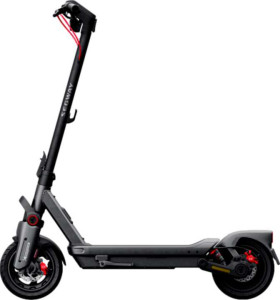
Ninebot by Segway eKickScooter Max G3
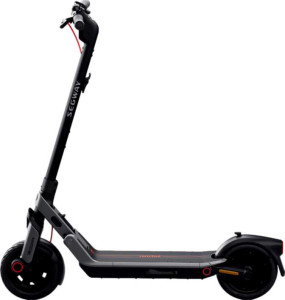
Ninebot by Segway KickScooter E3

Ninebot by Segway eKickScooter Max G3 Ninebot by Segway KickScooter E3

Overview

Welcome to our in-depth specification comparison between the Ninebot by Segway eKickScooter Max G3 and the Ninebot by Segway KickScooter E3. Both scooters share a solid foundation — folding design, pneumatic tires, suspension, and dual braking — but they diverge significantly when it comes to motor power and top speed, range per charge, and overall weight. Read on to see how these two models stack up across every key specification.

Common Features

  • Both scooters feature suspension.
  • Both scooters have a dedicated smartphone app.
  • Both scooters are equipped with pneumatic tires.
  • Neither scooter comes with a seat.
  • Both scooters can be folded for storage or transport.
  • Neither scooter is designed for kids.
  • Both scooters have front light(s).
  • Both scooters have rear light(s).
  • Both scooters are powered by a single motor, with no dual-motor setup on either.
  • Both scooters have a rear brake.
  • Both scooters have a front brake.
  • Both scooters include a battery level indicator.
  • Neither scooter has a removable battery.

Main Differences

  • Weight is 24600 g on Ninebot by Segway eKickScooter Max G3 and 17500 g on Ninebot by Segway KickScooter E3.
  • Wheel diameter is 11″ on Ninebot by Segway eKickScooter Max G3 and 10″ on Ninebot by Segway KickScooter E3.
  • Height is 1299 mm on Ninebot by Segway eKickScooter Max G3 and 1235 mm on Ninebot by Segway KickScooter E3.
  • Width is 1218 mm on Ninebot by Segway eKickScooter Max G3 and 1165 mm on Ninebot by Segway KickScooter E3.
  • Ingress Protection rating is IPX6 on Ninebot by Segway eKickScooter Max G3 and IPX5 on Ninebot by Segway KickScooter E3.
  • Motor power is 2000W on Ninebot by Segway eKickScooter Max G3 and 800W on Ninebot by Segway KickScooter E3.
  • Top speed is 45 km/h on Ninebot by Segway eKickScooter Max G3 and 25 km/h on Ninebot by Segway KickScooter E3.
  • Climbing angle is 30° on Ninebot by Segway eKickScooter Max G3 and 18° on Ninebot by Segway KickScooter E3.
  • Maximum weight capacity is 150 kg on Ninebot by Segway eKickScooter Max G3 and 120 kg on Ninebot by Segway KickScooter E3.
  • Charge time is 3.5 hours on Ninebot by Segway eKickScooter Max G3 and 7 hours on Ninebot by Segway KickScooter E3.
  • Maximum distance per charge is 80 km on Ninebot by Segway eKickScooter Max G3 and 45 km on Ninebot by Segway KickScooter E3.
Specs Comparison
Ninebot by Segway eKickScooter Max G3

Ninebot by Segway eKickScooter Max G3

Ninebot by Segway KickScooter E3

Ninebot by Segway KickScooter E3

Design:
weight 24600 g 17500 g
has suspension
Has a dedicated smartphone app
has pneumatic tires
wheel diameter 11" 10"
has a seat
can be folded
is designed for kids
height 1299 mm 1235 mm
width 1218 mm 1165 mm
has front light(s)
has rear light(s)
Ingress Protection (IP) rating IPX6 IPX5
release date January 2025 January 2025

Both the Ninebot by Segway eKickScooter Max G3 and the Ninebot by Segway KickScooter E3 share a strong design foundation: foldable form factors, pneumatic tires, front and rear lighting, suspension, and dedicated app support. These shared traits place both squarely in the adult commuter segment, not the entry-level or kids' market.

The most consequential difference is weight. The G3 tips the scales at 24,600 g versus the E3's 17,500 g — a gap of roughly 7 kg. That translates directly to how manageable the scooter is when carrying it up stairs, loading it into a car trunk, or navigating a crowded transit station. The G3's larger 11″ wheels (versus the E3's 10″) and slightly taller, wider overall dimensions further reinforce that it is the bulkier, more road-ready machine of the two. The E3's lighter, more compact build gives it a real-world portability edge for mixed-mode commuters.

On weather resistance, the G3 holds a meaningful advantage with an IPX6 rating compared to the E3's IPX5. IPX6 withstands powerful water jets, while IPX5 covers only low-pressure water streams — a practical difference if you ride through heavy rain or puddles regularly. Overall, the E3 has the edge in portability and everyday handling, while the G3 edges ahead in weather durability and wheel size, making it the stronger pick for riders who prioritize all-weather resilience over carry-weight convenience.

Performance:
motor power 2000W 800W
top speed 45 km/h 25 km/h
has dual motors
climbing angle 30° 18°
has a rear brake
has a front brake
maximum weight capacity 150kg 120kg

The performance gap between these two scooters is substantial. The Max G3's 2000W motor delivers more than double the output of the E3's 800W unit, and the real-world consequences of that difference cascade through nearly every performance metric. A top speed of 45 km/h versus 25 km/h means the G3 is genuinely highway-adjacent in capability — suitable for bike lanes on arterial roads or longer open stretches — while the E3 operates comfortably in the urban 25 km/h speed-limit zone common across many cities, which is also the regulatory ceiling for e-scooters in numerous regions.

Hill-climbing tells a similar story. The G3's 30° climbing angle is an impressive figure that covers steep urban inclines and even aggressive ramps with confidence, whereas the E3's 18° rating is adequate for moderate grades but will struggle on hilly terrain. Payload capacity follows the same pattern — 150 kg on the G3 versus 120 kg on the E3 — meaning the G3 accommodates a wider range of riders without performance compromise. Both scooters share front and rear braking, which is the expected safety baseline at these respective speed tiers.

The G3 holds a commanding performance edge across every metric in this group. That said, the E3's 25 km/h ceiling is not a weakness in isolation — for riders who need a legally compliant urban commuter and do not face significant hills, the E3 is adequately spec'd. The G3, however, is the clear choice for anyone prioritizing raw capability, heavier loads, or hilly routes.

Battery:
charge time 3.5 hours 7 hours
maximum distance per charge 80 km 45 km
has a battery level indicator
has a removable battery

Range and charge time are where the battery comparison gets decisive. The Max G3 claims an 80 km maximum range per charge — nearly double the E3's 45 km — which shifts it from a daily commuter tool into a machine capable of longer recreational rides or multi-stop urban routes without anxiety. The E3's 45 km is still respectable for a typical city commute, covering most round-trip urban distances comfortably, but riders with longer routes or irregular access to charging will feel the limitation.

Charge time swings even more dramatically in the G3's favor. Plugging in the G3 for 3.5 hours restores a battery that goes nearly twice as far, while the E3 demands 7 hours to fully replenish its smaller pack — meaning the E3 effectively requires an overnight charge to be reliably ready each morning. That 7-hour figure is a genuine inconvenience for anyone who cannot charge during off-peak hours or needs a midday top-up. Neither scooter offers a removable battery, so there is no workaround of swapping packs on the go.

The G3 wins this category outright, and it is not particularly close. More range, faster charging, and no removable battery trade-off on either side — the G3 simply demands less of the rider's time and planning to keep it operational.

Comparison Summary & Verdict

After reviewing all the specifications, these two scooters clearly target different riders. The Ninebot by Segway eKickScooter Max G3 is the stronger performer in virtually every measurable category: its 2000W motor pushes it to 45 km/h, it handles inclines up to 30°, carries up to 150 kg, and delivers an impressive 80 km range — all while charging in just 3.5 hours. It also offers a higher IPX6 water resistance rating. The Ninebot by Segway KickScooter E3, on the other hand, is notably lighter at 17500 g, more compact, and reaches a 45 km range on a charge, making it a practical and manageable choice for everyday urban commutes. Choose the Max G3 if you need high performance and long range; opt for the E3 if portability and a lower-intensity ride are your priorities.

Ninebot by Segway eKickScooter Max G3
Buy Ninebot by Segway eKickScooter Max G3 if...

Buy the Ninebot by Segway eKickScooter Max G3 if you need a high-performance scooter with a powerful 2000W motor, a top speed of 45 km/h, an 80 km range, and faster 3.5-hour charging for longer or more demanding rides.

Ninebot by Segway KickScooter E3
Buy Ninebot by Segway KickScooter E3 if...

Buy the Ninebot by Segway KickScooter E3 if you prioritize a lighter, more compact scooter for everyday urban use where a 25 km/h top speed and 45 km range are sufficient for your commute.