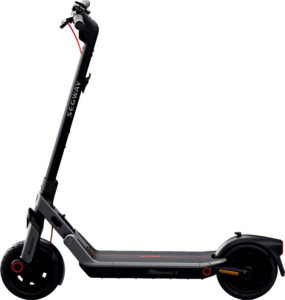
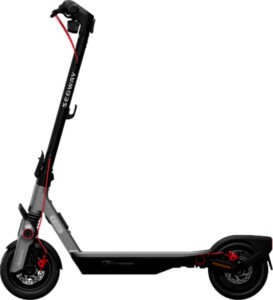
From a design standpoint, the E3 Pro and F3 Pro share a remarkably consistent foundation: both are adult-oriented, foldable scooters rolling on 10″ pneumatic tires with suspension, front and rear lighting, and companion app support. These shared traits mean neither has an inherent ergonomic or convenience advantage at a surface level — both fold for storage and portability, and both are built for grown-up riders.
Where the two diverge meaningfully is in weight and water resistance. The F3 Pro tips the scale at 19,300 g versus the E3 Pro's 17,900 g — a 1,400 g (roughly 3 lb) difference that matters most when carrying the scooter up stairs, loading it into a vehicle, or navigating multi-modal commutes. The E3 Pro's lighter build gives it a practical handling edge in those everyday scenarios. On the other hand, the F3 Pro steps up to an IPX6 rating compared to the E3 Pro's IPX5, meaning it can withstand powerful water jets rather than just low-pressure splashes — a real-world advantage for riders who commute in heavier rain or frequently ride through puddles.
The design edge ultimately depends on the rider's priorities. For portability and ease of handling, the E3 Pro wins with its lower weight. For all-weather durability, the F3 Pro holds the advantage with its superior IP rating. Neither dominates outright, but the F3 Pro's trade-off — heavier but more weather-resistant — suggests it is engineered for more demanding, commuter-centric use.