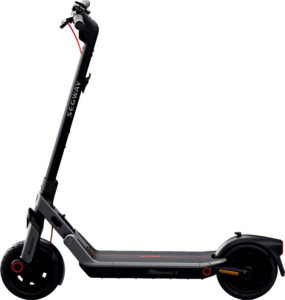
Ninebot by Segway KickScooter E3 Pro
Xiaomi Electric Scooter 5 Pro

Ninebot by Segway KickScooter E3 Pro Xiaomi Electric Scooter 5 Pro

Overview

When comparing the Ninebot by Segway KickScooter E3 Pro and the Xiaomi Electric Scooter 5 Pro, it quickly becomes clear that both scooters share a strong common foundation — from their 25 km/h top speed and 10″ pneumatic tires to suspension systems and smartphone app support. Yet the real story unfolds when examining motor power, battery capacity, riding range, and overall weight. Dive in to discover which scooter best matches your riding needs.

Common Features

  • Both scooters come equipped with suspension.
  • Both scooters have a dedicated smartphone app.
  • Both scooters feature pneumatic tires.
  • Both scooters have a 10″ wheel diameter.
  • Neither scooter has a seat.
  • Both scooters can be folded.
  • Neither scooter is designed for kids.
  • Both scooters have front light(s).
  • Both scooters have a top speed of 25 km/h.
  • Neither scooter uses dual motors.
  • Both scooters have a rear brake.
  • Both scooters have a front brake.
  • Both scooters support a maximum weight capacity of 120 kg.
  • Both scooters have a battery level indicator.
  • Both scooters feature regenerative braking.
  • Neither scooter has a removable battery.

Main Differences

  • Weight is 17900 g on Ninebot by Segway KickScooter E3 Pro and 22400 g on Xiaomi Electric Scooter 5 Pro.
  • Motor power is 800W on Ninebot by Segway KickScooter E3 Pro and 1000W on Xiaomi Electric Scooter 5 Pro.
  • Climbing angle is 18° on Ninebot by Segway KickScooter E3 Pro and 22° on Xiaomi Electric Scooter 5 Pro.
  • Maximum distance per charge is 55 km on Ninebot by Segway KickScooter E3 Pro and 60 km on Xiaomi Electric Scooter 5 Pro.
  • Battery size is 368 Wh on Ninebot by Segway KickScooter E3 Pro and 477 Wh on Xiaomi Electric Scooter 5 Pro.
Specs Comparison
Ninebot by Segway KickScooter E3 Pro

Ninebot by Segway KickScooter E3 Pro

Xiaomi Electric Scooter 5 Pro

Xiaomi Electric Scooter 5 Pro

Design:
weight 17900 g 22400 g
has suspension
Has a dedicated smartphone app
has pneumatic tires
wheel diameter 10" 10"
has a seat
can be folded
is designed for kids
has front light(s)
has rear light(s)
Ingress Protection (IP) rating IPX5 IPX5
release date January 2025 January 2025

From a design standpoint, the Ninebot by Segway KickScooter E3 Pro and the Xiaomi Electric Scooter 5 Pro share a remarkably similar feature set: both are foldable adult scooters equipped with 10″ pneumatic tires, front and rear lighting, suspension, a dedicated smartphone app, and an IPX5 water-resistance rating. This means neither has a meaningful advantage in terms of everyday usability features or all-weather capability — they are, on paper, near-identical in their design philosophy.

The one tangible differentiator is weight. The E3 Pro comes in at 17,900 g (~17.9 kg), while the Xiaomi 5 Pro is noticeably heavier at 22,400 g (~22.4 kg) — a gap of roughly 4.5 kg, which represents about 25% more mass. In real-world use, this matters most when carrying the scooter up stairs, lifting it onto public transit, or storing it. The difference between ~18 kg and ~22 kg is genuinely felt during those moments, and for commuters who regularly need to carry their scooter, the Segway's lighter build is a practical advantage.

On design, the Ninebot by Segway E3 Pro holds a clear edge due to its lower weight. Every other design attribute — folding mechanism, tire type, wheel size, lighting, app connectivity, and water resistance — is equivalent between the two, making weight the single deciding factor in this category.

Performance:
motor power 800W 1000W
top speed 25 km/h 25 km/h
has dual motors
climbing angle 18° 22°
has a rear brake
has a front brake
maximum weight capacity 120kg 120kg

Both scooters share a 25 km/h top speed and an identical 120 kg maximum load capacity, so neither has an edge in outright speed or rider weight support. Where they diverge is in the engine room: the Xiaomi Electric Scooter 5 Pro packs a 1000W motor versus the 800W unit in the Ninebot by Segway E3 Pro. Since both hit the same top speed, that extra 200W doesn't translate to faster riding — instead, it means the Xiaomi reaches that ceiling more forcefully and sustains it more comfortably under load or on inclines.

That motor advantage connects directly to the climbing specs. The Xiaomi's 22° climbing angle versus the Segway's 18° is a meaningful real-world gap. A 4-degree difference may sound modest, but on steeper urban streets, bridges, or parking ramp entrances, it can be the difference between breezing through and struggling — especially for heavier riders approaching the weight limit. For users in hilly cities, this is arguably the most practically significant spec in this entire group.

The braking setup is identical across both — dual front and rear brakes — so safety hardware is a wash. Overall, the Xiaomi 5 Pro holds a clear performance edge, driven by its more powerful motor and superior climbing ability. Riders on flat terrain may never notice the difference, but anyone dealing with elevation changes regularly will find the Xiaomi measurably more capable.

Battery:
maximum distance per charge 55 km 60 km
has a battery level indicator
Has regenerative braking
has a removable battery
battery size 368 Wh 477 Wh

The battery gap between these two scooters is substantial. The Xiaomi Electric Scooter 5 Pro carries a 477 Wh pack versus the 368 Wh unit in the Ninebot by Segway E3 Pro — a difference of roughly 30% more stored energy. That larger reservoir directly supports the Xiaomi's rated range advantage: 60 km per charge compared to 55 km for the Segway. Interestingly, the range gap (about 9%) is narrower than the capacity gap (30%), which suggests the Xiaomi's heavier weight and more powerful motor consume that extra energy at a higher rate, partially offsetting the raw capacity advantage.

Both scooters share regenerative braking and a battery level indicator — useful features that are now table stakes at this tier. Neither offers a removable battery, which means charging always requires access to the scooter itself; there's no option to swap in a fresh pack for extended riding sessions. For daily commuters, this is worth noting if charging access mid-day is limited.

All things considered, the Xiaomi 5 Pro holds the edge in battery, both in absolute capacity and in rated range. The advantage is real but not dramatic in practice — 5 km of additional range is unlikely to be decisive for most urban riders. However, for longer commutes or riders who prefer to charge less frequently, the Xiaomi's larger pack provides a tangible buffer.

Comparison Summary & Verdict

Both the Ninebot by Segway KickScooter E3 Pro and the Xiaomi Electric Scooter 5 Pro are well-rounded electric scooters that share an impressive list of features: identical top speeds, front and rear brakes, regenerative braking, suspension, and smartphone connectivity. The deciding factors come down to priorities. If portability matters most, the Ninebot by Segway KickScooter E3 Pro holds a clear edge with its significantly lighter 17,900 g frame, making it easier to carry, fold, and store. If performance and endurance are your priority, the Xiaomi Electric Scooter 5 Pro steps ahead with a more powerful 1000W motor, a steeper 22° climbing angle, a larger 477 Wh battery, and a longer range of 60 km per charge — making it the stronger companion for hilly terrain and longer daily commutes.

Ninebot by Segway KickScooter E3 Pro
Buy Ninebot by Segway KickScooter E3 Pro if...

Buy the Ninebot by Segway KickScooter E3 Pro if you prioritize a lighter build at 17,900 g, making it the more portable and manageable option for everyday carry and storage.

Xiaomi Electric Scooter 5 Pro
Buy Xiaomi Electric Scooter 5 Pro if...

Buy the Xiaomi Electric Scooter 5 Pro if you need stronger performance, with its 1000W motor, 22° climbing angle, and a 60 km range powered by a larger 477 Wh battery.