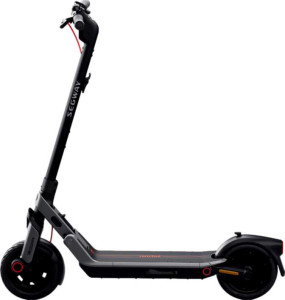
Ninebot by Segway KickScooter E3
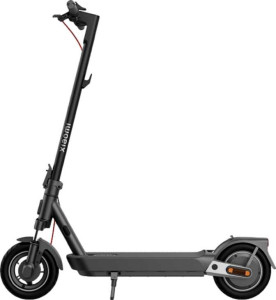
Xiaomi Electric Scooter 5

Ninebot by Segway KickScooter E3 Xiaomi Electric Scooter 5

Overview

When it comes to picking the right electric scooter, the Ninebot by Segway KickScooter E3 and the Xiaomi Electric Scooter 5 both make a compelling case. While the two share a surprisingly common feature set, they diverge in meaningful ways across motor power, weight, and battery range — the very factors that tend to matter most for everyday riders. Read on to see how they truly stack up.

Common Features

  • Both scooters come equipped with suspension.
  • Both scooters are compatible with a dedicated smartphone app.
  • Both scooters feature pneumatic tires.
  • Both scooters have a 10″ wheel diameter.
  • Neither scooter comes with a seat.
  • Both scooters can be folded for storage or transport.
  • Neither scooter is designed for kids.
  • Both scooters are equipped with front lights.
  • Both scooters have a top speed of 25 km/h.
  • Neither scooter has dual motors.
  • Both scooters have a climbing angle of 18°.
  • Both scooters are equipped with a rear brake.
  • Both scooters are equipped with a front brake.
  • Both scooters support a maximum weight capacity of 120 kg.
  • Both scooters include a battery level indicator.
  • Neither scooter has a removable battery.

Main Differences

  • Weight is 17500 g on Ninebot by Segway KickScooter E3 and 20100 g on Xiaomi Electric Scooter 5.
  • Height is 1235 mm on Ninebot by Segway KickScooter E3 and 1275 mm on Xiaomi Electric Scooter 5.
  • Width is 1165 mm on Ninebot by Segway KickScooter E3 and 1142 mm on Xiaomi Electric Scooter 5.
  • Motor power is 800W on Ninebot by Segway KickScooter E3 and 700W on Xiaomi Electric Scooter 5.
  • Charge time is 7 hours on Ninebot by Segway KickScooter E3 and 9 hours on Xiaomi Electric Scooter 5.
  • Maximum distance per charge is 45 km on Ninebot by Segway KickScooter E3 and 60 km on Xiaomi Electric Scooter 5.
Specs Comparison
Ninebot by Segway KickScooter E3

Ninebot by Segway KickScooter E3

Xiaomi Electric Scooter 5

Xiaomi Electric Scooter 5

Design:
weight 17500 g 20100 g
has suspension
Has a dedicated smartphone app
has pneumatic tires
wheel diameter 10" 10"
has a seat
can be folded
is designed for kids
height 1235 mm 1275 mm
width 1165 mm 1142 mm
has front light(s)
has rear light(s)
Ingress Protection (IP) rating IPX5 IPX5
release date January 2025 January 2025

From a design standpoint, the Ninebot by Segway KickScooter E3 and the Xiaomi Electric Scooter 5 share a strikingly similar blueprint: both are foldable, adult-oriented scooters rolling on 10-inch pneumatic tires, equipped with front and rear lighting, suspension, a companion app, and an IPX5 water-resistance rating. That rating means both can handle rain splashes and light wet-road riding, but neither is suited for submersion or heavy downpours — a practical limitation worth keeping in mind for daily commuters.

Where the two diverge most meaningfully is in weight. The E3 comes in at 17,500 g versus the Xiaomi 5's 20,100 g — a difference of roughly 2.6 kg. On paper that may seem minor, but in everyday use — carrying the scooter up stairs, lifting it onto public transit, or stowing it in a car trunk — that gap is consistently noticeable. The Xiaomi 5 is also slightly taller when unfolded (1,275 mm vs. 1,235 mm), which may suit taller riders marginally better, while the E3 is fractionally wider (1,165 mm vs. 1,142 mm), a difference too small to have any practical significance.

Overall, the E3 holds a clear design edge primarily due to its lower weight, which directly improves portability — one of the most important practical considerations for a foldable commuter scooter. All other design attributes are effectively tied, making the weight advantage the single most decisive differentiator in this category.
Performance:
motor power 800W 700W
top speed 25 km/h 25 km/h
has dual motors
climbing angle 18° 18°
has a rear brake
has a front brake
maximum weight capacity 120kg 120kg

Performance-wise, these two scooters are remarkably well-matched across most metrics — identical 25 km/h top speeds, the same 18° climbing angle, dual front-and-rear braking, and a shared 120 kg maximum rider capacity. The climbing angle is worth calling out specifically: 18° is a fairly capable figure, meaning both scooters can handle moderately steep urban inclines without significant struggle, which is a practical asset for hilly city commutes.

The one tangible differentiator is motor output. The E3 packs an 800W motor versus the Xiaomi 5's 700W — a 100W advantage for the Segway. While both scooters reach the same governed top speed, that extra wattage translates into real-world benefits in dynamic conditions: quicker acceleration from a standstill, more confident hill climbing under load (particularly relevant for heavier riders approaching the weight limit), and better sustained performance when battling headwinds. It is the kind of difference that may not show up on a spec sheet comparison at first glance, but becomes noticeable in day-to-day riding.

The E3 earns a narrow performance edge on the strength of its higher motor output. The Xiaomi 5 is by no means underpowered, and for most average-weight riders on flat terrain the gap will rarely be felt — but the E3's motor headroom gives it more confidence-inspiring performance across a wider range of real-world conditions.

Battery:
charge time 7 hours 9 hours
maximum distance per charge 45 km 60 km
has a battery level indicator
has a removable battery

Battery is where the clearest trade-off between these two scooters emerges. The Xiaomi Electric Scooter 5 offers a substantially longer maximum range of 60 km per charge compared to the E3's 45 km — a 33% range advantage that is hard to dismiss. For a commuter covering 20–25 km round trips daily, the E3 could theoretically last two days between charges while the Xiaomi 5 stretches to nearly three, reducing how often you need to think about plugging in altogether.

The flip side of that larger battery is charge time. The Xiaomi 5 takes 9 hours to fully replenish versus the E3's 7 hours — a two-hour difference that matters most if you rely on overnight charging. Both scooters share the same practical limitation of a non-removable battery, meaning you must bring the entire scooter to a power outlet rather than swapping in a spare pack, a constraint equally felt by both riders.

The Xiaomi 5 holds a decisive battery advantage. The extra range it delivers outweighs the longer charge time for most use cases — particularly for riders with longer commutes or those who simply prefer fewer charging interruptions throughout the week. The E3's faster charge is a modest consolation, but range is typically the more critical day-to-day variable for scooter users.

Comparison Summary & Verdict

Both the Ninebot by Segway KickScooter E3 and the Xiaomi Electric Scooter 5 share the same top speed, wheel size, braking system, and maximum rider capacity, making either a solid all-around choice. However, the right pick depends on your priorities. The E3 edges ahead with a more powerful 800W motor, a lighter frame at 17,500 g, and a notably faster 7-hour charging time, suiting riders who value responsiveness and convenience on shorter routes. The Xiaomi Electric Scooter 5 counters with an impressive 60 km maximum range per charge — 15 km more than the E3 — making it the smarter companion for longer commutes or riders who prefer fewer charging stops, despite its heavier build and longer 9-hour charge cycle.

Ninebot by Segway KickScooter E3
Buy Ninebot by Segway KickScooter E3 if...

Buy the Ninebot by Segway KickScooter E3 if you want a lighter scooter with a more powerful 800W motor and a faster 7-hour charge time for daily short-to-medium trips.

Xiaomi Electric Scooter 5
Buy Xiaomi Electric Scooter 5 if...

Buy the Xiaomi Electric Scooter 5 if maximizing range is your top priority, as its 60 km per charge makes it ideal for longer commutes between charging sessions.