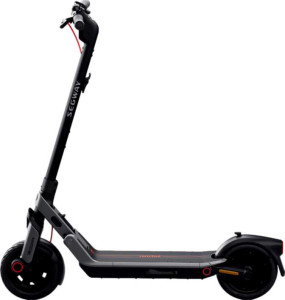
Ninebot by Segway KickScooter E3
Xiaomi Electric Scooter Elite

Ninebot by Segway KickScooter E3 Xiaomi Electric Scooter Elite

Overview

Welcome to our in-depth spec comparison between the Ninebot by Segway KickScooter E3 and the Xiaomi Electric Scooter Elite — two capable adult electric scooters sharing a surprising amount of common ground. In this head-to-head, we explore the key battlegrounds that set them apart, including motor power, weight and portability, hill-climbing ability, and charging speed, to help you decide which one truly fits your daily ride.

Common Features

  • Both scooters have suspension.
  • Both scooters have a dedicated smartphone app.
  • Both scooters have pneumatic tires.
  • The wheel diameter is 10″ on both scooters.
  • Neither scooter has a seat.
  • Both scooters can be folded.
  • Neither scooter is designed for kids.
  • Both scooters have front lights.
  • The top speed is 25 km/h on both scooters.
  • Neither scooter has dual motors.
  • Both scooters have a rear brake.
  • Both scooters have a front brake.
  • The maximum weight capacity is 120 kg on both scooters.
  • The maximum distance per charge is 45 km on both scooters.
  • Both scooters have a battery level indicator.
  • Neither scooter has a removable battery.

Main Differences

  • Weight is 17500 g on Ninebot by Segway KickScooter E3 and 20000 g on Xiaomi Electric Scooter Elite.
  • Height is 1235 mm on Ninebot by Segway KickScooter E3 and 1270 mm on Xiaomi Electric Scooter Elite.
  • Width is 1165 mm on Ninebot by Segway KickScooter E3 and 1175 mm on Xiaomi Electric Scooter Elite.
  • Motor power is 800W on Ninebot by Segway KickScooter E3 and 700W on Xiaomi Electric Scooter Elite.
  • Climbing angle is 18° on Ninebot by Segway KickScooter E3 and 20° on Xiaomi Electric Scooter Elite.
  • Charge time is 7 hours on Ninebot by Segway KickScooter E3 and 8 hours on Xiaomi Electric Scooter Elite.
Specs Comparison
Ninebot by Segway KickScooter E3

Ninebot by Segway KickScooter E3

Xiaomi Electric Scooter Elite

Xiaomi Electric Scooter Elite

Design:
weight 17500 g 20000 g
has suspension
Has a dedicated smartphone app
has pneumatic tires
wheel diameter 10" 10"
has a seat
can be folded
is designed for kids
height 1235 mm 1270 mm
width 1165 mm 1175 mm
has front light(s)
has rear light(s)
Ingress Protection (IP) rating IPX5 IPX5
release date January 2025 January 2025

In terms of design fundamentals, the Ninebot by Segway KickScooter E3 and the Xiaomi Electric Scooter Elite share a remarkably similar blueprint: both fold for portability, ride on 10″ pneumatic tires, feature suspension, front and rear lighting, and carry an IPX5 water resistance rating — meaning neither is designed for riding in heavy rain, but both can handle light splashes. Neither offers a seat, and both have companion smartphone apps. For the average buyer, these shared traits mean the day-to-day riding and ownership experience will feel broadly comparable.

Where the two diverge is in physical dimensions and weight. The Xiaomi Elite is measurably larger — 1270 mm tall versus 1235 mm, and 1175 mm wide versus 1165 mm — and notably heavier at 20,000 g compared to the Segway's 17,500 g. That 2.5 kg difference is meaningful in practice: carrying a scooter up stairs, lifting it onto public transit, or storing it under a desk becomes noticeably more effortful with the Xiaomi. The extra bulk also suggests a potentially more robust or feature-rich build, but based solely on design specs, it translates primarily to a portability disadvantage.

On design alone, the Ninebot by Segway KickScooter E3 holds a clear edge. Its lighter weight and slightly more compact form factor make it the more practical choice for commuters who need to carry or maneuver their scooter regularly, without sacrificing any of the core design features the Xiaomi offers.
Performance:
motor power 800W 700W
top speed 25 km/h 25 km/h
has dual motors
climbing angle 18° 20°
has a rear brake
has a front brake
maximum weight capacity 120kg 120kg

Both scooters share a 25 km/h top speed, dual braking systems, and a 120 kg maximum rider capacity — so for flat urban commuting, the day-to-day performance ceiling feels identical on paper. The real story, however, lies beneath those surface similarities. The Ninebot by Segway KickScooter E3 packs an 800W motor versus the Xiaomi Elite's 700W. That 100W gap doesn't change top speed, but it does affect how confidently and quickly each scooter reaches it — the Segway will feel more responsive off the line and less strained when carrying heavier riders.

Hill-climbing flips the advantage. The Xiaomi Elite manages a 20° climbing angle compared to the Segway's 18°. Two degrees may sound trivial, but on real-world inclines — think steep urban streets or parking garage ramps — it translates to meaningful extra capability. The Xiaomi achieves this despite its lower motor output, suggesting a more efficient power-to-gradient tuning. For riders in hilly cities, this difference genuinely matters.

Performance here is a genuine split verdict. The Ninebot by Segway KickScooter E3 edges ahead on raw motor muscle, making it the stronger choice for heavier riders or those prioritizing punchy acceleration. The Xiaomi Electric Scooter Elite, however, takes the hill-climbing crown — making it the smarter pick for anyone navigating consistently steep terrain.

Battery:
charge time 7 hours 8 hours
maximum distance per charge 45 km 45 km
has a battery level indicator
has a removable battery

Range anxiety is a non-issue for either scooter — both deliver an identical 45 km maximum distance per charge, which comfortably covers most urban commutes with room to spare. Neither offers a removable battery, so topping up always means plugging in rather than swapping packs, a limitation worth noting for riders who need all-day range without access to an outlet.

The only meaningful distinction in this group is charging time. The Ninebot by Segway KickScooter E3 replenishes in 7 hours, while the Xiaomi Electric Scooter Elite requires 8 hours. That one-hour gap is most consequential for riders who charge overnight on tight schedules or need a same-day top-up — the Segway simply gets back to full readiness faster for the same usable range.

Battery-wise, the Ninebot by Segway KickScooter E3 holds a narrow but practical edge. Equal range with a shorter charge cycle is an objectively more efficient proposition, and over weeks of regular use that hour adds up. The Xiaomi is not far behind, but there is no spec here that offsets its slower recharge time.

Comparison Summary & Verdict

After a thorough comparison, both scooters prove to be well-matched rivals: they share the same 25 km/h top speed, 45 km range, 120 kg capacity, and 10″ pneumatic tires with suspension. However, the differences are meaningful. The Ninebot by Segway KickScooter E3 stands out with a more powerful 800W motor, a lighter 17,500 g frame, and a faster 7-hour charge time, making it the stronger choice for riders who prioritize raw power and everyday convenience. The Xiaomi Electric Scooter Elite, meanwhile, edges ahead with a steeper 20° climbing angle, making it the better pick for riders who regularly tackle hilly terrain, even if it charges slightly slower and weighs a bit more.

Ninebot by Segway KickScooter E3
Buy Ninebot by Segway KickScooter E3 if...

Buy the Ninebot by Segway KickScooter E3 if you want a more powerful 800W motor, a lighter and more compact build, and faster charging at 7 hours.

Xiaomi Electric Scooter Elite
Buy Xiaomi Electric Scooter Elite if...

Buy the Xiaomi Electric Scooter Elite if you frequently ride on hilly routes, as its superior 20° climbing angle gives it a clear edge on inclines.