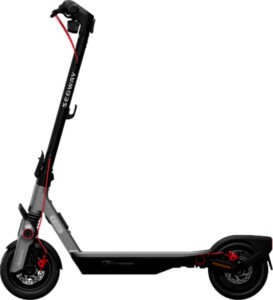
Ninebot by Segway KickScooter F3 Pro
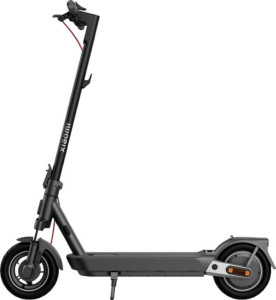
Xiaomi Electric Scooter 5 Max

Ninebot by Segway KickScooter F3 Pro Xiaomi Electric Scooter 5 Max

Overview

Welcome to our detailed spec comparison between the Ninebot by Segway KickScooter F3 Pro and the Xiaomi Electric Scooter 5 Max — two capable electric scooters that share plenty of common ground. Both ride on 10″ pneumatic tires, fold for convenience, and pack a 477 Wh battery, yet key differences in motor power, range, and build quality set them apart. Read on to see which one earns a place in your daily commute.

Common Features

  • Both scooters feature suspension for a smoother ride.
  • Both scooters have a dedicated smartphone app.
  • Both scooters are equipped with pneumatic tires.
  • Both scooters have a 10″ wheel diameter.
  • Neither scooter comes with a seat.
  • Both scooters can be folded for easy storage and transport.
  • Neither scooter is designed for kids.
  • Both scooters have front lights.
  • Both scooters have a top speed of 25 km/h.
  • Neither scooter uses dual motors.
  • Both scooters are equipped with a rear brake.
  • Both scooters are equipped with a front brake.
  • Both scooters support a maximum weight capacity of 120 kg.
  • Both scooters have a battery level indicator.
  • Both scooters feature regenerative braking.
  • Neither scooter has a removable battery.
  • Both scooters share the same battery size of 477 Wh.

Main Differences

  • Weight is 19300 g on Ninebot by Segway KickScooter F3 Pro and 22300 g on Xiaomi Electric Scooter 5 Max.
  • Height is 1262 mm on Ninebot by Segway KickScooter F3 Pro and 1271 mm on Xiaomi Electric Scooter 5 Max.
  • Width is 1152 mm on Ninebot by Segway KickScooter F3 Pro and 1192 mm on Xiaomi Electric Scooter 5 Max.
  • Ingress Protection rating is IPX6 on Ninebot by Segway KickScooter F3 Pro and IPX5 on Xiaomi Electric Scooter 5 Max.
  • Motor power is 1200W on Ninebot by Segway KickScooter F3 Pro and 1000W on Xiaomi Electric Scooter 5 Max.
  • Climbing angle is 24° on Ninebot by Segway KickScooter F3 Pro and 22° on Xiaomi Electric Scooter 5 Max.
  • Charge time is 8 hours on Ninebot by Segway KickScooter F3 Pro and 9 hours on Xiaomi Electric Scooter 5 Max.
  • Maximum distance per charge is 70 km on Ninebot by Segway KickScooter F3 Pro and 60 km on Xiaomi Electric Scooter 5 Max.
Specs Comparison
Ninebot by Segway KickScooter F3 Pro

Ninebot by Segway KickScooter F3 Pro

Xiaomi Electric Scooter 5 Max

Xiaomi Electric Scooter 5 Max

Design:
weight 19300 g 22300 g
has suspension
Has a dedicated smartphone app
has pneumatic tires
wheel diameter 10" 10"
has a seat
can be folded
is designed for kids
height 1262 mm 1271 mm
width 1152 mm 1192 mm
has front light(s)
has rear light(s)
Ingress Protection (IP) rating IPX6 IPX5
release date January 2025 January 2025

Both the Ninebot by Segway KickScooter F3 Pro and the Xiaomi Electric Scooter 5 Max share a remarkably similar design foundation: 10″ pneumatic tires, full suspension, front and rear lighting, a foldable frame, and a companion smartphone app. For riders, this means both scooters deliver a comparable ride quality baseline — the air-filled tires absorb road vibration, and the suspension adds meaningful comfort on imperfect surfaces. Neither is designed for children, and neither offers a seat, positioning both firmly as stand-up adult commuters.

Where the designs diverge meaningfully is in two areas: weight and water resistance. The F3 Pro comes in at 19,300 g versus the Xiaomi 5 Max at 22,300 g — a difference of 3 kg. In practice, that gap is felt every time you carry the scooter up stairs, lift it onto public transit, or load it into a car trunk. The F3 Pro′s dimensional footprint is also slightly more compact (1152 mm wide vs. 1192 mm, and 1262 mm tall vs. 1271 mm), which can matter in tight storage spaces. On water resistance, the F3 Pro holds an IPX6 rating compared to the Xiaomi′s IPX5 — meaning the F3 Pro can withstand powerful water jets from any direction, while the Xiaomi is only rated for lower-pressure water streams. For riders who commute in rainy conditions, this is a tangible real-world advantage.

Overall, the Ninebot by Segway KickScooter F3 Pro has a clear design edge in this group. Its lighter weight makes it notably more portable day-to-day, and its superior IPX6 rating offers greater confidence in wet weather — two practical advantages that directly affect the ownership experience.
Performance:
motor power 1200W 1000W
top speed 25 km/h 25 km/h
has dual motors
climbing angle 24° 22°
has a rear brake
has a front brake
maximum weight capacity 120kg 120kg

At first glance, the performance specs of these two scooters look nearly identical — same top speed of 25 km/h, same dual-brake setup, and an equal maximum rider capacity of 120 kg. But two figures separate them in a meaningful way: motor power and climbing angle. The F3 Pro packs a 1200W motor versus the Xiaomi 5 Max′s 1000W — a 20% power advantage that doesn′t translate into a higher top speed (both are capped at 25 km/h, likely for regulatory reasons), but does influence how each scooter delivers that speed under demanding conditions.

That extra wattage shows up most clearly in hill climbing. The F3 Pro manages a 24° climbing angle compared to the Xiaomi′s 22° — a modest but real difference. For riders in flat urban environments, this gap is largely academic. However, for anyone navigating hilly terrain or steep parking garage ramps regularly, the F3 Pro will maintain composure and speed more confidently, while the Xiaomi may struggle or slow noticeably near its limits. More power also typically means less motor strain under heavy loads or sustained high-speed riding, which can affect long-term reliability.

The Ninebot by Segway KickScooter F3 Pro takes the edge in this category. While the shared top speed and braking setup make day-to-day riding feel comparable for most users, the F3 Pro′s superior motor output and steeper climbing capability give it a genuine advantage for heavier riders, hilly commutes, or anyone who wants more performance headroom built into their ride.

Battery:
charge time 8 hours 9 hours
maximum distance per charge 70 km 60 km
has a battery level indicator
Has regenerative braking
has a removable battery
battery size 477 Wh 477 Wh

The most striking detail in this battery comparison is that both scooters carry an identical 477 Wh battery — yet they deliver meaningfully different outcomes. The F3 Pro achieves a claimed range of 70 km per charge, while the Xiaomi 5 Max is rated at 60 km. That 10 km gap, drawn from the same energy reservoir, points directly to efficiency differences elsewhere in the system — likely the F3 Pro′s higher-wattage motor being better tuned for range, or differences in energy recovery and drivetrain losses.

Charge time adds another dimension: the F3 Pro replenishes in 8 hours versus the Xiaomi′s 9 hours, despite both starting from the same battery capacity. A one-hour faster charge cycle is a genuine quality-of-life improvement for riders who plug in overnight and want a reliable full charge before a morning commute. Both scooters include regenerative braking and a battery level indicator, and neither offers a removable battery — so top-up charging on the go isn′t an option for either.

The Ninebot by Segway KickScooter F3 Pro holds a clear advantage here. Squeezing more range and a faster charge out of an equal-sized battery is a meaningful real-world win: riders get farther between charges and spend less time tethered to an outlet — without any trade-off in battery capacity.

Comparison Summary & Verdict

After examining every specification, both scooters prove to be well-matched in the fundamentals: identical top speed of 25 km/h, the same 477 Wh battery capacity, and shared safety features like front and rear brakes with regenerative braking. However, the distinctions matter depending on your priorities. The Ninebot by Segway KickScooter F3 Pro stands out with its stronger 1200W motor, superior 70 km range, faster 8-hour charge time, steeper 24° climbing angle, and better IPX6 water resistance — all in a lighter 19.3 kg frame. The Xiaomi Electric Scooter 5 Max, while heavier and slightly less powerful, remains a solid contender for riders who are comfortable with a 60 km range and a 1000W motor. Choose the Segway if raw performance and range are paramount; choose the Xiaomi if brand ecosystem or availability sways your decision.

Ninebot by Segway KickScooter F3 Pro
Buy Ninebot by Segway KickScooter F3 Pro if...

Buy the Ninebot by Segway KickScooter F3 Pro if you want a longer range of 70 km, a more powerful 1200W motor, faster charging, and better water resistance with its IPX6 rating — all in a lighter package.

Xiaomi Electric Scooter 5 Max
Buy Xiaomi Electric Scooter 5 Max if...

Buy the Xiaomi Electric Scooter 5 Max if you are comfortable with a 60 km range and a 1000W motor, and prefer the Xiaomi ecosystem for your connected scooter experience.