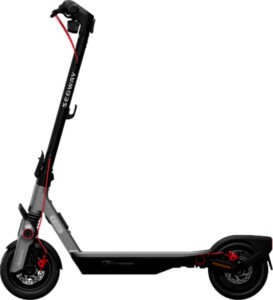
Both the Ninebot by Segway KickScooter F3 Pro and the Xiaomi Electric Scooter 5 Pro share a remarkably similar physical blueprint: foldable full-size frames, 10-inch pneumatic tires, front and rear lighting, suspension, and a dedicated smartphone app. Neither is designed for children or equipped with a seat, positioning both squarely as adult commuter scooters. For everyday usability, this common foundation means neither product has a structural disadvantage in terms of core design philosophy.
Where differences emerge, they are meaningful. The F3 Pro weighs in at 19,300 g versus the Xiaomi's 22,400 g — a gap of roughly 3.1 kg. In practice, that difference is felt most when lifting the scooter onto public transit, carrying it up stairs, or loading it into a car. The Xiaomi's added mass could become a daily inconvenience for riders who frequently need to carry it. The dimensional differences (9 mm in height, 40 mm in width) are negligible and unlikely to affect storage or portability in any real-world scenario.
On water resistance, the F3 Pro holds a clear advantage with an IPX6 rating compared to the Xiaomi's IPX5. Both ratings offer protection against rain and splashing, but IPX6 adds resistance to powerful water jets — a meaningful upgrade for riders who commute in heavier rain or through puddles at speed. Overall, the Ninebot F3 Pro has the edge in design for most users, thanks to its lighter weight and stronger water protection rating.