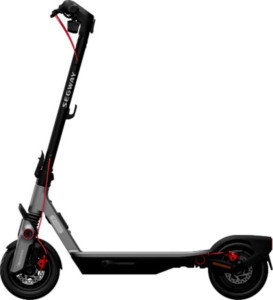
Ninebot by Segway KickScooter F3
Xiaomi Electric Scooter 5 Pro

Ninebot by Segway KickScooter F3 Xiaomi Electric Scooter 5 Pro

Overview

Welcome to our detailed spec comparison between the Ninebot by Segway KickScooter F3 and the Xiaomi Electric Scooter 5 Pro — two powerful electric scooters sharing a surprisingly similar foundation. While both models agree on motor power, top speed, and battery capacity, the real story lies in their differences: from weight and dimensions to range per charge and weather resistance. Read on to find out which one fits your riding needs best.

Common Features

  • Both scooters feature suspension for a smoother ride.
  • Both scooters are compatible with a dedicated smartphone app.
  • Both scooters are equipped with pneumatic tires.
  • Both scooters have a wheel diameter of 10″.
  • Neither scooter comes with a seat.
  • Both scooters can be folded for easy storage or transport.
  • Neither scooter is designed for kids.
  • Both scooters have front lights included.
  • Both scooters are powered by a 1000W motor.
  • Both scooters have a top speed of 25 km/h.
  • Neither scooter uses dual motors.
  • Both scooters are equipped with a rear brake.
  • Both scooters are equipped with a front brake.
  • Both scooters support a maximum weight capacity of 120 kg.
  • Both scooters include a battery level indicator.
  • Both scooters support regenerative braking.
  • Neither scooter has a removable battery.
  • Both scooters have a battery size of 477 Wh.

Main Differences

  • Weight is 18600 g on Ninebot by Segway KickScooter F3 and 22400 g on Xiaomi Electric Scooter 5 Pro.
  • Height is 1262 mm on Ninebot by Segway KickScooter F3 and 1271 mm on Xiaomi Electric Scooter 5 Pro.
  • Width is 1152 mm on Ninebot by Segway KickScooter F3 and 1192 mm on Xiaomi Electric Scooter 5 Pro.
  • Ingress Protection rating is IPX6 on Ninebot by Segway KickScooter F3 and IPX5 on Xiaomi Electric Scooter 5 Pro.
  • Climbing angle is 20° on Ninebot by Segway KickScooter F3 and 22° on Xiaomi Electric Scooter 5 Pro.
  • Charge time is 8 hours on Ninebot by Segway KickScooter F3 and 9 hours on Xiaomi Electric Scooter 5 Pro.
  • Maximum distance per charge is 70 km on Ninebot by Segway KickScooter F3 and 60 km on Xiaomi Electric Scooter 5 Pro.
Specs Comparison
Ninebot by Segway KickScooter F3

Ninebot by Segway KickScooter F3

Xiaomi Electric Scooter 5 Pro

Xiaomi Electric Scooter 5 Pro

Design:
weight 18600 g 22400 g
has suspension
Has a dedicated smartphone app
has pneumatic tires
wheel diameter 10" 10"
has a seat
can be folded
is designed for kids
height 1262 mm 1271 mm
width 1152 mm 1192 mm
has front light(s)
has rear light(s)
Ingress Protection (IP) rating IPX6 IPX5
release date January 2025 January 2025

Both the Ninebot by Segway KickScooter F3 and the Xiaomi Electric Scooter 5 Pro share a remarkably similar design foundation: identical 10″ pneumatic tires, suspension, a foldable frame, front and rear lighting, and a dedicated smartphone app. These shared traits mean both scooters are built for a comparable riding experience and commuter convenience, making the finer details all the more decisive.

The most impactful differentiator is weight. The F3 comes in at 18,600 g versus the 5 Pro's 22,400 g — a nearly 3.8 kg difference. In practice, this matters every time you carry the scooter up stairs, fold it onto public transit, or load it into a car trunk. The F3's lighter build is a meaningful everyday advantage for urban commuters. Physical dimensions are close, with the 5 Pro being marginally taller and wider, but the gap is negligible in real-world use.

On water resistance, the F3 holds a genuine edge with an IPX6 rating versus the 5 Pro's IPX5. IPX6 protects against powerful water jets, while IPX5 only covers lower-pressure streams — a meaningful distinction if you frequently ride in rain or through puddles. Overall, the F3 has a clear design advantage, being both lighter to carry and better sealed against the elements.

Performance:
motor power 1000W 1000W
top speed 25 km/h 25 km/h
has dual motors
climbing angle 20° 22°
has a rear brake
has a front brake
maximum weight capacity 120kg 120kg

At the performance level, these two scooters are remarkably well-matched. Both deliver a 1000W single motor, cap out at 25 km/h, and share a 120 kg maximum rider capacity — meaning neither holds an advantage in raw speed, power delivery, or load-bearing ability. The dual-brake setup (front and rear) on both also puts them on equal footing for stopping safety.

The only measurable performance differentiator is the climbing angle: the Xiaomi Electric Scooter 5 Pro edges ahead at 22° versus the F3's 20°. While a 2-degree difference may sound marginal on paper, hill-climbing ability is a compounding challenge — steeper grades demand more from the motor and reduce effective range. For riders in hilly urban environments, the 5 Pro's slight gradient advantage could translate into a more confident and consistent ride uphill.

Taken as a whole, performance is essentially a near-dead heat, with the 5 Pro holding a narrow edge purely on account of its superior climbing angle. For flat-city commuters, this distinction is negligible; for those regularly tackling inclines, it tips the scales modestly in the 5 Pro's favor.

Battery:
charge time 8 hours 9 hours
maximum distance per charge 70 km 60 km
has a battery level indicator
Has regenerative braking
has a removable battery
battery size 477 Wh 477 Wh

An identical 477 Wh battery capacity in both scooters sets a level playing field on paper — yet the real-world outcomes diverge noticeably. The Ninebot by Segway KickScooter F3 achieves a rated range of 70 km per charge, while the Xiaomi Electric Scooter 5 Pro tops out at 60 km. Squeezing more distance from the same energy pool suggests the F3 is the more efficient scooter — a gap of 10 km is substantial enough to matter for longer commuters or riders who cannot charge daily.

Charge time adds another dimension to this story. The F3 replenishes in 8 hours versus the 5 Pro's 9 hours — a one-hour difference that, while not dramatic, does favor the F3 for overnight charging routines. Both scooters share regenerative braking and a battery level indicator, which are practical features that help extend usable range and keep riders informed, but neither product gains an edge here since both offer them equally.

The battery category delivers a clear advantage to the F3: it goes farther on the same charge and refills faster. For a commuter weighing long-term ownership costs and daily reliability, these two compounding efficiency wins make the F3 the stronger choice in this group.

Comparison Summary & Verdict

After a thorough look at the specs, both scooters prove to be well-matched rivals — identical in motor power, top speed, battery size, and braking systems. However, the key differentiators are clear. The Ninebot by Segway KickScooter F3 stands out with a longer range of 70 km per charge, a faster 8-hour charge time, a lighter 18.6 kg build, and a superior IPX6 water resistance rating. The Xiaomi Electric Scooter 5 Pro, on the other hand, offers a slightly steeper 22° climbing angle, making it the better pick for hilly terrain, despite its heavier frame and shorter 60 km range. Choose the Segway if everyday commuting range and weather resilience matter most; choose the Xiaomi if you regularly tackle steep inclines.

Ninebot by Segway KickScooter F3
Buy Ninebot by Segway KickScooter F3 if...

Buy the Ninebot by Segway KickScooter F3 if you prioritize a longer range of 70 km per charge, faster charging, a lighter build, and stronger IPX6 water resistance.

Xiaomi Electric Scooter 5 Pro
Buy Xiaomi Electric Scooter 5 Pro if...

Buy the Xiaomi Electric Scooter 5 Pro if you frequently ride on steep terrain, as its superior 22° climbing angle gives it a clear edge on hilly routes.