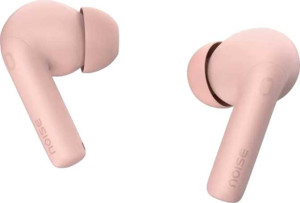
Noise Air Buds Pro 6
Realme Buds Air 7

Noise Air Buds Pro 6 Realme Buds Air 7

Overview

Welcome to our in-depth spec comparison between the Noise Air Buds Pro 6 and the Realme Buds Air 7. Both are fully wireless, ANC-equipped in-ear earbuds sharing a surprising amount of common ground, yet they diverge in ways that could matter greatly depending on your lifestyle. The key battlegrounds in this head-to-head include battery endurance, ingress protection, spatial audio capability, and microphone count. Read on to discover which set of buds is the right fit for you.

Common Features

  • Both products use an in-ear fit design.
  • Both products are water resistant.
  • Both products are wireless with no cables.
  • Neither product is a neckband earbud style.
  • Neither product includes wingtips.
  • Neither product features RGB lighting.
  • Both products have stereo speakers.
  • Neither product includes a UV light.
  • Both products support active noise cancellation (ANC).
  • Both products offer passive noise reduction.
  • Both products use a 12.4 mm driver unit.
  • Both products share the same frequency range of 20 Hz to 20000 Hz.
  • Neither product supports Dolby Atmos.
  • Neither product supports Dirac Virtuo.
  • Neither product uses a neodymium magnet.
  • Both products take 1.5 hours to fully charge.
  • Neither product supports wireless charging.
  • Neither product has a solar power battery.
  • Both products include a battery level indicator.
  • Both products have a rechargeable battery.
  • Both products support fast pairing.
  • Both products feature a USB Type-C connector.
  • Neither product supports LDAC.
  • Both products support LDHC.
  • Neither product supports Bluetooth LE Audio.
  • Neither product supports aptX Adaptive.
  • Neither product supports aptX Low Latency.
  • Neither product supports aptX HD.
  • Both products include an ambient sound mode.
  • Both products feature in/on-ear detection.
  • Both products support fast charging.
  • Both products support multipoint connection with up to 2 devices.
  • Neither product can read notifications aloud.
  • Both products include a mute function.
  • Both products can be used as a headset.
  • Both products have a control panel placed on the device.
  • Both products include a noise-canceling microphone.

Main Differences

  • The Ingress Protection rating is IPX5 on the Noise Air Buds Pro 6 and IP55 on the Realme Buds Air 7.
  • Spatial audio support is present on the Realme Buds Air 7 but not available on the Noise Air Buds Pro 6.
  • Battery life is 7 hours on the Noise Air Buds Pro 6 and 13 hours on the Realme Buds Air 7.
  • Battery life of the charging case is 36 hours on the Noise Air Buds Pro 6 and 39 hours on the Realme Buds Air 7.
  • The number of microphones is 4 on the Noise Air Buds Pro 6 and 6 on the Realme Buds Air 7.
Specs Comparison
Noise Air Buds Pro 6

Noise Air Buds Pro 6

Realme Buds Air 7

Realme Buds Air 7

Design:
Fit In-ear In-ear
Ingress Protection (IP) rating IPX5 IP55
water resistance Water resistant Water resistant
has no wires or cables
are neckband earbuds
wingtips included
has RGB lighting
has stereo speakers
has UV light
Has a display

In terms of overall design philosophy, the Noise Air Buds Pro 6 and Realme Buds Air 7 are nearly identical on paper: both are true wireless, in-ear earbuds with stereo sound, no neckband, no wingtips, no RGB lighting, and no display. For most users, the day-to-day wearing experience will feel very similar between the two.

The one meaningful differentiator in this category is the ingress protection rating. The Noise Air Buds Pro 6 carries an IPX5 rating, meaning it is tested against water jets but has no official dust resistance certification — the ″X″ denotes an unrated dust class. The Realme Buds Air 7, by contrast, is rated IP55, which adds a solid-particle (dust) protection layer on top of the same water-jet resistance. In real-world terms, this means the Realme earbuds are better equipped for dusty commutes, outdoor workouts, or sandy environments where fine particles could otherwise work their way into the housing over time.

Edge: Realme Buds Air 7. The broader IP55 certification gives it a tangible durability advantage over the IPX5-rated Noise earbuds, particularly for active or outdoor users. All other design attributes are shared equally between the two.

Sound quality:
has active noise cancellation (ANC)
has passive noise reduction
driver unit size 12.4 mm 12.4 mm
lowest frequency 20 Hz 20 Hz
highest frequency 20000 Hz 20000 Hz
supports spatial audio
has Dolby Atmos
has Dirac Virtuo
has a neodymium magnet

At the core, both earbuds are built around the same 12.4 mm dynamic driver and share an identical frequency range of 20 Hz – 20,000 Hz — the full span of human hearing. Both also feature active noise cancellation paired with passive noise reduction, meaning each earbud uses both physical seal and electronic processing to block ambient sound. For the vast majority of listening scenarios, these two products start from an equal sonic foundation.

The single differentiator here is spatial audio support, which is present on the Realme Buds Air 7 but absent on the Noise Air Buds Pro 6. Spatial audio creates a sense of three-dimensional sound placement — particularly noticeable in movies, gaming, and certain music mixes — making audio feel like it surrounds the listener rather than playing strictly left-to-right. It is worth noting that neither product supports Dolby Atmos or Dirac Virtuo, so the Realme's spatial audio is a more generic implementation, but it still adds a dimension of immersion the Noise earbuds simply cannot offer.

Edge: Realme Buds Air 7. With an otherwise identical acoustic setup, spatial audio support is the tiebreaker — it broadens the use case for multimedia and gaming listeners without any trade-off in the fundamentals.

Power:
Battery life 7 hours 13 hours
Battery life of charging case 36 hours 39 hours
charge time 1.5 hours 1.5 hours
has wireless charging
Has a solar power battery
has a battery level indicator
has a rechargeable battery

Battery life is where these two earbuds diverge most sharply. The Realme Buds Air 7 delivers up to 13 hours of playback on a single charge, compared to just 7 hours for the Noise Air Buds Pro 6 — nearly double the endurance per session. For commuters, travelers, or anyone who regularly uses earbuds through a full workday without reaching for the case, that gap is practically significant.

The charging case gap is narrower but still favors the Realme: 39 hours of total combined battery versus 36 hours for the Noise. Both figures are respectable for multi-day use away from a power source, but the Realme's longer per-earbud runtime means users will return to the case less often in the first place. Charge times are identical at 1.5 hours, and neither product offers wireless charging — so refueling speed and convenience are equal on both sides.

Edge: Realme Buds Air 7, and it is not close. The combination of a substantially longer single-charge runtime and a marginally larger total case capacity makes it the clear winner for users who prioritize going long stretches without interruption.

Connectivity:
has fast pairing
Has USB Type-C
has LDAC
has LDHC
has Bluetooth LE Audio
has aptX Adaptive
has aptX Low Latency
has aptX HD
has aptX
has aptX Lossless
has aptX Voice
has Auracast
maximum Bluetooth range 10 m 10 m
supports Bluetooth pairing using NFC
Can be used wirelessly
has AAC

Connectivity is the one category where these two earbuds are completely indistinguishable. Both support AAC and LDHC as their audio codec options — AAC for broad compatibility with Apple and Android devices, and LDHC for higher-bitrate wireless audio that can outperform standard SBC in audio quality when the source device supports it. Neither earbud offers LDAC, aptX in any of its variants, or Bluetooth LE Audio, so the codec ceiling is identical on both sides.

Practical wireless features are also mirrored exactly: both offer fast pairing, a 10 m maximum Bluetooth range, USB Type-C charging, and no NFC pairing support. The 10 m range is standard for modern true wireless earbuds and is sufficient for typical use — moving between rooms or leaving a phone on a desk — though it is not exceptional for open outdoor environments.

Verdict: Dead tie. There is no connectivity-based reason to choose one over the other. Users who prioritize a specific codec ecosystem, such as Sony's LDAC or Qualcomm's aptX, will find neither product accommodates those preferences — but for everyone else, the shared LDHC and AAC support represents a solid and equivalent wireless audio foundation on both devices.

Features:
release date April 2025 February 2025
has ambient sound mode
has in/on-ear detection
Supports fast charging
multipoint count 2 2
can read notifications
has a mute function
can be used as a headset
control panel placed on a device
Has voice prompts
travel bag is included
Has an in-line control panel
Has a temperature sensor
Has a built-in camera remote control function

Much like the connectivity category, features here are a complete match across the board. Both the Noise Air Buds Pro 6 and Realme Buds Air 7 support ambient sound mode, which lets external audio pass through so users can stay aware of their surroundings without removing the earbuds — a genuinely useful feature for commuting or street use. Both also include in/on-ear detection, which automatically pauses playback when an earbud is removed, a small but appreciated quality-of-life convenience.

On the practical side, multipoint connectivity — supported by both at a count of 2 — allows simultaneous pairing with two devices, so switching between a laptop and a phone requires no manual re-pairing. Fast charging support on both means a short top-up can restore meaningful playback time quickly. Call functionality is equally matched: both can be used as headsets with on-device controls, a mute function, and voice prompts, covering all the essentials for remote work or hands-free use. A travel bag is also included with both.

Verdict: Complete tie. Every feature present on one is present on the other, at the same specification level. There is no functional differentiator here — users will get an identical feature set regardless of which product they choose.

Microphone:
number of microphones 4 6
has a noise-canceling microphone

Both earbuds include noise-canceling microphones, so the baseline call quality expectation — filtering out background noise during calls and voice commands — is met by each. The real differentiator, however, is microphone count: the Noise Air Buds Pro 6 uses 4 microphones, while the Realme Buds Air 7 steps up to 6 microphones.

More microphones generally enable more sophisticated beamforming and noise-isolation algorithms. With additional pickup points, the system can more precisely identify the direction of the user's voice and more aggressively suppress sound coming from other directions — wind, traffic, crowd noise, and so on. This matters most during calls in noisy environments, where a higher microphone count can mean the difference between being clearly understood and having to repeat yourself. It also benefits the ANC system, which uses microphones to sample and cancel ambient sound.

Edge: Realme Buds Air 7. The 6-microphone array gives it a structural advantage for call clarity and environmental noise suppression over the Noise's 4-microphone setup — a distinction that will be most apparent for frequent callers or those regularly in loud surroundings.

Comparison Summary & Verdict

After a thorough comparison, both the Noise Air Buds Pro 6 and the Realme Buds Air 7 share a strong foundation: ANC, fast charging, LDHC support, ambient sound mode, and multipoint connectivity. However, the differences are meaningful. The Realme Buds Air 7 pulls ahead with an impressive 13-hour battery life versus 7 hours, a broader IP55 dust and water resistance rating, spatial audio support, and a higher 6-microphone array for clearer calls. The Noise Air Buds Pro 6 remains a solid choice for users who prioritize a trusted brand at a competitive level and do not require spatial audio or extended battery sessions. The Realme Buds Air 7 is the stronger pick for power users, commuters, and those who demand more from their call quality and audio immersion.

Noise Air Buds Pro 6
Buy Noise Air Buds Pro 6 if...

Buy the Noise Air Buds Pro 6 if you are satisfied with solid ANC performance and wireless essentials without needing extended battery life or spatial audio support.

Realme Buds Air 7
Buy Realme Buds Air 7 if...

Buy the Realme Buds Air 7 if you want significantly longer battery life, broader dust and water resistance, spatial audio, and superior call quality with a 6-microphone setup.