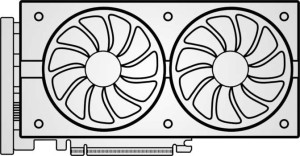
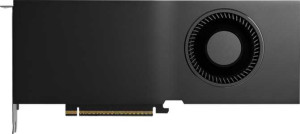
At first glance, the RTX 5080's base clock of 2300 MHz versus the RTX Pro 5000 Blackwell's 1590 MHz might suggest a clear consumer-side advantage — but clock speed alone is a misleading metric when the underlying silicon is significantly different in scale. Both cards reach virtually identical turbo frequencies (~2620 MHz), meaning under sustained load they operate at the same per-core speed. The real story is in the hardware unit counts: the Pro 5000 fields 14,080 shading units, 440 TMUs, and 176 ROPs compared to the 5080's 10,752, 336, and 112 respectively — a roughly 31% wider execution engine across the board.
That wider architecture directly translates into the compute and throughput numbers. The Pro 5000 delivers 73.69 TFLOPS of floating-point performance versus the 5080's 56.34 TFLOPS — about a 31% lead — and its texture and pixel fill rates follow the same margin, reaching 1,151 GTexels/s and 460.6 GPixel/s against the 5080's 880 GTexels/s and 293.4 GPixel/s. In practice, this means the Pro 5000 can push more geometry, resolve more pixels per clock, and handle heavier compute workloads such as 3D rendering, simulation, or AI inference at a meaningfully higher sustained throughput. The 5080 partially offsets this with a slightly faster memory speed of 1875 MHz versus 1750 MHz, which can help in bandwidth-sensitive scenarios, but this advantage is narrow.
Both GPUs support Double Precision Floating Point (DPFP), which is relevant for scientific and professional compute tasks — so neither holds an exclusive edge there. Overall, the RTX Pro 5000 Blackwell holds a clear performance advantage in this group: its substantially larger shader array and resulting lead in TFLOPS, texture rate, and pixel rate make it the more powerful compute engine by a consistent ~30% margin, provided the workload can utilize those extra execution resources.