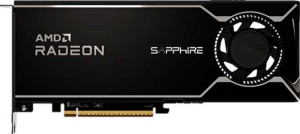
The clock speed story here is more nuanced than a simple comparison. The RTX 5080 starts from a significantly higher base of 2300 MHz versus the R9700's 1660 MHz, meaning sustained, non-peak workloads favor Nvidia's card. However, the Sapphire R9700 flips the script at its turbo ceiling, reaching 2920 MHz against the RTX 5080's 2620 MHz — a meaningful gap that benefits short, burst-heavy compute tasks. The practical takeaway is that the RTX 5080 is the more consistent performer, while the R9700 can spike higher when thermal and power headroom allow.
On raw compute throughput, the RTX 5080 holds a decisive lead. Its 56.34 TFLOPS of floating-point performance and 880 GTexels/s texture rate — backed by a massive 10,752 shading units — translate directly to faster shader-heavy workloads, AI inference pipelines, and geometry-dense rendering. The R9700's 47.8 TFLOPS and 747.5 GTexels/s are competitive but trail meaningfully. Where the R9700 punches back is pixel output: its 128 ROPs versus the RTX 5080's 112, combined with a higher turbo clock, give it a superior 373.8 GPixel/s pixel fill rate against 293.4 GPixel/s — an advantage relevant to high-resolution framebuffer operations and anti-aliasing passes. The R9700 also pairs those ROPs with notably faster memory at 2518 MHz versus 1875 MHz, which helps feed that pixel pipeline efficiently.
Overall, the RTX 5080 holds the broader performance edge for general GPU compute, texturing, and shader-intensive workloads where shading unit count and TFLOPS dominate. The R9700 carves out a real but narrower advantage in pixel throughput and memory bandwidth efficiency, making it relatively stronger in scenarios bottlenecked by ROP output or memory latency. Both support Double Precision Floating Point, so neither has an exclusive edge for DPFP-dependent professional workloads.