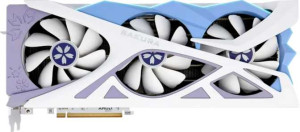
At first glance, the performance picture here is counterintuitive: the RTX 5090 Laptop carries a dramatically larger shader array — 10,496 shading units and 328 TMUs versus the Yeston RX 9070 XT's 4,096 units and 256 TMUs — yet the 9070 XT decisively outscores it across every throughput metric. The reason is clock speed: the 9070 XT boosts to 3060 MHz, more than double the 5090 Laptop's 1515 MHz turbo. Raw compute throughput is the product of unit count and frequency, and the 9070 XT's massive frequency advantage overwhelms the 5090 Laptop's broader execution width, resulting in 50.14 TFLOPS of floating-point performance against 31.8 TFLOPS — a roughly 58% lead.
The gap carries through to rasterization. The 9070 XT's pixel rate of 391.7 GPixel/s and texture rate of 783.4 GTexels/s are approximately double those of the 5090 Laptop, meaning it can push geometry and fill high-resolution frames with considerably more headroom. The shared 128 ROPs on both cards is one area of parity, and both support Double Precision Floating Point, relevant for compute workloads like simulations or scientific tasks. The 9070 XT also edges ahead in memory bus speed at 2518 MHz versus 2000 MHz, which reduces a potential bottleneck when feeding its shaders.
The 5090 Laptop's lower clocks are a direct consequence of laptop thermal and power constraints — its large shader count is engineered to compensate under a tight TDP envelope, but based strictly on these specs, it cannot match the desktop 9070 XT's raw output. The Yeston RX 9070 XT holds a clear performance advantage in this group across compute throughput, pixel fill rate, texture throughput, and memory speed, making it the stronger performer for demanding rendering and compute tasks by a significant margin.