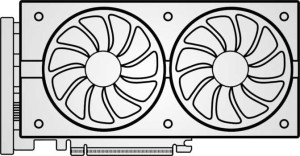
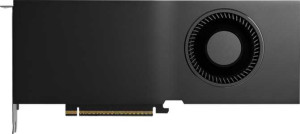
At the heart of this comparison is a tale of two different architectural priorities. The RTX 5090 fields a significantly larger shader array — 21,760 shading units and 680 TMUs versus 14,080 units and 440 TMUs on the RTX Pro 5000 Blackwell — which directly translates into its dominant 104.9 TFLOPS of floating-point performance, a 42% lead over the Pro 5000's 73.69 TFLOPS. In practice, this gap is most felt in workloads that are heavily shader-bound: real-time ray tracing, AI-accelerated rendering, and large-scale simulations. The RTX 5090 also pulls ahead in texture throughput (1,638.8 GTexels/s vs 1,151 GTexels/s), meaning it can handle more complex, high-resolution texturing pipelines without becoming a bottleneck.
The RTX Pro 5000 Blackwell pushes back in a few specific areas. Its GPU turbo clock of 2,617 MHz actually exceeds the RTX 5090's 2,410 MHz peak, and that higher boost frequency contributes to a slightly better pixel fill rate of 460.6 GPixel/s compared to 424.2 GPixel/s — a counterintuitive edge despite having fewer ROPs (both share 176 ROPs). This suggests the Pro 5000 is tuned to sustain higher per-clock efficiency at its boost state, which can benefit display-output-heavy or rasterization-focused professional workloads. Both cards share identical GPU memory speed of 1,750 MHz and both support Double Precision Floating Point (DPFP), keeping them on equal footing for scientific or professional compute tasks that depend on FP64 accuracy.
Overall, the RTX 5090 holds a clear performance advantage for the majority of GPU-intensive use cases, driven by its substantially larger compute engine and superior throughput metrics. The RTX Pro 5000 Blackwell's higher turbo clock and slight pixel rate edge are real, but they do not offset the raw compute deficit — they merely narrow the gap in specific rasterization scenarios. Users prioritizing maximum throughput in rendering, AI, or general-purpose GPU compute should favor the RTX 5090; the Pro 5000 is better positioned as a workstation card where burst clock speed and professional tuning matter more than peak TFLOP counts.