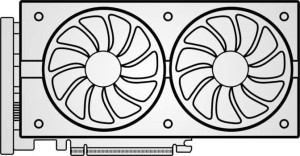
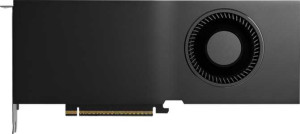
At first glance, the RTX Pro 4000 and RTX Pro 5000 Blackwell appear deceptively similar: both share an identical base clock of 1590 MHz, the same turbo ceiling of 2617 MHz, and the same memory speed of 1750 MHz. This means the performance gap between them is not driven by how fast each chip runs, but by how much raw silicon is doing the work — a crucial distinction for workstation buyers.
The 5000 pulls decisively ahead once you look at shader and rasterization resources. With 14,080 shading units versus the 4000's 8,960, and 440 TMUs against 280, the 5000 packs roughly 57% more compute and texturing muscle. This directly translates into its 73.69 TFLOPS of floating-point throughput versus 46.9 TFLOPS — a gap that matters enormously in GPU-accelerated rendering, simulation, and AI inference workloads. Equally telling is the render output advantage: 176 ROPs on the 5000 versus 96 on the 4000, yielding a pixel rate of 460.6 GPixel/s compared to 251.2 GPixel/s — nearly double. In practice, this means the 5000 can resolve and output complex, high-resolution frames substantially faster, reducing bottlenecks in viewport rendering and post-processing pipelines.
Both cards include Double Precision Floating Point (DPFP) support, which is essential for scientific computing and engineering simulation — so neither has an edge there. Overall, the RTX Pro 5000 Blackwell holds a commanding performance advantage across every compute and rasterization metric in this group, making it the clear choice for demanding professional workloads. The 4000 is not weak, but it is definitively the lesser performer of the two at every measurable level.