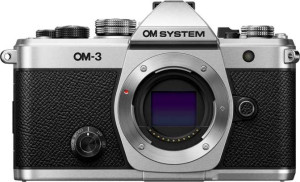
OM System OM-3
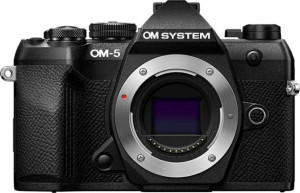
OM System OM-5 Mark II

OM System OM-3 OM System OM-5 Mark II

Overview

Welcome to our in-depth spec comparison between the OM System OM-3 and the OM System OM-5 Mark II — two Micro Four Thirds mirrorless cameras that share a strong foundation yet diverge in meaningful ways. Both cameras offer weather-sealed bodies, flip-out touchscreens, and raw shooting support, but key battlegrounds including autofocus performance, battery life, video capabilities, and connectivity set them apart. Read on to find out which camera best fits your shooting style.

Common Features

  • Both cameras are mirrorless type.
  • Both cameras feature an electronic viewfinder (EVF) with 100% coverage.
  • Both cameras are weather-sealed (splashproof).
  • Both cameras have a flip-out screen sized at 3″.
  • Both cameras have a touchscreen.
  • Both cameras have a hot shoe.
  • Both cameras use a Micro Four Thirds sensor size and lens mount.
  • Both cameras offer 20.4 MP resolution on the main camera.
  • Both cameras have sensor shift image stabilization.
  • Both cameras support AF tracking and touch autofocus.
  • Both cameras have a fastest shutter speed of 0.000125 s.
  • Both cameras support manual focus.
  • Both cameras have continuous autofocus when recording movies.
  • Both cameras include a microphone input, a stereo microphone, and two microphones.
  • Both cameras support a 24p cinema mode and have a timelapse function.
  • Both cameras have a removable, rechargeable battery with a battery level indicator.
  • Both cameras support Wi-Fi, Bluetooth, pixel shift shooting, and raw shooting.
  • Both cameras support remote smartphone control and have an HDMI output.
  • Neither camera has dual card slots.
  • Neither camera has GPS.

Main Differences

  • Screen resolution is 1620k dots on OM System OM-3 and 1037k dots on OM System OM-5 Mark II.
  • Weight is 496 g on OM System OM-3 and 418 g on OM System OM-5 Mark II.
  • Volume is 567.18 cm³ on OM System OM-3 and 555.13 cm³ on OM System OM-5 Mark II.
  • Width is 139.3 mm on OM System OM-3 and 125.3 mm on OM System OM-5 Mark II.
  • Height is 88.9 mm on OM System OM-3 and 85.2 mm on OM System OM-5 Mark II.
  • Thickness is 45.8 mm on OM System OM-3 and 52 mm on OM System OM-5 Mark II.
  • Focus points total 1053 on OM System OM-3 and 121 on OM System OM-5 Mark II.
  • Maximum ISO is 25600 on OM System OM-3 and 6400 on OM System OM-5 Mark II.
  • Maximum expanded ISO is 102400 on OM System OM-3 and 25600 on OM System OM-5 Mark II.
  • Continuous shooting speed (mechanical) is 6 fps on OM System OM-3 and 10 fps on OM System OM-5 Mark II.
  • A CMOS sensor is present on OM System OM-3 but not on OM System OM-5 Mark II.
  • Image stabilization rating (CIPA) is 6.5 stops on OM System OM-3 and 7.5 stops on OM System OM-5 Mark II.
  • Maximum video recording is 2160 x 60 fps on OM System OM-3 and 2160 x 30 fps on OM System OM-5 Mark II.
  • A 3.5 mm audio jack socket is present on OM System OM-3 but not available on OM System OM-5 Mark II.
  • Battery life (CIPA) is 590 shots on OM System OM-3 and 310 shots on OM System OM-5 Mark II.
  • Battery power is 2280 mAh on OM System OM-3 and 1210 mAh on OM System OM-5 Mark II.
  • The processor is TruePic X on OM System OM-3 and TruePic IX on OM System OM-5 Mark II.
  • Wi-Fi version supports both Wi-Fi 5 (802.11ac) and Wi-Fi 4 (802.11n) on OM System OM-3, while OM System OM-5 Mark II supports only Wi-Fi 4 (802.11n).
  • Bluetooth version is 5.2 on OM System OM-3 and 4.2 on OM System OM-5 Mark II.
Specs Comparison
OM System OM-3

OM System OM-3

OM System OM-5 Mark II

OM System OM-5 Mark II

Design:
Type Mirrorless Mirrorless
viewfinder Electronic viewfinder (EVF) Electronic viewfinder (EVF)
is weather-sealed (splashproof)
screen resolution 1620k dots 1037k dots
Has a flip-out screen
viewfinder coverage 100% 100%
screen size 3" 3"
weight 496 g 418 g
has a touch screen
Has a hot shoe
volume 567.176666 cm³ 555.12912 cm³
is a system camera
has a flash
lowest potential operating temperature -10 °C -10 °C
maximum operating temperature 40 °C 40 °C
Has a tilting viewfinder
width 139.3 mm 125.3 mm
height 88.9 mm 85.2 mm
thickness 45.8 mm 52 mm

Both the OM System OM-3 and OM-5 Mark II share the same fundamental design philosophy: mirrorless bodies with a fully articulating flip-out screen, electronic viewfinder with 100% coverage, touchscreen, hot shoe, and robust weather sealing down to -10 °C. Neither includes a built-in flash, and both qualify as full system cameras. For users who prioritize these core features, neither camera will feel like a compromise.

Where the two diverge meaningfully is in size, weight, and screen quality. The OM-3 is noticeably larger — 139.3 × 88.9 × 45.8 mm versus the OM-5 II's 125.3 × 85.2 × 52 mm — giving it a wider, flatter profile while the OM-5 II is more compact but slightly chunkier in depth. More importantly, the OM-3 is 78 g heavier (496 g vs 418 g), a difference that becomes tangible on long shooting days or when traveling light. The OM-5 II's smaller footprint and lower weight give it a real ergonomic edge for portability. On the flip side, the OM-3 offers a considerably sharper rear display at 1620k dots compared to the OM-5 II's 1037k dots — that roughly 56% resolution advantage translates to crisper image review, more precise manual focus confirmation, and a generally more refined live-view experience.

In terms of design, the edge depends on priorities: the OM-5 Mark II wins on portability and compactness, making it the better travel companion, while the OM-3 counters with a significantly superior rear screen, which matters most to photographers who rely heavily on live view or post-shot review in the field. Neither camera has a clear overall design victory — it comes down to whether you value a lighter, more pocketable body or a higher-fidelity display.

Optics:
sensor size Micro Four Thirds Micro Four Thirds
lens mount Micro Four Thirds Micro Four Thirds
focus points 1053 121
megapixels (main camera) 20.4 MP 20.4 MP
maximum ISO 25600 ISO 6400 ISO
maximum expanded ISO 102400 ISO 25600 ISO
has sensor shift stabilization
continuous shooting (mechanical) 6 fps 10 fps
has AF tracking
fastest shutter speed 0.000125 s 0.000125 s
has manual focus
has touch autofocus
has manual shutter speed
has a built-in HDR mode
has a BSI sensor
has manual exposure
has a two-stage shutter
has a serial shot mode
has a CMOS sensor
has manual ISO
flash sync speed 0.004 s 0.004 s
has manual white balance
exposure time 60 s 60 s
Maximum electronic shutter speed 3.125E-5 s 3.125E-5 s
image stabilization rating (CIPA) 6.5 stops 7.5 stops
can combine image stabilization

On paper, the OM-3 and OM-5 Mark II share a strong optical foundation: identical 20.4 MP Micro Four Thirds sensors with BSI architecture, the same lens mount, matching fastest shutter speeds, and an equivalent suite of manual controls. For most shooters, this common ground means image quality potential is closely matched straight out of the gate. However, several spec-level differences reveal two cameras tuned for meaningfully different use cases.

The autofocus system is where the gap is most striking. The OM-3 packs 1053 focus points versus just 121 on the OM-5 II — a nearly 9× advantage that translates directly into more precise subject tracking, better coverage across the frame, and greater reliability when shooting fast or erratically moving subjects. Compounding this, the OM-3 uses a CMOS sensor while the OM-5 II does not, which generally contributes to faster readout speeds and more capable AF performance. The OM-5 II counters with a faster mechanical burst rate of 10 fps versus the OM-3's 6 fps, which is useful for action sequences, though the AF point advantage of the OM-3 arguably matters more for actually keeping a subject in focus during those bursts. On high-ISO sensitivity, the OM-3 again pulls ahead with a native maximum of 25600 ISO (expandable to 102400) compared to the OM-5 II's 6400 ISO native ceiling — a two-stop difference that gives the OM-3 a tangible edge in low-light situations.

The OM-5 II does claim one notable win: its in-body stabilization is rated at 7.5 stops (CIPA) versus the OM-3's 6.5 stops, and both support combined stabilization with compatible lenses. That extra stop of IS is a genuine advantage for handheld slow-shutter or telephoto work. Overall though, the OM-3 holds the broader optics edge — its vastly superior autofocus system, higher ISO range, and CMOS sensor make it the more versatile performer, while the OM-5 II's stronger stabilization appeals specifically to photographers prioritizing steady handheld shooting over focusing precision and low-light reach.

Videography:
video recording (main camera) 2160 x 60 fps 2160 x 30 fps
has continuous autofocus when recording movies
has a microphone input
has a socket for a 3.5 mm audio jack
has a stereo microphone
Has timelapse function
number of microphones 2 2
has a 24p cinema mode

For video, both cameras record 4K (2160p) footage, support continuous autofocus during recording, include a built-in stereo dual-microphone setup, timelapse, and a 24p cinema mode. That shared baseline is solid for a camera in this class. The critical divergence, however, lies in two specs that matter significantly to video-focused users.

First, the OM-3 tops out at 4K/60fps while the OM-5 Mark II is capped at 4K/30fps. That extra headroom at 60fps is not just a numbers game — it enables smooth slow-motion footage when downsampled to 30fps, and produces noticeably more fluid motion for fast-moving subjects like sports or wildlife at full resolution. For anyone shooting action video, this is a genuine functional advantage. Second, only the OM-3 includes a 3.5mm audio jack, allowing connection of an external microphone or headphones for monitoring. The OM-5 II omits this entirely, which is a meaningful limitation for videographers who rely on clean, externally sourced audio — a staple requirement for interview work, documentary, or any serious video production.

The verdict here is clear: the OM-3 is the stronger video tool by a meaningful margin. Higher maximum frame rate and the presence of a 3.5mm audio input together make it the more capable and flexible option for videography, while the OM-5 II's video feature set is better suited to casual or incidental recording rather than dedicated video work.

Battery:
Battery life (CIPA) 590 shots 310 shots
has a removable battery
has a rechargeable battery
has a battery level indicator
battery power 2280 mAh 1210 mAh

Battery performance is one of the starkest dividing lines between these two cameras. The OM-3 carries a 2280 mAh battery rated for 590 shots per charge (CIPA), while the OM-5 Mark II runs on a significantly smaller 1210 mAh pack good for just 310 shots. That is nearly double the capacity and nearly double the rated endurance — a gap that translates directly into fewer battery swaps during a full day of shooting and greater confidence on longer trips where charging opportunities may be limited.

To put the numbers in practical terms, 310 shots is a figure that experienced shooters can exhaust within a few hours of active use, particularly when working with live view, continuous autofocus, or frequent playback. At 590 shots, the OM-3 comfortably covers a typical day of photography for most users without needing a spare. Both cameras use removable, rechargeable batteries with a level indicator, so carrying a backup remains an option for either — but the OM-5 II makes that backup essentially a necessity for demanding outings, while the OM-3 treats it as a precaution.

The OM-3 wins this category decisively. Its battery advantage is not marginal — it is the kind of real-world difference that affects how freely and confidently a photographer can shoot, especially in travel, wildlife, or event contexts where stopping to recharge is not practical.

Features:
release date February 2025 June 2025
processor TruePic X TruePic IX
supports Wi-Fi
Has Bluetooth
Has dual card slots
has pixel shift shot
shoots raw
Wi-Fi version Wi-Fi 5 (802.11ac), Wi-Fi 4 (802.11n) Wi-Fi 4 (802.11n)
supports a remote smartphone
has an HDMI output
has GPS
has first-party support for live streaming
has an advanced hot shoe
has NFC
has an external memory slot
Has USB Type-C
Bluetooth version 5.2 4.2

Much of the feature set here is shared territory: both cameras support Wi-Fi, Bluetooth, smartphone remote control, HDMI output, USB Type-C, an external memory slot, pixel shift shooting, and RAW capture. Neither includes GPS, NFC, dual card slots, or first-party live streaming support. For everyday connectivity and workflow needs, users of either camera will find a comparable foundation.

The differences, while fewer, are meaningful. The OM-3 runs on the newer TruePic X processor compared to the OM-5 Mark II's TruePic IX, which in principle reflects a more recent processing pipeline — though the practical impact on day-to-day image output cannot be inferred from the spec alone. More concretely, the OM-3 supports Wi-Fi 5 (802.11ac) in addition to Wi-Fi 4, enabling faster wireless transfer speeds when offloading images to a compatible device — a tangible time-saver when moving large RAW files. The OM-5 II is limited to Wi-Fi 4 (802.11n) only. Similarly, the OM-3's Bluetooth 5.2 versus the OM-5 II's 4.2 brings improved connection stability, lower energy consumption, and better range for remote control and pairing workflows.

Across this feature group, the OM-3 holds a clear if not dramatic edge. Its newer wireless stack — faster Wi-Fi and a more capable Bluetooth version — makes it the more future-ready option for photographers who regularly transfer files wirelessly or use smartphone integration as part of their shooting workflow.
Comparison Summary & Verdict

Both the OM System OM-3 and OM System OM-5 Mark II are well-rounded Micro Four Thirds cameras with weatherproofing, flip-out touchscreens, and solid video features. However, their differences reveal two distinct profiles. The OM System OM-3 stands out with a significantly higher 1053 focus points, a wider ISO range up to 102400, a larger 2280 mAh battery delivering 590 shots per charge, 4K 60fps video recording, and a 3.5 mm audio jack — making it the stronger choice for photographers and videographers who demand flexibility and endurance. The OM System OM-5 Mark II counters with a superior 7.5-stop image stabilization rating, a faster 10 fps continuous shooting speed, a more compact and lighter body, and a newer CIPA-rated stabilization system — appealing to shooters who prioritize handheld stability and portability above all else.

OM System OM-3
Buy OM System OM-3 if...

Buy the OM System OM-3 if you need longer battery life, a wider autofocus coverage with 1053 focus points, a higher ISO ceiling, 4K 60fps video, and a 3.5 mm audio jack for versatile shooting.

OM System OM-5 Mark II
Buy OM System OM-5 Mark II if...

Buy the OM System OM-5 Mark II if you prioritize superior 7.5-stop image stabilization, a lighter and more compact body, and faster 10 fps continuous shooting for handheld and action photography.