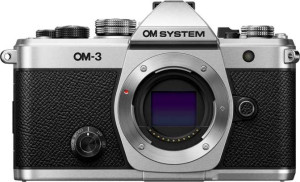
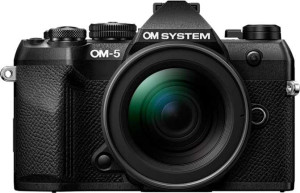
Both cameras share the same Micro Four Thirds sensor size, mount, and 20.4 MP resolution, so the output ceiling is theoretically identical. The divergence begins with autofocus: the OM-3 offers a dramatically higher 1,053 focus points compared to just 121 on the OM-5 Mark II bundle. In practice, more focus points means finer spatial coverage across the frame, enabling more precise subject acquisition — particularly useful for off-center subjects or tracking small, fast-moving details. Both cameras support AF tracking and touch autofocus, but the OM-3's denser AF grid gives it a meaningful real-world edge in focus precision.
On light sensitivity, the OM-3 again pulls ahead with a native maximum ISO of 25,600 versus the OM-5 Mark II's 6,400 — a two-stop advantage that directly translates to cleaner, usable images in low-light environments without relying on expanded (noisier) values. The OM-5 Mark II's expanded ceiling of 25,600 only matches the OM-3's native ceiling, which is a significant gap for available-light photographers. Countering this, the OM-5 Mark II edges ahead in burst speed at 10 fps mechanical versus the OM-3's 6 fps, and its image stabilization rating is stronger at 7.5 stops CIPA compared to 6.5 stops — a full stop more shake compensation that benefits handheld shooting at slow shutter speeds. It's also worth noting the OM-5 Mark II is listed as not having a CMOS sensor, which is an unusual distinction in this class and may reflect a different sensor architecture with its own tradeoffs in readout behavior.
Overall, the OM-3 holds a clear optics-related advantage for photographers who prioritize autofocus coverage and high-ISO performance — the two areas where it outpaces the OM-5 Mark II bundle most decisively. The OM-5 Mark II bundle fights back with faster burst shooting and superior in-body stabilization, making it better suited for action or long-exposure handheld work. Which edge matters more depends squarely on the user's primary shooting scenarios.