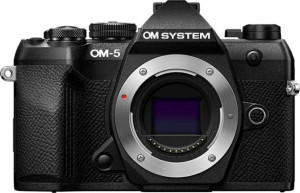
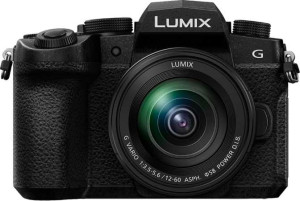
Sharing the same Micro Four Thirds sensor size, lens mount, and near-identical ~20 MP resolution, these two cameras start from a common imaging baseline. However, the similarities quickly give way to meaningful technical gaps. The OM-5 Mark II employs a BSI (back-side illuminated) sensor architecture, which positions the photodetectors closer to incoming light and generally improves sensitivity and dynamic range — an advantage the G97, which uses a conventional front-illuminated CMOS sensor, does not share. This helps explain why the OM-5 II achieves competitive low-light performance despite a lower native maximum ISO of 6400 versus the G97′s native 25600 ISO; both cameras reach the same expanded ceiling of 25600, but the OM-5 II gets there with a more efficient sensor design.
The autofocus gap is also hard to overlook. The OM-5 II offers 121 focus points compared to the G97′s 49, which translates to broader frame coverage and more precise subject acquisition — particularly relevant for tracking moving subjects. Speaking of tracking, both cameras support AF tracking, but the denser focus grid of the OM-5 II gives it a structural edge in reliability. On the shutter side, the OM-5 II reaches 1/8000 s mechanically and 1/32000 s electronically, versus the G97′s 1/4000 s and 1/16000 s respectively — a meaningful difference when shooting in bright light with fast lenses wide open.
Perhaps the single most impactful differentiator in this group is image stabilization: the OM-5 II is rated at 7.5 stops CIPA versus the G97′s 5 stops, and both support combined optical-plus-sensor stabilization. That 2.5-stop gap is substantial in practice, enabling much slower handheld shutter speeds for low-light or telephoto work. The OM-5 II also adds a built-in HDR mode absent from the G97. Taken together, the OM-5 Mark II holds a clear and comprehensive advantage in this group, outperforming the G97 across autofocus density, shutter ceiling, sensor architecture, and — most significantly — image stabilization.