OnePlus Nord CE5
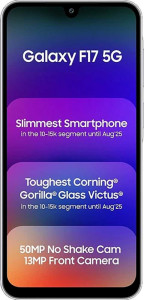
Samsung Galaxy F17

OnePlus Nord CE5 Samsung Galaxy F17

Overview

Welcome to our in-depth comparison of the OnePlus Nord CE5 and the Samsung Galaxy F17 — two competitive mid-range smartphones with distinct strengths worth examining closely. Both devices share a solid foundation: OLED displays, 5G connectivity, Android 15, and fast charging support. Yet they diverge notably when it comes to performance credentials, battery capacity, display refresh rates, and audio codec support. Read on to discover which device aligns best with your priorities.

Common Features

  • Both phones are water resistant.
  • Neither phone has a rugged build.
  • Neither phone can be folded.
  • Both phones feature an OLED/AMOLED display.
  • Always-On Display is available on both phones.
  • Neither phone supports Dolby Vision.
  • Neither phone has a secondary screen.
  • Both phones have a touch screen.
  • Both phones have integrated LTE.
  • Both phones support 64-bit processing.
  • Both phones support DirectX 12.
  • Both phones have integrated graphics.
  • Both phones use big.LITTLE technology.
  • Both phones have an 8-thread CPU.
  • Both phones have an NX bit.
  • Both phones support OpenCL version 2.
  • Both phones have a multi-lens main camera.
  • Both phones have built-in optical image stabilization.
  • Neither phone has a dual-tone LED flash.
  • Both phones have a CMOS sensor.
  • Both phones support continuous autofocus when recording movies.
  • Both phones support phase-detection autofocus for photos.
  • Both phones support slow-motion video recording.
  • Both phones run Android 15.
  • Both phones have clipboard warnings.
  • Both phones have location privacy options.
  • Both phones have camera and microphone privacy options.
  • Neither phone has Mail Privacy Protection.
  • Both phones support theme customization.
  • Both phones can block app tracking.
  • Neither phone blocks cross-site tracking.
  • Neither phone supports wireless charging.
  • Both phones support fast charging.
  • Neither phone has a removable battery.
  • Both phones have a battery level indicator.
  • Both phones have a rechargeable battery.
  • Neither phone has a 3.5 mm audio jack.
  • Neither phone has stereo speakers.
  • Neither phone supports aptX Adaptive.
  • Neither phone supports aptX Lossless.
  • Neither phone has a radio.
  • Both phones support 5G.
  • Both phones have dual SIM card slots.
  • Both phones have an external memory slot.
  • Both phones have a USB Type-C port.
  • Both phones use USB version 2.
  • Both phones have NFC.
  • Both phones have a fingerprint scanner.
  • Neither phone supports emergency SOS via satellite.
  • Both phones have a video light.
  • Neither phone has a sapphire glass display.
  • Neither phone has a curved display.
  • Neither phone has an e-paper display.

Main Differences

  • Weight is 199 g on OnePlus Nord CE5 and 192 g on Samsung Galaxy F17.
  • Thickness is 8.2 mm on OnePlus Nord CE5 and 7.5 mm on Samsung Galaxy F17.
  • Width is 76 mm on OnePlus Nord CE5 and 77.9 mm on Samsung Galaxy F17.
  • Height is 163.6 mm on OnePlus Nord CE5 and 164.4 mm on Samsung Galaxy F17.
  • Volume is 101.96 cm³ on OnePlus Nord CE5 and 96.05 cm³ on Samsung Galaxy F17.
  • IP rating is IP65 on OnePlus Nord CE5 and IP54 on Samsung Galaxy F17.
  • Screen size is 6.77″ on OnePlus Nord CE5 and 6.7″ on Samsung Galaxy F17.
  • Pixel density is 387 ppi on OnePlus Nord CE5 and 385 ppi on Samsung Galaxy F17.
  • Resolution is 1080 x 2392 px on OnePlus Nord CE5 and 1080 x 2340 px on Samsung Galaxy F17.
  • Refresh rate is 120Hz on OnePlus Nord CE5 and 90Hz on Samsung Galaxy F17.
  • Typical brightness is 1300 nits on OnePlus Nord CE5 and 800 nits on Samsung Galaxy F17.
  • Branded damage-resistant glass is present on Samsung Galaxy F17 but not on OnePlus Nord CE5.
  • HDR10 support is available on OnePlus Nord CE5 but not on Samsung Galaxy F17.
  • HDR10+ support is available on OnePlus Nord CE5 but not on Samsung Galaxy F17.
  • Internal storage is 256GB on OnePlus Nord CE5 and 128GB on Samsung Galaxy F17.
  • RAM is 12GB on OnePlus Nord CE5 and 6GB on Samsung Galaxy F17.
  • Chipset is MediaTek Dimensity 8350 on OnePlus Nord CE5 and Samsung Exynos 1330 on Samsung Galaxy F17.
  • GPU is Mali G615 MC6 on OnePlus Nord CE5 and Mali G68 MP2 on Samsung Galaxy F17.
  • CPU speed is 1 x 3.35 & 3 x 3.2 & 4 x 2.2 GHz on OnePlus Nord CE5 and 2 x 2.4 & 6 x 2 GHz on Samsung Galaxy F17.
  • GPU clock speed is 1400 MHz on OnePlus Nord CE5 and 800 MHz on Samsung Galaxy F17.
  • RAM speed is 8533 MHz on OnePlus Nord CE5 and 3200 MHz on Samsung Galaxy F17.
  • Semiconductor size is 4 nm on OnePlus Nord CE5 and 5 nm on Samsung Galaxy F17.
  • Maximum memory bandwidth is 68.2 GB/s on OnePlus Nord CE5 and 51.2 GB/s on Samsung Galaxy F17.
  • Maximum memory amount is 24GB on OnePlus Nord CE5 and 8GB on Samsung Galaxy F17.
  • Main camera megapixels are 50 & 8 MP on OnePlus Nord CE5 and 50 & 5 & 2 MP on Samsung Galaxy F17.
  • Main camera wide aperture is f/2.2 & f/1.8 on OnePlus Nord CE5 and f/1.8, f/2.2 & f/2.4 on Samsung Galaxy F17.
  • Front camera megapixels are 16MP on OnePlus Nord CE5 and 13MP on Samsung Galaxy F17.
  • Main camera video recording is up to 2160p at 60 fps on OnePlus Nord CE5 and up to 1080p at 30 fps on Samsung Galaxy F17.
  • Number of flash LEDs is 2 on OnePlus Nord CE5 and 1 on Samsung Galaxy F17.
  • Front camera wide aperture is f/1 on OnePlus Nord CE5 and f/2 on Samsung Galaxy F17.
  • Battery power is 7100 mAh on OnePlus Nord CE5 and 5000 mAh on Samsung Galaxy F17.
  • Charging speed is 80W on OnePlus Nord CE5 and 25W on Samsung Galaxy F17.
  • aptX support is present on OnePlus Nord CE5 but not available on Samsung Galaxy F17.
  • LDAC support is present on OnePlus Nord CE5 but not available on Samsung Galaxy F17.
  • aptX HD support is present on OnePlus Nord CE5 but not available on Samsung Galaxy F17.
  • Wi-Fi versions supported are Wi-Fi 4, Wi-Fi 5, and Wi-Fi 6 on OnePlus Nord CE5 and Wi-Fi 4 and Wi-Fi 5 on Samsung Galaxy F17.
  • Bluetooth version is 5.4 on OnePlus Nord CE5 and 5.3 on Samsung Galaxy F17.
  • An infrared sensor is present on OnePlus Nord CE5 but not available on Samsung Galaxy F17.
Specs Comparison
OnePlus Nord CE5

OnePlus Nord CE5

Samsung Galaxy F17

Samsung Galaxy F17

Design:
water resistance Water resistant Water resistant
weight 199 g 192 g
thickness 8.2 mm 7.5 mm
width 76 mm 77.9 mm
height 163.6 mm 164.4 mm
volume 101.95552 cm³ 96.0507 cm³
Ingress Protection (IP) rating IP65 IP54
has a rugged build
can be folded

In terms of physical form factor, the Samsung Galaxy F17 has a clear ergonomic edge. At 192 g and 7.5 mm thick, it is noticeably lighter and slimmer than the OnePlus Nord CE5, which weighs 199 g and measures 8.2 mm in thickness. This translates to a smaller overall volume — 96.05 cm³ versus 101.96 cm³ — meaning the F17 will feel more pocket-friendly and less fatiguing during extended one-handed use. The Nord CE5 is marginally narrower at 76 mm versus 77.9 mm, but this small difference does little to offset the F17's overall compactness advantage.

Where the OnePlus Nord CE5 decisively pulls ahead is water and dust resistance. Its IP65 rating means it is fully dust-tight and protected against low-pressure water jets from any direction — a meaningful level of protection for daily real-world scenarios like rain, splashes near sinks, or dusty environments. The Galaxy F17's IP54 rating, by contrast, only guarantees partial dust ingress protection and resistance to water splashing from any direction, offering a noticeably lower safety margin. For users who prioritize durability or work in varied environments, this is a significant practical differentiator.

Neither phone offers a rugged build or a foldable form factor, so those factors are a wash. Overall, the choice comes down to priorities: the Galaxy F17 wins on comfort and portability thanks to its slimmer, lighter chassis, while the Nord CE5 wins on durability with its superior IP65 protection. For most users, the stronger water and dust resistance of the Nord CE5 is likely the more impactful real-world advantage.

Display:
Display type OLED/AMOLED OLED/AMOLED
screen size 6.77" 6.7"
pixel density 387 ppi 385 ppi
resolution 1080 x 2392 px 1080 x 2340 px
refresh rate 120Hz 90Hz
brightness (typical) 1300 nits 800 nits
has branded damage-resistant glass
supports HDR10
supports HDR10+
Always-On Display
supports Dolby Vision
Has a secondary screen
has a touch screen

Both phones share an OLED/AMOLED panel and nearly identical screen sizes — 6.77″ on the Nord CE5 versus 6.7″ on the Galaxy F17 — and pixel density is essentially a tie at 387 ppi and 385 ppi respectively. In practice, neither display will look sharper than the other to the naked eye. Where things diverge meaningfully is in refresh rate and brightness: the Nord CE5 runs at 120Hz compared to the F17's 90Hz, delivering visibly smoother scrolling, animations, and gaming. More strikingly, the Nord CE5 peaks at 1300 nits of typical brightness versus just 800 nits on the F17 — a gap that becomes very noticeable under direct sunlight, where the F17 is likely to struggle with legibility.

The Nord CE5 also supports HDR10+, the dynamic metadata HDR standard that enables scene-by-scene tone mapping for compatible streaming content. The Galaxy F17 supports neither HDR10 nor HDR10+, meaning it will not unlock the enhanced contrast and color depth that HDR-capable platforms like Netflix or YouTube can deliver. This is a tangible content consumption disadvantage. On the other hand, the F17 counters with branded damage-resistant glass — a real-world durability advantage the Nord CE5 lacks, offering meaningful scratch and drop protection for the screen itself.

The verdict here leans clearly toward the OnePlus Nord CE5 for display performance. Its smoother refresh rate, substantially higher brightness, and HDR10+ support make it the stronger choice for media consumption and everyday usability. The Galaxy F17's glass protection is a practical bonus, but it cannot offset the Nord CE5's overall screen quality advantages.

Performance:
internal storage 256GB 128GB
RAM 12GB 6GB
Chipset (SoC) name MediaTek Dimensity 8350 Samsung Exynos 1330
GPU name Mali G615 MC6 Mali G68 MP2
CPU speed 1 x 3.35 & 3 x 3.2 & 4 x 2.2 GHz 2 x 2.4 & 6 x 2 GHz
GPU clock speed 1400 MHz 800 MHz
Has integrated LTE
RAM speed 8533 MHz 3200 MHz
semiconductor size 4 nm 5 nm
Supports 64-bit
DirectX version DirectX 12 DirectX 12
Has integrated graphics
Uses big.LITTLE technology
CPU threads 8 threads 8 threads
Has NX bit
maximum memory bandwidth 68.2 GB/s 51.2 GB/s
OpenCL version 2 2
maximum memory amount 24GB 8GB
DDR memory version 5 5

The performance gap between these two phones is substantial and runs across nearly every dimension. The Nord CE5 is powered by the MediaTek Dimensity 8350, built on a 4 nm process, while the Galaxy F17 uses the Samsung Exynos 1330 on a 5 nm node. The smaller fabrication process on the Nord CE5 translates to greater power efficiency and headroom for higher sustained performance — meaningful advantages for demanding tasks and thermal management over long sessions.

The raw hardware figures reinforce this gap considerably. The Nord CE5 ships with 12 GB of RAM running at 8533 MHz and a GPU clocked at 1400 MHz, against the F17's 6 GB of RAM at 3200 MHz and a GPU at just 800 MHz. In practice, the Nord CE5's faster RAM reduces bottlenecks when multitasking or loading large assets, and the GPU advantage is significant enough to affect gaming frame rates and graphical fidelity. Memory bandwidth further underscores this — 68.2 GB/s versus 51.2 GB/s on the F17 — meaning data moves between the processor and memory considerably faster on the Nord CE5. Storage is also doubled, with 256 GB on the Nord CE5 compared to 128 GB on the F17.

This is one of the most one-sided categories in this comparison. The OnePlus Nord CE5 holds a clear and decisive performance advantage across chipset efficiency, RAM capacity and speed, GPU power, memory bandwidth, and onboard storage. For users who multitask heavily, game, or simply want a phone that stays responsive over its lifespan, the Nord CE5 is the stronger choice by a wide margin.

Cameras:
megapixels (main camera) 50 & 8 MP 50 & 5 & 2 MP
wide aperture (main camera) 2.2 & 1.8f 1.8 & 2.2 & 2.4f
Has a dual-lens (or multi-lens) main camera
megapixels (front camera) 16MP 13MP
has built-in optical image stabilization
video recording (main camera) 2160 x 60 fps 1080 x 30 fps
Has a dual-tone LED flash
number of flash LEDs 2 1
has a BSI sensor
has a CMOS sensor
has continuous autofocus when recording movies
Has phase-detection autofocus for photos
supports slow-motion video recording
has a built-in HDR mode
has manual exposure
has a flash
optical zoom 0x 0x
has manual ISO
has a serial shot mode
has manual focus
has a front camera
Has laser autofocus
Shoots 360° panorama
has manual white balance
shoots raw
has touch autofocus
has manual shutter speed
can create panoramas in-camera
wide aperture (front camera) 1f 2f
Has timelapse function
Has a front-facing LED flash
has a dual-lens (or multi-lens) front camera
supports HDR10 recording
supports Dolby Vision recording
has a front-facing camera under the display
Has a RGB LED flash
has 3D photo/video recording capabilities

Both phones anchor their rear systems with a 50 MP primary sensor at f/1.8, so the starting point is the same. The Galaxy F17 expands to a triple-camera setup, adding a 5 MP ultrawide and a 2 MP depth sensor, while the Nord CE5 stays with a dual system but pairs its main lens with a more capable 8 MP ultrawide. In real-world use, the F17's ultrawide captures noticeably less detail than the Nord CE5's, and the 2 MP depth sensor is a largely nominal addition — it contributes to portrait mode processing but offers little standalone utility. The Nord CE5's two-lens approach is arguably more practical than the F17's three-lens arrangement.

The sharpest differentiator in this category, however, is video capability. The Nord CE5 records at up to 4K at 60 fps, while the Galaxy F17 tops out at 1080p at 30 fps — a two-generation gap in video quality that matters enormously for anyone who uses their phone to capture events, travel footage, or content. 4K at 60 fps produces far smoother, higher-resolution footage that holds up much better when cropped or viewed on larger screens. On the selfie side, the Nord CE5's 16 MP front camera at a very wide f/1.0 aperture outpaces the F17's 13 MP shooter at f/2.0, meaning the Nord CE5 will capture significantly more light in low-light selfie scenarios.

The OnePlus Nord CE5 takes a clear overall win in this category. Its video recording advantage alone is decisive, and it also leads on front camera specs and ultrawide resolution. The Galaxy F17's triple-camera count sounds appealing on paper, but the underlying hardware tells a different story.

Operating system:
Android version Android 15 Android 15
has clipboard warnings
has location privacy options
has camera/microphone privacy options
has Mail Privacy Protection
has theme customization
can block app tracking
blocks cross-site tracking
has on-device machine learning
has notification permissions
has media picker
Can play games while they download
has dark mode
has Wi-Fi password sharing
has battery health check
has an extra dim mode
has focus modes
has dynamic theming
can offload apps
Has customizable notifications
has Live Text
has full-page screenshots
supports split screen
gets direct OS updates
has PiP
Can be used as a PC
Has sharing intents
has a child lock
Supports widgets
Is free and open source
Has offline voice recognition
has voice commands
Tracks the current position of a mobile device
is a multi-user system
has Quick Start

This is a rare category where the data tells a straightforward story: the OnePlus Nord CE5 and Samsung Galaxy F17 are a complete tie. Every single spec in this group is identical — both ship with Android 15, and both support the same full set of privacy controls, productivity features, and customization options. This includes on-device machine learning, dynamic theming, split-screen multitasking, Picture-in-Picture, customizable notifications, and Live Text, among others.

From a privacy standpoint, users of either phone get the same protections: location and camera/microphone permission controls, clipboard warnings, and app tracking blocks are all present on both. Neither phone offers cross-site tracking protection or direct OS updates — meaning both will rely on their respective manufacturers for Android patches rather than receiving them straight from Google. That is a shared limitation worth noting, particularly for security-conscious users.

With no differentiating data points anywhere in this group, the verdict is a dead heat. The software experience, at least as defined by these specifications, gives neither device an advantage over the other.

Battery:
battery power 7100 mAh 5000 mAh
has wireless charging
Supports fast charging
charging speed 80W 25W
has a removable battery
has a battery level indicator
has a rechargeable battery

Few categories in this comparison are as lopsided as battery. The Nord CE5 packs a 7100 mAh cell — a genuinely large capacity that sits well above the mainstream — while the Galaxy F17 carries a more conventional 5000 mAh battery. That 42% capacity advantage translates directly to real-world endurance: users who consume a lot of media, navigate frequently, or simply forget to charge can expect the Nord CE5 to last considerably longer between top-ups. For heavy users, the difference could mean finishing a second full day versus reaching for a charger by evening.

Charging speed compounds this advantage further. The Nord CE5 supports 80W fast charging versus 25W on the Galaxy F17. Not only does the Nord CE5 start with more energy to replenish, it refills that larger tank dramatically faster. In practical terms, a short charging window — say, during a commute or a lunch break — will restore far more capacity on the Nord CE5 than on the F17. Neither phone supports wireless charging, so that feature is a non-factor for both.

The OnePlus Nord CE5 wins this category decisively and it is not particularly close. A significantly larger battery combined with more than triple the charging speed makes it the clear choice for anyone who prioritizes battery life and charging convenience.

Audio:
has a socket for a 3.5 mm audio jack
has stereo speakers
has aptX
has LDAC
has aptX HD
has aptX Adaptive
has aptX Lossless
Has a radio

Audio is a category where shared limitations define the baseline for both phones — no 3.5 mm headphone jack, no stereo speakers, and no radio — but one product pulls meaningfully ahead on wireless audio quality. The Nord CE5 supports aptX, aptX HD, and LDAC, while the Galaxy F17 supports none of these codecs. For casual listeners this may not register, but for anyone using quality Bluetooth headphones or earbuds, the difference is tangible.

These codecs matter because standard Bluetooth audio compresses music significantly. LDAC, developed by Sony, transmits up to three times the data of standard SBC, enabling near-lossless wireless audio quality when paired with a compatible device. aptX HD similarly targets high-resolution audio streaming with reduced compression. The Galaxy F17's absence of any high-quality audio codec means it will default to the more compressed SBC or AAC standards regardless of how premium the paired headphones are — effectively leaving audio quality on the table.

The OnePlus Nord CE5 is the clear winner here. Its codec support is a meaningful advantage for anyone who prioritizes audio fidelity over Bluetooth, and the Galaxy F17 offers no compensating audio feature to offset this gap.

Connectivity & Features:
release date July 2025 September 2025
has 5G support
Wi-Fi version Wi-Fi 4 (802.11n), Wi-Fi 6 (802.11ax), Wi-Fi 5 (802.11ac) Wi-Fi 4 (802.11n), Wi-Fi 5 (802.11ac)
SIM cards 2 SIM 2 SIM
Bluetooth version 5.4 5.3
has an external memory slot
Has USB Type-C
USB version 2 2
has NFC
Has a fingerprint scanner
has emergency SOS via satellite
has crash detection
is DLNA-certified
has a gyroscope
supports ANT+
Has a heart rate monitor
has GPS
has a compass
supports Wi-Fi
Has an infrared sensor
has an accelerometer
has a cellular module
Has a barometer
has an HDMI output
Uses 3D facial recognition
Has an iris scanner
Stylus included
supports Galileo
Has motion tracking
Has optical tracking
Has a built-in projector

The connectivity foundations of these two phones are broadly similar — both support 5G, dual SIM, NFC, USB Type-C, expandable storage, and GPS with Galileo. For most users, these shared features will cover all everyday connectivity needs. The differences, while not numerous, are meaningful enough to give the Nord CE5 a consistent edge across multiple dimensions.

On wireless networking, the Nord CE5 supports Wi-Fi 6 (802.11ax) in addition to Wi-Fi 4 and 5, whereas the Galaxy F17 tops out at Wi-Fi 5. Wi-Fi 6 delivers faster throughput, lower latency, and better performance in congested environments — a genuine upgrade for users on modern routers in busy households or offices. The Nord CE5 also carries a slightly newer Bluetooth 5.4 versus the F17's 5.3, offering incremental improvements in connection reliability and efficiency. Additionally, the Nord CE5 includes an infrared sensor — a feature absent on the F17 — which allows it to function as a universal remote for TVs and other appliances, a small but practical convenience that some users actively seek out.

Neither phone stands out for exotic features — no satellite SOS, no crash detection, no barometer on either side. But taken together, the Nord CE5's Wi-Fi 6 support, newer Bluetooth version, and infrared blaster give it a clear and consistent connectivity advantage over the Galaxy F17, even if the margin in any single spec is modest.

Miscellaneous:
has a video light
Has sapphire glass display
Has a curved display
Has an e-paper display

The Miscellaneous category offers very little to distinguish these two phones — every spec listed here is identical. Both have a video light, and neither features a sapphire glass display, a curved display, or an e-paper display. With no differentiating data points anywhere in this group, the only honest verdict is a complete tie.

Comparison Summary & Verdict

After weighing all the evidence, these two phones serve noticeably different audiences. The OnePlus Nord CE5 stands out as the more powerful and feature-rich option, packing a 7100 mAh battery with 80W fast charging, a smoother 120Hz display with HDR10+ and 1300 nits of brightness, the more capable MediaTek Dimensity 8350 chipset with 12GB of RAM, superior audio codec support including LDAC and aptX HD, Wi-Fi 6 compatibility, and a higher IP65 rating. It is the clear pick for power users and multimedia enthusiasts. The Samsung Galaxy F17, on the other hand, offers a lighter and slimmer build, a damage-resistant glass display, and a more compact package — making it a sensible choice for users who prioritize everyday durability, comfortable handling, and a no-frills Samsung experience over raw performance metrics.

OnePlus Nord CE5
Buy OnePlus Nord CE5 if...

Buy the OnePlus Nord CE5 if you want top-tier performance, a massive 7100 mAh battery with 80W fast charging, a brighter 120Hz HDR10+ display, and superior audio codec support including LDAC and aptX HD.

Samsung Galaxy F17
Buy Samsung Galaxy F17 if...

Buy the Samsung Galaxy F17 if you prefer a lighter, slimmer phone with damage-resistant glass and a straightforward Samsung experience at a more modest performance level.