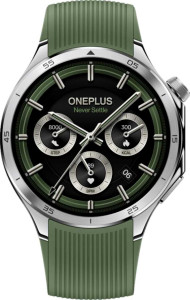
OnePlus Watch 3
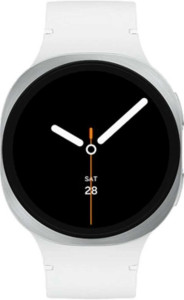
Samsung Galaxy Watch8 LTE 40mm

OnePlus Watch 3 Samsung Galaxy Watch8 LTE 40mm

Overview

Welcome to our in-depth spec comparison between the OnePlus Watch 3 and the Samsung Galaxy Watch8 LTE 40mm. These two smartwatches share a strong foundation of health and fitness tracking features, yet they diverge sharply when it comes to battery life, design size, and connectivity. Whether you prioritize endurance on the wrist or a slim, feature-rich companion with cellular independence, this comparison will help you find the right fit for your lifestyle.

Common Features

  • Both watches feature an OLED/AMOLED display type.
  • Both watches are water resistant with a 5 ATM rating and IP68 ingress protection up to 50 m.
  • Always-On Display is available on both watches.
  • The watch band is replaceable on both watches.
  • Neither watch features branded damage-resistant glass.
  • Both watches monitor blood oxygenation levels.
  • Both watches include a heart rate monitor.
  • Both watches have GPS, an accelerometer, a temperature sensor, a compass, a barometer, and a gyroscope.
  • Both watches track sleep, distance, steps taken, pace, and elevation.
  • Both watches provide sleep reports and detect activities automatically.
  • Both watches include a route tracker.
  • Neither watch is compatible with iOS, while both are compatible with Android.
  • Both watches support Wi-Fi 4 (802.11n) and NFC.
  • Galileo satellite support is available on both watches.
  • Neither watch supports ANT+.
  • Both watches have a rechargeable battery with no solar power or removable battery option.
  • HRV tracking, VO2 max measurement, resting heart rate measurement, and fast/slow heart rate notifications are available on both watches.
  • Both watches can be used to answer calls, locate your phone, and provide call control.
  • Both watches show readiness level.
  • Both watches provide activity reports, inactivity alerts, calorie tracking, goal setting, achievements, an exercise diary, and are ad-free with a free app.
  • Both watches have a battery level indicator and passcode support.
  • Neither watch is compatible with Windows or Mac OS X, has an external memory slot, or includes a 3.5 mm audio jack socket.

Main Differences

  • Screen size is 1.5″ on the OnePlus Watch 3 and 1.34″ on the Samsung Galaxy Watch8 LTE 40mm.
  • Pixel density is 439 ppi on the OnePlus Watch 3 and 327 ppi on the Samsung Galaxy Watch8 LTE 40mm.
  • Resolution is 466 x 466 px on the OnePlus Watch 3 and 438 x 438 px on the Samsung Galaxy Watch8 LTE 40mm.
  • Thickness is 11.8 mm on the OnePlus Watch 3 and 8.6 mm on the Samsung Galaxy Watch8 LTE 40mm.
  • Weight is 81 g on the OnePlus Watch 3 and 30 g on the Samsung Galaxy Watch8 LTE 40mm.
  • Height is 47.6 mm on the OnePlus Watch 3 and 42.7 mm on the Samsung Galaxy Watch8 LTE 40mm.
  • Width is 46.6 mm on the OnePlus Watch 3 and 40.4 mm on the Samsung Galaxy Watch8 LTE 40mm.
  • Band width is 22 mm on the OnePlus Watch 3 and 20 mm on the Samsung Galaxy Watch8 LTE 40mm.
  • Maximum operating temperature is 70 °C on the OnePlus Watch 3 and 35 °C on the Samsung Galaxy Watch8 LTE 40mm.
  • Lowest potential operating temperature is -40 °C on the OnePlus Watch 3 and 0 °C on the Samsung Galaxy Watch8 LTE 40mm.
  • Volume is 26.174288 cm³ on the OnePlus Watch 3 and 14.835688 cm³ on the Samsung Galaxy Watch8 LTE 40mm.
  • A cadence sensor is present on the OnePlus Watch 3 but not available on the Samsung Galaxy Watch8 LTE 40mm.
  • Cellular module support is present on the Samsung Galaxy Watch8 LTE 40mm but not available on the OnePlus Watch 3.
  • Bluetooth version is 5.2 on the OnePlus Watch 3 and 5.3 on the Samsung Galaxy Watch8 LTE 40mm.
  • Battery life is 5 days on the OnePlus Watch 3 and 2 days on the Samsung Galaxy Watch8 LTE 40mm.
  • Battery power is 631 mAh on the OnePlus Watch 3 and 325 mAh on the Samsung Galaxy Watch8 LTE 40mm.
  • Wireless charging is present on the Samsung Galaxy Watch8 LTE 40mm but not available on the OnePlus Watch 3.
  • Irregular heart rate warnings are present on the Samsung Galaxy Watch8 LTE 40mm but not available on the OnePlus Watch 3.
  • ECG technology is present on the Samsung Galaxy Watch8 LTE 40mm but not available on the OnePlus Watch 3.
  • Coaching is available on the Samsung Galaxy Watch8 LTE 40mm but not on the OnePlus Watch 3.
  • Period notifications are available on the Samsung Galaxy Watch8 LTE 40mm but not on the OnePlus Watch 3.
  • Route support is available on the Samsung Galaxy Watch8 LTE 40mm but not on the OnePlus Watch 3.
Specs Comparison
OnePlus Watch 3

OnePlus Watch 3

Samsung Galaxy Watch8 LTE 40mm

Samsung Galaxy Watch8 LTE 40mm

Design:
screen size 1.5" 1.34"
Display type OLED/AMOLED OLED/AMOLED
water resistance Water resistant Water resistant
ATM rating 5 ATM 5 ATM
Ingress Protection (IP) rating IP68 IP68
waterproof depth rating 50 m 50 m
Always-On Display
pixel density 439 ppi 327 ppi
resolution 466 x 466 px 438 x 438 px
Watch band is replaceable
has branded damage-resistant glass
thickness 11.8 mm 8.6 mm
weight 81 g 30 g
height 47.6 mm 42.7 mm
width 46.6 mm 40.4 mm
maximum operating temperature 70 °C 35 °C
lowest potential operating temperature -40 °C 0 °C
Has a display
has a touch screen
Has sapphire glass display
volume 26.174288 cm³ 14.835688 cm³
is designed for kids
width of band 22 mm 20 mm

Both watches share a strong design foundation: OLED/AMOLED panels, sapphire glass, always-on display support, IP68/5 ATM water resistance rated to 50 m, and replaceable bands. These shared traits mean neither watch compromises on display quality or durability at a fundamental level. Where they diverge sharply, however, is in physical form factor and visual sharpness.

The OnePlus Watch 3 is a noticeably larger and heavier device: at 81 g and 11.8 mm thick, with a 1.5″ screen at 439 ppi, it prioritizes screen real estate and visual detail. The Galaxy Watch8 40mm, by contrast, weighs just 30 g and measures only 8.6 mm thick — less than half the weight and significantly slimmer. In practice, that 51 g difference is substantial during all-day and overnight wear; the Samsung will feel almost invisible on the wrist, while the OnePlus has a more prominent, tool-watch presence. The OnePlus's higher pixel density (439 ppi vs 327 ppi) does translate to a crisper display, but both are well above the threshold where sharpness becomes difficult to distinguish in daily use.

One often-overlooked differentiator is the operating temperature range: the OnePlus Watch 3 is rated from -40 °C to 70 °C, versus a much narrower 0 °C to 35 °C for the Galaxy Watch8 — a meaningful edge for users in extreme climates or demanding outdoor environments. Overall, the Samsung Galaxy Watch8 40mm has a clear advantage for wearers who prioritize comfort and discretion, while the OnePlus Watch 3 suits those who want a larger, sharper display and broader environmental resilience.

Sensors:
Monitors blood oxygenation levels
Has a heart rate monitor
has GPS
has an accelerometer
Has a temperature sensor
has a compass
Has a barometer
has a gyroscope
Has a cadence sensor
Monitors perspiration

The sensor packages on these two watches are remarkably aligned. Both cover the core health and navigation suite: heart rate monitoring, SpO2 (blood oxygen), GPS, accelerometer, gyroscope, barometer, compass, and temperature sensor. For the vast majority of users — whether tracking daily wellness metrics or logging outdoor workouts — either watch delivers a complete and capable sensor array without meaningful compromise.

The single differentiator here is the cadence sensor, present on the OnePlus Watch 3 but absent on the Galaxy Watch8 40mm. Cadence — the measure of steps or pedal strokes per minute — is particularly valuable for runners optimizing their stride efficiency and cyclists monitoring pedaling rhythm. It is a niche but genuine advantage for performance-focused athletes, and one that cannot be offset by software alone if the hardware is not present.

On the whole, this category is nearly a dead heat, but the OnePlus Watch 3 earns a narrow edge strictly on the basis of its cadence sensor. For casual and general fitness users the difference is largely academic; for dedicated runners or cyclists, however, it is a tangible, real-world advantage that the Galaxy Watch8 40mm simply does not match.

Activity tracking:
Tracks your sleep
Tracks distance
Tracks steps taken
Measures pace
Provides sleep reports
Detects activities automatically
Has a route tracker
Tracks elevation
Has multi-sport mode
Has exercise tagging
Tracks calorie intake
Designed for golf

Activity tracking is one area where choosing between these two watches becomes straightforward — because the data shows a perfect tie. Every feature in this category is shared identically: both track sleep, steps, distance, pace, and elevation, both provide sleep reports, auto-detect activities, include a route tracker, support exercise tagging, and track calorie intake. Neither is designed for golf, and neither offers a dedicated multi-sport mode.

The absence of multi-sport mode is worth noting for competitive or variety athletes who switch frequently between disciplines and expect seamless, sport-specific transitions without manual intervention. That said, since both watches share this limitation equally, it does not factor into any relative advantage — it is simply a shared ceiling on what this spec group covers for both devices.

Based strictly on the provided activity tracking specs, this category is a complete tie. Neither the OnePlus Watch 3 nor the Galaxy Watch8 40mm holds any advantage here; a decision between the two must rest entirely on other specification groups.

Connectivity:
has a cellular module
Is compatible with iOS
Is compatible with Android
Bluetooth version 5.2 5.3
supports Wi-Fi
Wi-Fi version Wi-Fi 4 (802.11n) Wi-Fi 4 (802.11n)
supports ANT+
has NFC
supports Galileo

Much of the connectivity foundation is shared between these two watches: both support Wi-Fi 4 (802.11n), NFC for contactless payments, Galileo satellite navigation, and are limited to Android compatibility only — a hard constraint for anyone in the Apple ecosystem. Neither supports ANT+, which rules out pairing with a broader range of third-party fitness equipment for both devices equally.

Where the gap opens up is in two areas. First, the Galaxy Watch8 40mm includes a cellular (LTE) module, while the OnePlus Watch 3 does not. This is a significant functional difference: LTE allows the Samsung to make calls, stream music, and receive notifications entirely independently of a paired phone — a meaningful freedom during runs, gym sessions, or any situation where carrying a smartphone is inconvenient. Second, the Galaxy Watch8 carries Bluetooth 5.3 versus 5.2 on the OnePlus — a minor generational step that offers marginally improved connection stability and efficiency, though the real-world difference between these two versions is subtle for most users.

The Samsung Galaxy Watch8 LTE 40mm holds a clear advantage in this category, and it is almost entirely due to the cellular module. Standalone connectivity is a feature that fundamentally changes how and when you can leave your phone behind — something the OnePlus Watch 3 simply cannot replicate.

Battery:
battery life 5 days 2 days
battery power 631 mAh 325 mAh
has wireless charging
has a rechargeable battery
Has a solar power battery
has a removable battery

Battery life is one of the starkest contrasts between these two watches. The OnePlus Watch 3 packs a 631 mAh cell rated for 5 days of use, while the Galaxy Watch8 40mm carries a 325 mAh battery with a rated life of just 2 days. In practical terms, that gap means OnePlus users can comfortably go a full work week — including overnight sleep tracking — without reaching for a charger, whereas Samsung users will need to charge roughly every other day, a rhythm that can disrupt continuous sleep monitoring and demands more deliberate charging habits.

The Samsung does recover one point through wireless charging support, which the OnePlus Watch 3 lacks entirely. Wireless charging adds a layer of convenience — simply placing the watch on a compatible pad rather than fiddling with a proprietary cable — and for users already invested in a wireless charging ecosystem, this is a genuine quality-of-life advantage. However, it does not offset the frequency with which charging is needed in the first place.

On balance, the OnePlus Watch 3 wins this category decisively. Nearly double the battery capacity and more than double the rated longevity make it the stronger choice for users who prioritize uninterrupted tracking and minimal charging overhead. The Galaxy Watch8's wireless charging is a convenience worth noting, but it is a secondary consideration when the core endurance gap is this wide.

Features:
release date February 2025 July 2025
has HRV tracking
measures VO2 max
measures resting heart rate
has fast/slow heart rate notifications
shows readiness level
Can be used to answer calls
Locates your phone
Has call control
Has notifications
has irregular heart rate warnings
Has ECG technology
Has silent alarm
Has vibrating alerts
has fall detection
Has a stopwatch
Has smart alarm
has voice commands
RAM 2GB 2GB
internal storage 32GB 32GB
Has a built-in camera remote control function
Acquires GPS faster

Across the broad features landscape, these two watches are strikingly well-matched. Identical on RAM (2GB) and internal storage (32GB), both support HRV tracking, VO2 max, resting heart rate, call answering and control, notifications, fall detection, voice commands, fast GPS acquisition, and a camera remote — covering essentially every mainstream smartwatch capability a user would expect. The shared floor here is genuinely high.

The meaningful separation comes down to cardiac safety features. The Galaxy Watch8 40mm adds ECG technology and irregular heart rate warnings — two capabilities absent on the OnePlus Watch 3. ECG (electrocardiogram) allows the watch to generate a single-lead heart rhythm reading that can help flag conditions such as atrial fibrillation, and paired with irregular heart rate alerts, it creates a passive safety net that runs continuously in the background. For users with a personal or family history of cardiac issues, or simply those who want a deeper layer of health monitoring, these are not minor additions — they represent a qualitatively different level of cardiac oversight.

The Samsung Galaxy Watch8 LTE 40mm earns the edge in this category solely on the strength of its ECG and irregular heart rate warning capabilities. For general users the rest of the feature set is effectively identical, but for health-conscious buyers these two additions carry real clinical relevance that the OnePlus Watch 3 cannot match.

App & Software:
Provides activity reports
Has inactivity alerts
Counts how many calories you've burned
Has goal setting
Has achievements
Free app
Has exercise diary
Ad-free
Has coaching
Has temperature tracking
Has period notifications
Supports routes
Has voice feedback
Has music playback
Supports widgets
Can be personalised
Has barcode scanner on app
Tracks water intake
Has weight tracking

The app and software experience is broadly comparable: both watches deliver a free, ad-free companion app with activity reports, goal setting, achievements, an exercise diary, calorie and water tracking, weight tracking, temperature tracking, music playback, widgets, voice feedback, and personalization options. For the average user, this shared foundation is comprehensive and leaves little to complain about on either side.

Three features tip the balance toward the Galaxy Watch8 40mm, however. Coached workouts provide guided, structured training sessions directly through the app — a meaningful step up for users who want more than passive data logging and prefer some direction in their fitness routine. Route support allows planned courses to be loaded and followed, which is particularly useful for hikers, cyclists, and runners who want to navigate unfamiliar terrain without a separate device. And period notifications extend the app's health utility for users who want menstrual cycle tracking integrated into their overall wellness picture — a feature the OnePlus Watch 3 omits entirely.

The Samsung Galaxy Watch8 LTE 40mm takes this category on the merit of three additive software capabilities that the OnePlus Watch 3 does not offer. None of them are essential for every user, but coaching and route support in particular add genuine depth for fitness-oriented users, making the Samsung's software ecosystem the more versatile of the two.
Miscellaneous:
has a battery level indicator
Has passcode
Is compatible with Windows
has an external memory slot
Is compatible with Mac OS X
has a socket for a 3.5 mm audio jack

The miscellaneous spec group for these two watches is a straightforward story: every data point is identical. Both include a battery level indicator and passcode security, and both share the same set of omissions — no external memory slot, no 3.5mm audio jack, and no compatibility with Windows or Mac OS X. There is nothing here that separates one from the other.

This category is a complete tie. Neither the OnePlus Watch 3 nor the Galaxy Watch8 40mm offers any advantage over the other based on the provided specs, and any purchasing decision must be made on the basis of the other specification groups.

Comparison Summary & Verdict

After examining every specification, it is clear that both watches serve different types of users. The OnePlus Watch 3 stands out for its exceptional 5-day battery life, larger and sharper display, wider operating temperature range, and cadence sensor — making it an ideal choice for endurance athletes and outdoor adventurers who need a rugged, long-lasting wearable. On the other hand, the Samsung Galaxy Watch8 LTE 40mm excels in compactness with its lighter 30 g build, adds critical health tools like ECG technology and irregular heart rate warnings, supports LTE cellular connectivity, and offers wireless charging plus coaching and route support in its app — making it better suited for health-conscious users who want a sleek, medically capable smartwatch with standalone connectivity.

OnePlus Watch 3
Buy OnePlus Watch 3 if...

Buy the OnePlus Watch 3 if you need a long-lasting smartwatch with a 5-day battery life, a larger high-density display, and a robust build that handles extreme temperatures — ideal for outdoor and endurance use.

Samsung Galaxy Watch8 LTE 40mm
Buy Samsung Galaxy Watch8 LTE 40mm if...

Buy the Samsung Galaxy Watch8 LTE 40mm if you want a lightweight, compact watch with ECG technology, irregular heart rate warnings, built-in LTE connectivity, and wireless charging for a health-first, always-connected experience.