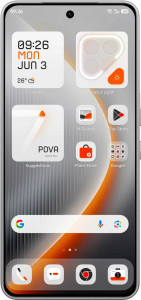
Oppo K13 Turbo Pro
Tecno Pova 7 Ultra 5G

Oppo K13 Turbo Pro Tecno Pova 7 Ultra 5G

Overview

Welcome to our in-depth comparison of the Oppo K13 Turbo Pro and the Tecno Pova 7 Ultra 5G, two compelling mid-to-upper-range 5G smartphones that take distinctly different approaches to performance, camera hardware, and everyday usability. From their contrasting chipsets and battery capacities to their differing display refresh rates and audio features, there is plenty to unpack before deciding which device deserves a place in your pocket.

Common Features

  • Neither product has a rugged build.
  • Neither product can be folded.
  • Both products use an OLED/AMOLED display type.
  • Both products have a touch sampling rate of 240Hz.
  • Neither product has branded damage-resistant glass.
  • Neither product supports HDR10.
  • Neither product supports HDR10+.
  • Neither product supports Dolby Vision.
  • Neither product has a secondary screen.
  • Both products have a touchscreen.
  • Both products have integrated LTE.
  • Both products use a 4 nm semiconductor size.
  • Both products support 64-bit processing.
  • Both products support DirectX 12.
  • Both products have integrated graphics.
  • Both products use big.LITTLE technology.
  • Both products have 8 CPU threads.
  • Both products have TrustZone support.
  • Both products have a dual-lens or multi-lens main camera.
  • Neither product has a dual-tone LED flash.
  • Both products have a CMOS sensor.
  • Both products support continuous autofocus when recording movies.
  • Both products have phase-detection autofocus for photos.
  • Both products support slow-motion video recording.
  • Both products have a built-in HDR mode.
  • Both products run Android 15.
  • Both products have clipboard warnings.
  • Both products have location privacy options.
  • Both products have camera and microphone privacy options.
  • Neither product has Mail Privacy Protection.
  • Both products have theme customization.
  • Both products can block app tracking.
  • Neither product blocks cross-site tracking.
  • Both products support fast charging.
  • Neither product has reverse wireless charging.
  • Both products come with a charger.
  • Neither product has a removable battery.
  • Both products have a battery level indicator.
  • Both products have a rechargeable battery.
  • Both products have stereo speakers.
  • Neither product has aptX support.
  • Neither product has LDAC support.
  • Neither product has aptX Adaptive support.
  • Neither product has aptX Lossless support.
  • Neither product has a radio.
  • Both products have 5G support.
  • Both products support 2 SIM cards.
  • Neither product has an external memory slot.
  • Both products have USB Type-C.
  • Both products use USB version 2.
  • Both products have NFC.
  • Both products have a fingerprint scanner.
  • Neither product has emergency SOS via satellite.
  • Both products have a video light.
  • Neither product has a sapphire glass display.
  • Neither product has a curved display.
  • Neither product has an e-paper display.

Main Differences

  • Water resistance is Waterproof on Oppo K13 Turbo Pro and Water resistant on Tecno Pova 7 Ultra 5G.
  • Thickness is 7.3 mm on Oppo K13 Turbo Pro and 8.9 mm on Tecno Pova 7 Ultra 5G.
  • Width is 77.2 mm on Oppo K13 Turbo Pro and 75.2 mm on Tecno Pova 7 Ultra 5G.
  • Height is 162.8 mm on Oppo K13 Turbo Pro and 160 mm on Tecno Pova 7 Ultra 5G.
  • Volume is 91.747568 cm³ on Oppo K13 Turbo Pro and 107.0848 cm³ on Tecno Pova 7 Ultra 5G.
  • IP rating is IP67 on Oppo K13 Turbo Pro and IP64 on Tecno Pova 7 Ultra 5G.
  • Screen size is 6.8″ on Oppo K13 Turbo Pro and 6.67″ on Tecno Pova 7 Ultra 5G.
  • Pixel density is 453 ppi on Oppo K13 Turbo Pro and 460 ppi on Tecno Pova 7 Ultra 5G.
  • Resolution is 1280 x 2800 px on Oppo K13 Turbo Pro and 1260 x 2800 px on Tecno Pova 7 Ultra 5G.
  • Refresh rate is 120Hz on Oppo K13 Turbo Pro and 144Hz on Tecno Pova 7 Ultra 5G.
  • Internal storage is 512GB on Oppo K13 Turbo Pro and 256GB on Tecno Pova 7 Ultra 5G.
  • RAM is 16GB on Oppo K13 Turbo Pro and 12GB on Tecno Pova 7 Ultra 5G.
  • The chipset is Qualcomm Snapdragon 8s Gen 4 on Oppo K13 Turbo Pro and MediaTek Dimensity 8350 on Tecno Pova 7 Ultra 5G.
  • The GPU is Adreno 825 on Oppo K13 Turbo Pro and Mali G615 MC6 on Tecno Pova 7 Ultra 5G.
  • CPU speed is 3 x 3.01 & 2 x 2.8 & 2 x 2.02 & 1 x 3.21 GHz on Oppo K13 Turbo Pro and 1 x 3.35 & 3 x 3.2 & 4 x 2.2 GHz on Tecno Pova 7 Ultra 5G.
  • Geekbench 6 multi-core score is 6833 on Oppo K13 Turbo Pro and 4700 on Tecno Pova 7 Ultra 5G.
  • Geekbench 6 single-core score is 2041 on Oppo K13 Turbo Pro and 1536 on Tecno Pova 7 Ultra 5G.
  • GPU clock speed is 1150 MHz on Oppo K13 Turbo Pro and 1400 MHz on Tecno Pova 7 Ultra 5G.
  • RAM speed is 4800 MHz on Oppo K13 Turbo Pro and 8533 MHz on Tecno Pova 7 Ultra 5G.
  • Maximum memory bandwidth is 76.8 GB/s on Oppo K13 Turbo Pro and 68.2 GB/s on Tecno Pova 7 Ultra 5G.
  • L3 cache is 8 MB on Oppo K13 Turbo Pro and 4 MB on Tecno Pova 7 Ultra 5G.
  • Main camera megapixels are 50 & 2 MP on Oppo K13 Turbo Pro and 108 & 8 MP on Tecno Pova 7 Ultra 5G.
  • Front camera megapixels are 16 MP on Oppo K13 Turbo Pro and 13 MP on Tecno Pova 7 Ultra 5G.
  • Optical image stabilization is present on Oppo K13 Turbo Pro but not available on Tecno Pova 7 Ultra 5G.
  • Number of flash LEDs is 1 on Oppo K13 Turbo Pro and 2 on Tecno Pova 7 Ultra 5G.
  • Battery power is 7000 mAh on Oppo K13 Turbo Pro and 6000 mAh on Tecno Pova 7 Ultra 5G.
  • Wireless charging is available on Tecno Pova 7 Ultra 5G but not on Oppo K13 Turbo Pro.
  • Charging speed is 80W on Oppo K13 Turbo Pro and 70W on Tecno Pova 7 Ultra 5G.
  • A 3.5 mm audio jack is present on Tecno Pova 7 Ultra 5G but not available on Oppo K13 Turbo Pro.
  • aptX HD support is present on Oppo K13 Turbo Pro but not available on Tecno Pova 7 Ultra 5G.
  • An infrared sensor is present on Oppo K13 Turbo Pro but not available on Tecno Pova 7 Ultra 5G.
Specs Comparison
Oppo K13 Turbo Pro

Oppo K13 Turbo Pro

Tecno Pova 7 Ultra 5G

Tecno Pova 7 Ultra 5G

Design:
water resistance Waterproof Water resistant
thickness 7.3 mm 8.9 mm
width 77.2 mm 75.2 mm
height 162.8 mm 160 mm
volume 91.747568 cm³ 107.0848 cm³
Ingress Protection (IP) rating IP67 IP64
has a rugged build
can be folded

The most consequential difference in this group is water protection. The Oppo K13 Turbo Pro carries an IP67 rating, meaning it can withstand submersion in up to 1 meter of fresh water for 30 minutes — earning the label ″Waterproof.″ The Tecno Pova 7 Ultra 5G is only rated IP64, which protects against water splashes from any direction but offers no submersion protection at all. In practice, this is the difference between surviving an accidental drop in a sink versus being merely safe in the rain.

Form factor also tilts clearly toward the Oppo. At just 7.3 mm thick and a total volume of 91.7 cm³, the K13 Turbo Pro is meaningfully slimmer and more compact than the Pova 7 Ultra 5G, which measures 8.9 mm thick and displaces 107.1 cm³. That 1.6 mm difference in thickness is perceptible in-hand and in a pocket. The Tecno is slightly narrower and shorter, but those marginal gains do not offset its considerably greater bulk.

Both phones share a standard, non-rugged, non-folding slab design, so neither offers a specialty form factor. However, the Oppo K13 Turbo Pro holds a clear edge in this group: it is significantly slimmer, more compact, and — most importantly — provides a substantially higher level of water protection.

Display:
Display type OLED/AMOLED OLED/AMOLED
screen size 6.8" 6.67"
pixel density 453 ppi 460 ppi
resolution 1280 x 2800 px 1260 x 2800 px
refresh rate 120Hz 144Hz
touch sampling rate 240Hz 240Hz
has branded damage-resistant glass
supports HDR10
supports HDR10+
supports Dolby Vision
Has a secondary screen
has a touch screen

Both phones use an OLED/AMOLED panel, so the foundational display quality — deep blacks, vivid colors, and power efficiency on dark content — is shared. Where they diverge is in refresh rate and screen size. The Tecno Pova 7 Ultra 5G runs at 144Hz versus the Oppo K13 Turbo Pro's 120Hz, a difference that is genuinely perceptible during fast-paced gaming and rapid scrolling, making animations feel slightly more fluid on the Tecno. The Oppo counters with a larger 6.8-inch canvas compared to the Tecno's 6.67 inches, which benefits media consumption and multitasking.

Pixel density is essentially a wash: 460 ppi on the Tecno versus 453 ppi on the Oppo. At this range, no human eye can distinguish the difference in sharpness. Both devices also share the same vertical resolution of 2800 pixels, meaning content scaling and aspect ratio are virtually identical despite the slight screen-size gap.

Neither phone offers branded damage-resistant glass or any HDR standard, which are notable absences at this tier. Overall, this group is closely matched, but the edge goes to the Tecno Pova 7 Ultra 5G on the strength of its higher refresh rate — a more day-to-day-relevant differentiator than the Oppo's modest size advantage.

Performance:
internal storage 512GB 256GB
RAM 16GB 12GB
Chipset (SoC) name Qualcomm Snapdragon 8s Gen 4 MediaTek Dimensity 8350
GPU name Adreno 825 Mali G615 MC6
CPU speed 3 x 3.01 & 2 x 2.8 & 2 x 2.02 & 1 x 3.21 GHz 1 x 3.35 & 3 x 3.2 & 4 x 2.2 GHz
Geekbench 6 result (multi) 6833 4700
Geekbench 6 result (single) 2041 1536
GPU clock speed 1150 MHz 1400 MHz
Has integrated LTE
RAM speed 4800 MHz 8533 MHz
semiconductor size 4 nm 4 nm
Supports 64-bit
DirectX version DirectX 12 DirectX 12
Has integrated graphics
Uses big.LITTLE technology
CPU threads 8 threads 8 threads
Has TrustZone
maximum memory bandwidth 76.8 GB/s 68.2 GB/s
OpenCL version 2 2
maximum memory amount 24GB 24GB
DDR memory version 5 5
L3 cache 8 MB 4 MB

The chipset gap here is significant. The Oppo K13 Turbo Pro runs on the Snapdragon 8s Gen 4, while the Tecno Pova 7 Ultra 5G uses the Dimensity 8350 — and the Geekbench 6 scores make the performance delta concrete. The Oppo posts a multi-core score of 6833 versus the Tecno's 4700, and a single-core score of 2041 against 1536. That roughly 45% multi-core advantage translates to noticeably faster app launches, smoother heavy multitasking, and a more responsive experience under sustained load.

Memory configuration further separates the two. The Oppo ships with 16 GB of RAM and 512 GB of storage versus the Tecno's 12 GB and 256 GB — meaningful differences for users who keep many apps open simultaneously or store large media libraries locally. The Oppo also holds an edge in memory bandwidth at 76.8 GB/s versus 68.2 GB/s, and doubles the Tecno's L3 cache at 8 MB versus 4 MB, both of which contribute to lower latency in data-intensive tasks. The Tecno's higher RAM speed of 8533 MHz versus 4800 MHz is a partial counterpoint, but it does not close the overall gap.

Both devices share the same 4 nm fabrication node, 8-thread CPU architecture, DDR5 memory, and a maximum memory ceiling of 24 GB, indicating a common generational baseline. Despite those similarities, the Oppo K13 Turbo Pro holds a decisive advantage in this group across raw CPU throughput, RAM capacity, storage, and memory subsystem specs.

Cameras:
megapixels (main camera) 50 & 2 MP 108 & 8 MP
Has a dual-lens (or multi-lens) main camera
megapixels (front camera) 16MP 13MP
has built-in optical image stabilization
Has a dual-tone LED flash
number of flash LEDs 1 2
has a BSI sensor
has a CMOS sensor
has continuous autofocus when recording movies
Has phase-detection autofocus for photos
supports slow-motion video recording
has a built-in HDR mode
has manual exposure
has a flash
optical zoom 0x 0x
has manual ISO
has a serial shot mode
has manual focus
has a front camera
Has laser autofocus
Shoots 360° panorama
has manual white balance
shoots raw
has touch autofocus
has manual shutter speed
can create panoramas in-camera
Has timelapse function
Has a front-facing LED flash
has a dual-lens (or multi-lens) front camera
supports HDR10 recording
supports Dolby Vision recording
has a front-facing camera under the display
Has a RGB LED flash
has 3D photo/video recording capabilities

On paper, the Tecno Pova 7 Ultra 5G leads with a 108 MP primary sensor and an 8 MP secondary lens, dwarfing the Oppo K13 Turbo Pro's 50 MP + 2 MP setup. However, high megapixel counts require context: a 108 MP sensor typically uses pixel-binning to produce effective 12–27 MP output shots, so the real-world sharpness gap is far narrower than the raw numbers suggest. The secondary lens difference is more meaningful — the Tecno's 8 MP ultra-wide or depth sensor has practical utility, whereas the Oppo's 2 MP secondary lens is largely supplementary.

The single most impactful differentiator in this group is optical image stabilization (OIS), which the Oppo carries and the Tecno does not. OIS physically compensates for hand movement, producing noticeably sharper shots in low light and significantly smoother video footage — benefits that affect everyday shooting in a way that extra megapixels rarely do. The Oppo also edges ahead on the selfie camera at 16 MP versus the Tecno's 13 MP, a modest but real advantage for front-facing photography. The Tecno counters with a dual-LED flash versus the Oppo's single LED, which can improve flash coverage and color balance, though this is a secondary consideration.

Feature parity is otherwise high: both cameras share phase-detection autofocus, continuous autofocus during video, slow-motion, HDR mode, and an identical set of manual controls. Given that, the presence of OIS on the Oppo K13 Turbo Pro is the decisive practical advantage here — it consistently matters more in real shooting conditions than the Tecno's higher megapixel count.

Operating system:
Android version Android 15 Android 15
has clipboard warnings
has location privacy options
has camera/microphone privacy options
has Mail Privacy Protection
has theme customization
can block app tracking
blocks cross-site tracking
has on-device machine learning
has notification permissions
has media picker
Can play games while they download
has dark mode
has Wi-Fi password sharing
has battery health check
has an extra dim mode
has focus modes
has dynamic theming
can offload apps
Has customizable notifications
has Live Text
has full-page screenshots
supports split screen
gets direct OS updates
has PiP
Can be used as a PC
Has sharing intents
has a child lock
Supports widgets
Is free and open source
Has offline voice recognition
has voice commands
Tracks the current position of a mobile device
is a multi-user system
has Quick Start

This is a rare case of complete parity. Both the Oppo K13 Turbo Pro and the Tecno Pova 7 Ultra 5G run Android 15 and return identical values across every single spec in this group — no exceptions. From privacy tools like location controls and camera/microphone permissions, to productivity features like split-screen, picture-in-picture, and widgets, to quality-of-life additions like dynamic theming, extra dim mode, and battery health checks, the two phones are functionally indistinguishable at the OS feature level.

Notably, neither device receives direct OS updates — meaning updates are routed through the manufacturer rather than pushed straight from Google. Users on both phones are equally dependent on Oppo and Tecno respectively maintaining their update pipelines, which is a shared limitation worth bearing in mind for long-term software support.

With no differentiating data point across the entire group, this category is an unambiguous tie. A buyer's OS experience will be shaped far more by each manufacturer's custom Android skin and update cadence than by anything this spec group can reveal.

Battery:
battery power 7000 mAh 6000 mAh
has wireless charging
Supports fast charging
charging speed 80W 70W
has reverse wireless charging
comes with a charger
has a removable battery
has a battery level indicator
has a rechargeable battery

Battery capacity is where the Oppo K13 Turbo Pro makes one of its strongest statements in this comparison. Its 7000 mAh cell outpaces the Tecno Pova 7 Ultra 5G's already-generous 6000 mAh by a full 1000 mAh — a 17% increase that, all else being equal, translates directly into extended screen-on time and longer intervals between charges. For heavy users or those frequently away from a power source, that gap is tangible.

Charging tells a more nuanced story. The Oppo edges ahead with 80W wired fast charging versus the Tecno's 70W, meaning it replenishes its larger battery at a faster rate — a meaningful combination. The Tecno, however, uniquely offers wireless charging, a convenience feature the Oppo entirely lacks. For users who rely on a wireless pad at a desk or bedside, that alone could tip the scales, regardless of the wired speed difference.

Both phones ship with a charger in the box and share a fixed, non-removable battery design. On balance, the Oppo K13 Turbo Pro holds the advantage in raw endurance and wired charging speed, but the Tecno Pova 7 Ultra 5G's wireless charging support introduces a lifestyle consideration that prevents this from being a clean sweep.

Audio:
has a socket for a 3.5 mm audio jack
has stereo speakers
has aptX
has LDAC
has aptX HD
has aptX Adaptive
has aptX Lossless
Has a radio

Wired audio users will find the Tecno Pova 7 Ultra 5G the more accommodating device, as it retains a 3.5 mm headphone jack — something the Oppo K13 Turbo Pro has dropped entirely. For anyone with a collection of wired headphones or earphones, this is a daily-use convenience that eliminates the need for a dongle. The Oppo, by omitting the jack, pushes users toward Bluetooth or USB-C audio exclusively.

The Oppo partially compensates with support for aptX HD, a high-definition Bluetooth audio codec that delivers better-than-CD-quality audio over wireless connections to compatible headphones. The Tecno supports none of the listed aptX variants, meaning its Bluetooth audio is limited to standard codec quality. So while the Tecno wins on wired connectivity, the Oppo offers a superior wireless listening experience for those with aptX HD-capable headphones.

Both phones feature stereo speakers and neither includes a radio. This group ends in a split: the Tecno Pova 7 Ultra 5G is the better fit for wired headphone users, while the Oppo K13 Turbo Pro holds the edge for wireless audio quality. The deciding factor comes down to how each user primarily listens to audio.

Connectivity & Features:
release date July 2025 June 2025
has 5G support
SIM cards 2 SIM 2 SIM
has an external memory slot
Has USB Type-C
USB version 2 2
has NFC
Has a fingerprint scanner
has emergency SOS via satellite
has crash detection
is DLNA-certified
has a gyroscope
supports ANT+
Has a heart rate monitor
has GPS
has a compass
supports Wi-Fi
Has an infrared sensor
has an accelerometer
has a cellular module
Has a barometer
has an HDMI output
Uses 3D facial recognition
Has an iris scanner
Stylus included
supports Galileo
Has motion tracking
Has optical tracking
Has a built-in projector

Across the broad sweep of connectivity features, these two phones are remarkably well-matched. Both support 5G, dual SIM, NFC, USB Type-C (USB 2.0), Wi-Fi, GPS with Galileo, and a full sensor suite including gyroscope, accelerometer, compass, and fingerprint scanner. For the vast majority of users, the day-to-day connectivity experience will be essentially identical.

The sole differentiator in this entire group is the infrared (IR) blaster, which the Oppo K13 Turbo Pro includes and the Tecno Pova 7 Ultra 5G does not. An IR blaster lets the phone function as a universal remote control for TVs, air conditioners, set-top boxes, and other IR-compatible appliances — a niche but genuinely useful feature for those who want to consolidate their remote controls into a single device.

With only one point of difference, this group nearly amounts to a tie, but the Oppo K13 Turbo Pro takes the narrow edge by virtue of offering an additional hardware capability that the Tecno simply lacks. Neither phone offers expandable storage, which is a shared limitation worth noting for users with heavy local storage needs.

Miscellaneous:
has a video light
Has sapphire glass display
Has a curved display
Has an e-paper display

The Miscellaneous group offers no basis for differentiation whatsoever. Both the Oppo K13 Turbo Pro and the Tecno Pova 7 Ultra 5G return identical values across every spec here: both include a video light, and neither features a sapphire glass display, a curved display, or an e-paper display. This is a clean, unambiguous tie with no advantage to either device.

Comparison Summary & Verdict

After examining every specification, it is clear that both phones serve different types of users. The Oppo K13 Turbo Pro stands out with its superior Snapdragon 8s Gen 4 performance, higher Geekbench scores, larger 7000 mAh battery, stronger IP67 waterproofing, optical image stabilization, and a slimmer 7.3 mm profile, making it the better pick for power users who demand raw speed and durability. The Tecno Pova 7 Ultra 5G, on the other hand, appeals to multimedia and versatility-focused users thanks to its 144Hz refresh rate, higher-resolution 108 MP main camera, wireless charging, 3.5 mm headphone jack, and dual LED flash. If you prioritize performance and battery endurance, lean toward the Oppo; if a smoother display, richer camera versatility, and broader connectivity options matter more, the Tecno is the stronger contender.

Oppo K13 Turbo Pro
Buy Oppo K13 Turbo Pro if...

Buy the Oppo K13 Turbo Pro if you want top-tier CPU performance, a larger 7000 mAh battery with 80W fast charging, superior IP67 waterproofing, and a slimmer design with optical image stabilization.

Tecno Pova 7 Ultra 5G
Buy Tecno Pova 7 Ultra 5G if...

Buy the Tecno Pova 7 Ultra 5G if you prioritize a smoother 144Hz display, a versatile 108 MP camera system, wireless charging, and the convenience of a 3.5 mm headphone jack.