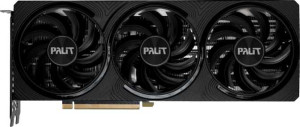
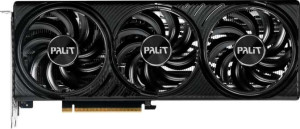
The memory configurations of these two cards reflect fundamentally different design philosophies, and the trade-offs are significant. The RTX 4070 Ti Super Infinity 3 OC pairs a wide 256-bit bus with GDDR6X to achieve 672 GB/s of memory bandwidth — a figure that directly determines how quickly the GPU can feed its large shader array with data. The RTX 5060 Ti Infinity 3 8GB, by contrast, uses the newer GDDR7 standard at a blazing 28000 MHz effective speed, but its narrow 128-bit bus caps bandwidth at 448 GB/s. GDDR7 is a generational leap in per-pin efficiency, yet halving the bus width more than offsets that gain in raw throughput terms.
The capacity gap is equally important. With 16 GB of VRAM, the 4070 Ti Super can hold much larger textures, scene data, and AI model weights in local memory — a meaningful advantage at 4K, in VRAM-hungry titles, or when running local AI inference tasks. The 5060 Ti's 8 GB is increasingly tight for modern games at high settings and can become a hard bottleneck when assets exceed that threshold, forcing slower system-RAM fallback. Both cards support ECC memory, a parity feature relevant mainly to professional compute use cases.
On balance, the RTX 4070 Ti Super holds a clear memory advantage. It delivers 50% more bandwidth and double the VRAM capacity, which matters far more in practice than the 5060 Ti's higher raw memory clock speed. The 5060 Ti's adoption of GDDR7 is a forward-looking architectural choice, but within the constraints of a 128-bit bus it cannot overcome the 4070 Ti Super's broader, more capacious memory subsystem.