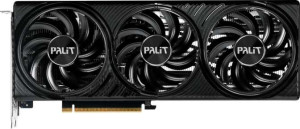
Palit GeForce RTX 5060 Ti Infinity 3 16GB
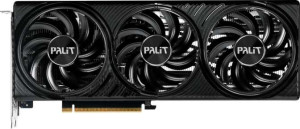
Palit GeForce RTX 5060 Ti Infinity 3 OC 16GB

Palit GeForce RTX 5060 Ti Infinity 3 16GB Palit GeForce RTX 5060 Ti Infinity 3 OC 16GB

Overview

Welcome to our detailed spec comparison between the Palit GeForce RTX 5060 Ti Infinity 3 16GB and the Palit GeForce RTX 5060 Ti Infinity 3 OC 16GB. Both cards are built on the Blackwell architecture with 16GB of GDDR7 memory, but they diverge in key performance metrics such as GPU turbo clock, pixel rate, and floating-point throughput. Read on to find out which card best matches your needs.

Common Features

  • Both cards have a base GPU clock speed of 2407 MHz.
  • Both cards have a GPU memory speed of 1750 MHz.
  • Both cards feature 4608 shading units.
  • Both cards have 144 texture mapping units (TMUs).
  • Both cards have 48 render output units (ROPs).
  • Double Precision Floating Point (DPFP) is supported on both cards.
  • Both cards have an effective memory speed of 28000 MHz.
  • Both cards offer a maximum memory bandwidth of 448 GB/s.
  • Both cards come with 16GB of VRAM.
  • Both cards use GDDR7 memory.
  • Both cards have a 128-bit memory bus width.
  • ECC memory is supported on both cards.
  • Both cards support DirectX 12 Ultimate.
  • Both cards support OpenGL version 4.6.
  • Both cards support OpenCL version 3.
  • Multi-display technology is supported on both cards.
  • Ray tracing is supported on both cards.
  • DLSS is supported on both cards.
  • XeSS (XMX) is not available on either card.
  • 3D support is available on both cards.
  • Both cards have one HDMI 2.1b output and three DisplayPort outputs, with no USB-C or DVI outputs.
  • Both cards are built on the Blackwell GPU architecture.
  • Both cards have a Thermal Design Power (TDP) of 180W.
  • Both cards use PCIe version 5.
  • Both cards are manufactured on a 5 nm process with 21,900 million transistors.
  • Air-water cooling is not available on either card.
  • Both cards share the same dimensions: 291.9 mm width and 116.6 mm height.

Main Differences

  • GPU turbo clock speed is 2572 MHz on the Palit GeForce RTX 5060 Ti Infinity 3 16GB and 2662 MHz on the Palit GeForce RTX 5060 Ti Infinity 3 OC 16GB.
  • Pixel rate is 123.5 GPixel/s on the Palit GeForce RTX 5060 Ti Infinity 3 16GB and 127.8 GPixel/s on the Palit GeForce RTX 5060 Ti Infinity 3 OC 16GB.
  • Floating-point performance is 23.7 TFLOPS on the Palit GeForce RTX 5060 Ti Infinity 3 16GB and 24.53 TFLOPS on the Palit GeForce RTX 5060 Ti Infinity 3 OC 16GB.
  • Texture rate is 370.4 GTexels/s on the Palit GeForce RTX 5060 Ti Infinity 3 16GB and 383.3 GTexels/s on the Palit GeForce RTX 5060 Ti Infinity 3 OC 16GB.
Specs Comparison
Palit GeForce RTX 5060 Ti Infinity 3 16GB

Palit GeForce RTX 5060 Ti Infinity 3 16GB

Palit GeForce RTX 5060 Ti Infinity 3 OC 16GB

Palit GeForce RTX 5060 Ti Infinity 3 OC 16GB

Performance:
GPU clock speed 2407 MHz 2407 MHz
GPU turbo 2572 MHz 2662 MHz
pixel rate 123.5 GPixel/s 127.8 GPixel/s
floating-point performance 23.7 TFLOPS 24.53 TFLOPS
texture rate 370.4 GTexels/s 383.3 GTexels/s
GPU memory speed 1750 MHz 1750 MHz
shading units 4608 4608
texture mapping units (TMUs) 144 144
render output units (ROPs) 48 48
Has Double Precision Floating Point (DPFP)

At their core, both cards share the same fundamental silicon configuration: 4608 shading units, 144 TMUs, 48 ROPs, and an identical base clock of 2407 MHz. This means the underlying architecture and its theoretical parallelism are identical — the real story here is in the boost frequencies. The standard Infinity 3 tops out at 2572 MHz turbo, while the OC variant pushes that ceiling to 2662 MHz — a 90 MHz delta that flows directly into every derived throughput metric.

That clock advantage translates into a 24.53 TFLOPS floating-point figure for the OC against 23.7 TFLOPS on the standard model — roughly a 3.5% uplift. Similarly, texture throughput rises from 370.4 GTexels/s to 383.3 GTexels/s, and pixel fill rate from 123.5 GPixel/s to 127.8 GPixel/s. In practice, these gains are proportional and consistent: you can expect the OC to sustain marginally higher average framerates and slightly snappier rendering of geometry-heavy or shader-intensive scenes, though the gap is narrow enough that it will rarely be the deciding factor in real-world titles.

The OC variant holds a clear, if modest, performance edge in this group. Both cards share the same memory speed, raster hardware count, and DPFP support, so there are no hidden architectural advantages on either side — the difference is purely clock-driven. Whether that 3–4% headroom justifies the likely price premium depends on the user's sensitivity to top-end throughput, but on raw numbers alone, the Infinity 3 OC is the faster card.
Memory:
effective memory speed 28000 MHz 28000 MHz
maximum memory bandwidth 448 GB/s 448 GB/s
VRAM 16GB 16GB
GDDR version GDDR7 GDDR7
memory bus width 128-bit 128-bit
Supports ECC memory

When it comes to memory, these two cards are completely indistinguishable. Both feature 16GB of GDDR7 VRAM running at an effective 28000 MHz across a 128-bit bus, yielding a maximum bandwidth of 448 GB/s. That bandwidth figure is worth contextualizing: GDDR7 extracts significantly more throughput per bus-width pin than its GDDR6X predecessor, meaning a 128-bit interface here punches well above what the same bus width would have delivered in a prior generation.

The 16GB capacity is the headline practical detail. It comfortably accommodates high-resolution texture sets, large AI model weights for on-device inference workloads, and the VRAM demands of modern titles at 1440p — a segment where 8GB cards have increasingly become a liability. ECC memory support adds a layer of data-integrity protection useful in compute or professional workloads, though it is equally available on both boards.

This group is an unambiguous tie. Every memory specification — capacity, type, speed, bandwidth, bus width, and ECC support — is identical across both variants. Buyers choosing between the standard Infinity 3 and the OC edition will find no differentiation here whatsoever; the decision comes down entirely to other specification groups.

Features:
DirectX version DirectX 12 Ultimate DirectX 12 Ultimate
OpenGL version 4.6 4.6
OpenCL version 3 3
Supports multi-display technology
supports ray tracing
Supports 3D
supports DLSS
has XeSS (XMX)
AMD SAM / Intel Resizable BAR Intel Resizable BAR Intel Resizable BAR
has LHR
has RGB lighting
supported displays 4 4

Feature parity is total here. Both cards run on DirectX 12 Ultimate, which unlocks the full suite of modern rendering capabilities — hardware-accelerated ray tracing, mesh shaders, and variable-rate shading — without any asterisks or partial support. Paired with DLSS support, users gain access to AI-driven upscaling that can substantially recover framerates at higher resolutions, making this particularly relevant for 1440p and 4K gaming scenarios where raw rasterization headroom is under pressure.

Support for up to 4 simultaneous displays and multi-display technology makes either card viable for productivity-heavy or sim-racing setups without additional hardware. Intel Resizable BAR is present on both, allowing the CPU to access the full VRAM pool in a single pass rather than in smaller chunks — a feature that yields measurable framerate improvements in a meaningful number of titles. Neither card carries an LHR limiter, which is relevant for compute users, and neither includes RGB lighting, keeping aesthetics straightforward.

There is no differentiator to call out in this group — every feature flag is identical across both variants. The standard Infinity 3 and the OC edition offer precisely the same software and API capability set, meaning the choice between them has no bearing on compatibility, ecosystem access, or supported workloads. This is another clean tie.

Ports:
has an HDMI output
HDMI ports 1 1
HDMI version HDMI 2.1b HDMI 2.1b
DisplayPort outputs 3 3
USB-C ports 0 0
DVI outputs 0 0
mini DisplayPort outputs 0 0

Both cards ship with an identical port layout: 3 DisplayPort outputs and 1 HDMI 2.1b port, totalling four physical connectors — which aligns neatly with the four-display limit noted in the Features group. The absence of USB-C, DVI, or mini-DisplayPort outputs is consistent with modern mid-range GPU design philosophy, where those legacy or niche interfaces have been phased out in favour of maximising standard DisplayPort and HDMI real estate.

HDMI 2.1b is the headline connectivity detail worth noting. It supports bandwidth sufficient for 4K at high refresh rates and 8K output, and carries enhanced Variable Refresh Rate features — relevant for users connecting to large-screen TVs or high-end monitors that lack DisplayPort. The three DisplayPort outputs, meanwhile, give multi-monitor desktop users or triple-display sim setups plenty of flexibility without adapters.

Predictably, this group is a tie in every respect. Port selection, versions, and counts are carbon copies across both variants. Connectivity requirements should play no part in choosing between the standard Infinity 3 and the OC edition.

General info:
GPU architecture Blackwell Blackwell
release date April 2025 April 2025
Thermal Design Power (TDP) 180W 180W
PCI Express (PCIe) version 5 5
semiconductor size 5 nm 5 nm
number of transistors 21900 million 21900 million
Has air-water cooling
width 291.9 mm 291.9 mm
height 116.6 mm 116.6 mm

Underneath both cards lies the same Blackwell architecture built on a 5nm process node, packing 21.9 billion transistors into identical physical dimensions of 291.9 × 116.6 mm. The 5nm fabrication is significant context: it enables higher transistor density and better power efficiency compared to previous nodes, which is part of why Blackwell can deliver its performance figures within a relatively contained power envelope.

That envelope is a 180W TDP for both variants — a noteworthy detail when considering the OC edition's higher clock speeds from the Performance group. Palit has tuned the OC model to extract more throughput without raising the rated thermal ceiling, which suggests the additional headroom is achieved through binning or refined voltage-frequency curves rather than brute-force power increases. Both cards use PCIe 5.0, ensuring interface bandwidth is not a bottleneck on current-generation platforms, and neither offers liquid cooling — air cooling is the sole thermal solution on both.

General info is a complete tie. Same die, same process, same TDP, same physical footprint — there is nothing here that separates the two. For buyers concerned about case clearance, system power budgets, or platform compatibility, either card can be treated as interchangeable on these criteria.

Comparison Summary & Verdict

After examining all available specifications, it is clear that the Palit GeForce RTX 5060 Ti Infinity 3 16GB and the Palit GeForce RTX 5060 Ti Infinity 3 OC 16GB are nearly identical cards sharing the same 16GB GDDR7 memory, 180W TDP, PCIe 5 interface, and full feature set including ray tracing and DLSS. The sole differentiator lies in the factory overclocked GPU turbo speed of the OC variant, which reaches 2662 MHz versus 2572 MHz, translating into a measurably higher floating-point performance of 24.53 TFLOPS, a superior texture rate of 383.3 GTexels/s, and a better pixel rate of 127.8 GPixel/s. For users who want every last drop of out-of-the-box performance without manual overclocking, the OC edition is the clear pick. Those prioritizing value or a slightly more conservative clock profile will find the standard model equally capable in all other respects.

Palit GeForce RTX 5060 Ti Infinity 3 16GB
Buy Palit GeForce RTX 5060 Ti Infinity 3 16GB if...

Buy the Palit GeForce RTX 5060 Ti Infinity 3 16GB if you want a capable Blackwell-based card with the full 16GB GDDR7 feature set and are comfortable with a standard factory clock profile.

Palit GeForce RTX 5060 Ti Infinity 3 OC 16GB
Buy Palit GeForce RTX 5060 Ti Infinity 3 OC 16GB if...

Buy the Palit GeForce RTX 5060 Ti Infinity 3 OC 16GB if you want higher out-of-the-box performance, with a faster GPU turbo clock, better floating-point throughput, and improved texture and pixel rates over the standard model.