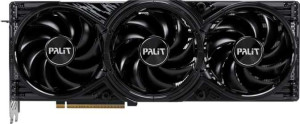
At their core, both the Palit GamingPro OC and the Zotac Solid OC share identical silicon foundations: the same 2325 MHz base clock, 6144 shading units, 192 TMUs, 80 ROPs, and 1750 MHz memory speed. This means any performance gap between them is purely a result of how aggressively each manufacturer has factory-overclocked the GPU boost frequency — not a difference in the underlying hardware tier.
That gap, while real, is narrow. The Palit GamingPro OC reaches a turbo clock of 2572 MHz versus the Zotac Solid OC's 2542 MHz — a 30 MHz difference. This flows directly into every derived metric: the Palit edges ahead with 31.6 TFLOPS of floating-point throughput versus 31.24 TFLOPS, and a texture rate of 493.8 GTexels/s versus 488.1 GTexels/s. In practice, a ~1% compute advantage of this magnitude is well within benchmark noise and would not produce a perceptible difference in gaming frame rates or rendering workloads.
The Palit GamingPro OC holds a technical edge in this performance group strictly by virtue of its higher factory boost clock, translating to marginally superior throughput across every compute metric. However, the delta is so small that real-world performance should be considered effectively equivalent between the two cards. Neither product offers a feature here — such as DPFP support, which both share — that the other lacks, so the Palit's slight overclock advantage is the sole differentiator.