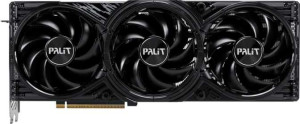
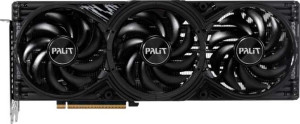
At first glance, the Palit RTX 5070 GamingPro appears to have a slight clock speed advantage — its base and turbo clocks of 2325 / 2512 MHz edge out the RTX 5070 Ti GamingPro-S OC's 2295 / 2482 MHz. However, raw clock speed is only one dimension of GPU performance. What truly determines throughput is how many execution units are ticking at that speed, and here the Ti pulls decisively ahead: it carries 8,960 shading units versus the standard model's 6,144 — a roughly 46% increase in shader count that completely overshadows the minor clock deficit.
This difference in silicon scale cascades across every throughput metric. The Ti's 44.48 TFLOPS of floating-point performance dwarfs the RTX 5070's 30.87 TFLOPS — a gap of nearly 44% — which directly translates to faster shader-heavy workloads like ray tracing, rasterization, and AI-accelerated tasks. Similarly, the Ti's texture rate of 695 GTexels/s (versus 482.3) means noticeably faster texture filtering in dense scenes, while its 96 ROPs versus 80 give it a higher pixel fill rate of 238.3 GPixel/s compared to 201 — relevant for high-resolution and high-refresh-rate gaming. The only spec where parity holds is GPU memory speed at 1750 MHz, and both cards support Double Precision Floating Point, making them equally capable for compute tasks that require it.
The RTX 5070 Ti GamingPro-S OC holds a clear and substantial performance advantage in this group. Despite marginally lower clock speeds, its significantly larger shader array and correspondingly higher compute, texture, and pixel throughput make it the stronger performer by a wide margin. The RTX 5070 GamingPro is not slow, but users prioritizing peak rendering performance will find the Ti's raw throughput lead difficult to dismiss.