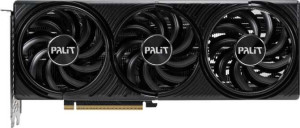
Palit GeForce RTX 5070 Infinity 3
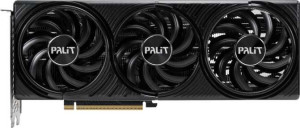
Palit GeForce RTX 5070 Infinity 3 OC

Palit GeForce RTX 5070 Infinity 3 Palit GeForce RTX 5070 Infinity 3 OC

Overview

Welcome to our in-depth specification comparison of the Palit GeForce RTX 5070 Infinity 3 and the Palit GeForce RTX 5070 Infinity 3 OC. These two Blackwell-architecture cards share the same 12GB GDDR7 memory configuration and 250W TDP, making their key battlegrounds the GPU turbo clock speed, floating-point performance, pixel rate, and texture rate. Read on to discover exactly how these two closely related cards stack up against each other.

Common Features

  • Both cards share the same base GPU clock speed of 2325 MHz.
  • Both cards have a GPU memory speed of 1750 MHz.
  • Both cards feature 6144 shading units.
  • Both cards include 192 texture mapping units (TMUs).
  • Both cards have 80 render output units (ROPs).
  • Double Precision Floating Point (DPFP) is supported on both cards.
  • Both cards have an effective memory speed of 28000 MHz.
  • Both cards offer a maximum memory bandwidth of 672 GB/s.
  • Both cards are equipped with 12GB of VRAM.
  • Both cards use GDDR7 memory.
  • Both cards have a 192-bit memory bus width.
  • ECC memory is supported on both cards.
  • Both cards support DirectX 12 Ultimate.
  • Both cards support OpenGL version 4.6.
  • Both cards support OpenCL version 3.
  • Multi-display technology is supported on both cards.
  • Ray tracing is supported on both cards.
  • 3D support is available on both cards.
  • DLSS is supported on both cards.
  • XeSS (XMX) is not available on either card.
  • Both cards include one HDMI 2.1b output.
  • Both cards feature three DisplayPort outputs.
  • Neither card includes a USB-C port.
  • Neither card includes a DVI output.
  • Neither card includes a mini DisplayPort output.
  • Both cards are built on the Blackwell GPU architecture.
  • Both cards have a Thermal Design Power (TDP) of 250W.
  • Both cards use PCIe version 5.
  • Both cards are manufactured on a 5 nm process.
  • Both cards contain 31100 million transistors.
  • Air-water cooling is not available on either card.
  • Both cards share the same width of 291.9 mm.
  • Both cards share the same height of 116.6 mm.

Main Differences

  • GPU turbo clock speed is 2512 MHz on Palit GeForce RTX 5070 Infinity 3 and 2542 MHz on Palit GeForce RTX 5070 Infinity 3 OC.
  • Pixel rate is 201 GPixel/s on Palit GeForce RTX 5070 Infinity 3 and 203.4 GPixel/s on Palit GeForce RTX 5070 Infinity 3 OC.
  • Floating-point performance is 30.87 TFLOPS on Palit GeForce RTX 5070 Infinity 3 and 31.24 TFLOPS on Palit GeForce RTX 5070 Infinity 3 OC.
  • Texture rate is 482.3 GTexels/s on Palit GeForce RTX 5070 Infinity 3 and 488.1 GTexels/s on Palit GeForce RTX 5070 Infinity 3 OC.
Specs Comparison
Palit GeForce RTX 5070 Infinity 3

Palit GeForce RTX 5070 Infinity 3

Palit GeForce RTX 5070 Infinity 3 OC

Palit GeForce RTX 5070 Infinity 3 OC

Performance:
GPU clock speed 2325 MHz 2325 MHz
GPU turbo 2512 MHz 2542 MHz
pixel rate 201 GPixel/s 203.4 GPixel/s
floating-point performance 30.87 TFLOPS 31.24 TFLOPS
texture rate 482.3 GTexels/s 488.1 GTexels/s
GPU memory speed 1750 MHz 1750 MHz
shading units 6144 6144
texture mapping units (TMUs) 192 192
render output units (ROPs) 80 80
Has Double Precision Floating Point (DPFP)

At their core, both cards share identical silicon configurations — 6144 shading units, 192 TMUs, and 80 ROPs — and an identical base clock of 2325 MHz, confirming they are built on the same physical GPU. The real distinction between the standard Infinity 3 and the OC variant lies entirely in the boost clock: the OC edition pushes its turbo to 2542 MHz versus 2512 MHz, a modest but meaningful 30 MHz uplift.

That 30 MHz difference cascades predictably through all derived performance metrics. The OC model edges ahead with 31.24 TFLOPS of floating-point throughput compared to 30.87 TFLOPS, and its texture rate of 488.1 GTexels/s slightly outpaces the standard card's 482.3 GTexels/s. In practice, these translate to roughly a 1.2% theoretical compute advantage — noticeable in sustained GPU-limited workloads, but unlikely to produce a perceptible frame-rate difference in most gaming scenarios without a frame counter.

Both cards share 1750 MHz memory speed and full Double Precision Floating Point support, so there is no gap in memory bandwidth or compute versatility. The Infinity 3 OC holds a clear, if slim, performance edge in this group purely by virtue of its higher turbo clock, making it the better choice if maximizing peak throughput matters — but buyers who prioritize value over marginal gains will find the standard Infinity 3 nearly indistinguishable in real-world use.

Memory:
effective memory speed 28000 MHz 28000 MHz
maximum memory bandwidth 672 GB/s 672 GB/s
VRAM 12GB 12GB
GDDR version GDDR7 GDDR7
memory bus width 192-bit 192-bit
Supports ECC memory

When it comes to memory, these two cards are completely interchangeable. Every single specification — 12GB GDDR7, a 192-bit bus, 28000 MHz effective speed, and 672 GB/s of bandwidth — is identical, meaning the OC suffix on the second card reflects a GPU clock adjustment only, with no memory-side changes whatsoever.

The memory configuration itself is worth contextualizing. GDDR7 represents the latest generation of graphics memory, delivering significantly higher bandwidth per pin than GDDR6X, and the 672 GB/s throughput is substantial for a 192-bit bus — a width that would have been a limiting factor in older generations but is well-served here by GDDR7's efficiency. This bandwidth headroom helps sustain performance in texture-heavy workloads and high-resolution rendering without becoming a bottleneck. ECC memory support is a bonus for users running compute or professional workloads where data integrity matters.

There is no winner to declare here — this is a clean tie across every metric. Memory configuration should play no role in choosing between these two cards; that decision belongs entirely to the performance and other differentiating spec groups.

Features:
DirectX version DirectX 12 Ultimate DirectX 12 Ultimate
OpenGL version 4.6 4.6
OpenCL version 3 3
Supports multi-display technology
supports ray tracing
Supports 3D
supports DLSS
has XeSS (XMX)
AMD SAM / Intel Resizable BAR Intel Resizable BAR Intel Resizable BAR
has LHR
has RGB lighting
supported displays 4 4

Feature parity is total between these two cards. Both support DirectX 12 Ultimate — the benchmark for modern gaming compatibility, enabling mesh shaders, variable rate shading, and DirectX Raytracing — alongside ray tracing and DLSS, NVIDIA's AI-driven upscaling technology that remains one of the most impactful performance tools available to gamers today. Neither card supports XeSS, which is expected given that is an Intel-native technology.

On the practical side, support for up to 4 simultaneous displays makes either card a capable choice for multi-monitor productivity or sim-racing setups, and Intel Resizable BAR support allows the CPU to access the full GPU frame buffer at once, yielding modest but real performance gains in supported titles. The absence of LHR (Lite Hash Rate) is a non-issue for gaming buyers, and RGB lighting support confirms both cards carry the same aesthetic hardware.

This group produces another unambiguous tie — every feature flag, API version, and capability is mirrored exactly. Feature set should carry zero weight in choosing between the Infinity 3 and the Infinity 3 OC; the decision ultimately rests on the clock speed delta and whatever price difference exists between them.

Ports:
has an HDMI output
HDMI ports 1 1
HDMI version HDMI 2.1b HDMI 2.1b
DisplayPort outputs 3 3
USB-C ports 0 0
DVI outputs 0 0
mini DisplayPort outputs 0 0

Port configuration is identical across both cards: 3 DisplayPort outputs and 1 HDMI 2.1b port, totaling four display connections — which aligns neatly with the four-display limit noted in the features group. The absence of USB-C, DVI, and mini DisplayPort outputs is consistent with modern mid-to-high-end GPU design philosophy, where legacy connectors have been phased out in favor of bandwidth-rich standards.

HDMI 2.1b is noteworthy: it supports up to 10K resolution and high frame rate 4K output, making it well-suited for connecting to a living-room TV or a high-refresh 4K monitor without any dongles or adapters. The three DisplayPort outputs, meanwhile, give multi-monitor users the flexibility to run a mixed setup — for instance, a primary gaming display alongside two productivity panels — all natively without a hub.

As with memory and features, this group is a straight tie. Neither card offers any connectivity advantage over the other, and port selection should not factor into the buying decision between these two models.

General info:
GPU architecture Blackwell Blackwell
release date March 2025 March 2025
Thermal Design Power (TDP) 250W 250W
PCI Express (PCIe) version 5 5
semiconductor size 5 nm 5 nm
number of transistors 31100 million 31100 million
Has air-water cooling
width 291.9 mm 291.9 mm
height 116.6 mm 116.6 mm

Underneath the OC badge, both cards are physically and architecturally identical. Sharing the same Blackwell architecture, a 5nm manufacturing process, and 31.1 billion transistors, they are cut from the same die — which is precisely why the OC variant's performance gains are limited to a modest boost clock adjustment rather than anything more structural.

A 250W TDP applies equally to both, which matters for system builders: power supply and cooling headroom requirements are the same regardless of which variant you choose. The shared PCIe 5.0 interface ensures neither card will face a bandwidth bottleneck on any current-generation platform, and physical dimensions — 291.9 mm long and 116.6 mm tall — are identical, so case compatibility planning is the same for both.

This group is another complete tie with no differentiators whatsoever. For buyers concerned about chassis fit, power draw, or platform compatibility, either card presents exactly the same considerations. The choice between the Infinity 3 and Infinity 3 OC remains, as consistently seen across every spec group, a question of that small boost clock delta and its corresponding price difference.

Comparison Summary & Verdict

After examining every available specification, it is clear that the Palit GeForce RTX 5070 Infinity 3 and the Palit GeForce RTX 5070 Infinity 3 OC are nearly identical cards, sharing the same 12GB GDDR7 memory, 192-bit bus, 672 GB/s bandwidth, 250W TDP, and full feature set including ray tracing and DLSS. The OC variant holds a measurable but modest edge, with a higher GPU turbo clock of 2542 MHz versus 2512 MHz, a slightly elevated floating-point performance of 31.24 TFLOPS compared to 30.87 TFLOPS, and marginally better pixel and texture rates. Choose the Palit GeForce RTX 5070 Infinity 3 if you want a capable, full-featured card at potentially a lower price point. Opt for the Palit GeForce RTX 5070 Infinity 3 OC if you want every last bit of out-of-the-box performance without manual overclocking.

Palit GeForce RTX 5070 Infinity 3
Buy Palit GeForce RTX 5070 Infinity 3 if...

Buy the Palit GeForce RTX 5070 Infinity 3 if you want the same core Blackwell architecture, 12GB GDDR7 memory, and full feature set at a potentially lower cost, and are comfortable with its 2512 MHz turbo clock and 30.87 TFLOPS performance.

Palit GeForce RTX 5070 Infinity 3 OC
Buy Palit GeForce RTX 5070 Infinity 3 OC if...

Buy the Palit GeForce RTX 5070 Infinity 3 OC if you want the maximum out-of-the-box performance this lineup offers, with a higher 2542 MHz turbo clock, 31.24 TFLOPS floating-point performance, and improved pixel and texture rates over the standard model.