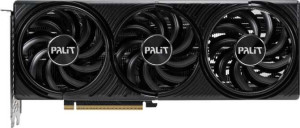
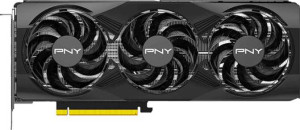
At their core, the Palit RTX 5070 Infinity 3 and the PNY RTX 5070 Triple Fan are built on identical silicon: both share 6144 shading units, 192 TMUs, and 80 ROPs, which means their theoretical throughput ceilings are nearly the same. This is reflected in the derived metrics — pixel rate, texture rate, and floating-point performance differ by less than 0.2% between the two cards, a gap that is functionally invisible in any real workload.
Where the two cards diverge is in their clock speed profiles and memory configuration. The Palit carries a significantly higher base GPU clock of 2325 MHz versus the PNY's 2160 MHz — a 165 MHz advantage. In practice, a higher base clock means the card sustains elevated performance more consistently under sustained, thermally demanding loads, rather than only boosting briefly. However, both cards reach an almost identical boost clock (~2510–2512 MHz), so peak burst performance is a wash. On the flip side, the PNY holds a notable edge in memory speed at 2209 MHz compared to the Palit's 1750 MHz, which translates to higher memory bandwidth — beneficial for memory-bound scenarios like high-resolution textures or large framebuffers.
Overall, these two cards are extremely evenly matched in performance. The Palit has an edge in sustained GPU compute consistency thanks to its higher base clock, while the PNY has an advantage in memory throughput. For most gaming and creative workloads the difference will be negligible, but workloads sensitive to memory bandwidth may lean slightly toward the PNY, while those stressing the shader cores under prolonged load may benefit marginally from the Palit's higher base clock floor.