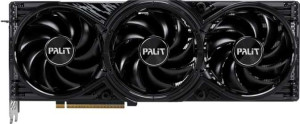
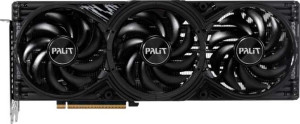
At their core, both cards share identical foundations: the same 2295 MHz base clock, 8960 shading units, 280 TMUs, 96 ROPs, and 1750 MHz memory speed. This means the underlying GPU silicon and memory subsystem are the same, and any performance delta between the two comes entirely from how far each card is willing to push that silicon under sustained load.
The meaningful divergence appears in the boost clock. The GamingPro-S OC sustains a 2482 MHz GPU turbo versus the GamingPro's 2452 MHz — a 30 MHz advantage that cascades directly into every throughput metric. The OC variant delivers 44.48 TFLOPS of floating-point performance against 43.94 TFLOPS, a 695 GTexels/s texture fill rate versus 686.6 GTexels/s, and a 238.3 GPixel/s pixel rate against 235.4 GPixel/s. In practice, these ~1.2% gains are modest — they translate to marginally smoother frame pacing at the very top end of a workload, particularly in texture-heavy scenes or GPU-bound rendering tasks, but are unlikely to produce a noticeable framerate difference in typical gaming.
The GamingPro-S OC holds a clear, if narrow, performance edge in this group. Every throughput figure it produces is higher, driven solely by its factory-overclocked boost clock. For users prioritizing peak theoretical throughput or running workloads that fully saturate the GPU, the OC model is the rational choice. However, given the gap is under 1.5% across all metrics, real-world gaming performance will be virtually indistinguishable between the two.