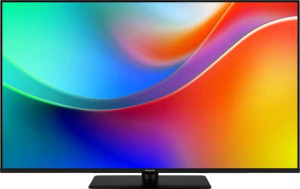
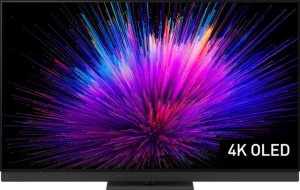
The most fundamental difference here is panel technology. The 55W85BEY uses a QLED LED-backlit LCD panel, while the 77Z95BEB features an OLED display — and this distinction shapes the entire viewing experience. OLED panels produce light on a per-pixel basis, enabling perfect blacks and theoretically infinite contrast ratios, whereas QLED relies on a backlight that, even with local dimming, cannot match OLED's precision in dark scenes. For cinematic content or dim-room viewing, the OLED panel of the Z95B holds a structural advantage that no spec number fully captures.
On pixel density, the picture flips: the smaller 55W85BEY delivers 80 ppi versus the Z95BEB's 57 ppi, meaning individual pixels are more tightly packed on the 55″ screen. At typical living-room viewing distances, both are unlikely to show visible pixelation at 4K, but the W85B's higher density can appear slightly crisper up close. Meanwhile, the Z95BEB edges ahead in motion handling with a 144Hz refresh rate compared to the W85B's 120Hz — a meaningful advantage for fast-motion sports or gaming, where the extra headroom reduces blur and tearing. Both share AMD FreeSync Premium adaptive sync, full HDR suite support (HDR10, HDR10+, Dolby Vision, HLG), 10-bit depth, and identical 178° viewing angles, so neither pulls ahead on color volume or format compatibility.
Overall, the 77Z95BEB holds a clear display advantage for home cinema use thanks to its OLED panel and higher refresh rate, plus the added practicality of an ambient light sensor that can automatically adjust brightness — a feature absent on the W85B. The 55W85BEY's stronger pixel density is a real but secondary benefit, and its QLED technology is competitive for bright-room environments. The choice ultimately comes down to panel priority: OLED contrast and size versus QLED sharpness at a smaller footprint.