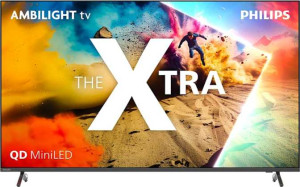
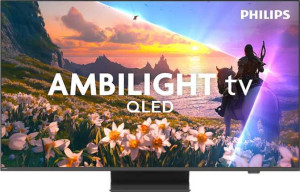
Philips 65MLED950/12 65"
Philips 65PUS8600/12 65"

Philips 65MLED950/12 65" Philips 65PUS8600/12 65"

Overview

Welcome to our in-depth specification comparison between the Philips 65MLED950/12 65″ and the Philips 65PUS8600/12 65″. Both are 4K QLED televisions sharing a strong foundation of smart features, HDR support, and audio capabilities, yet they differ meaningfully in areas like display technology, refresh rate, and physical design. Read on to discover which of these two Philips screens best suits your living room and viewing habits.

Common Features

  • Both products have a 4K (UHD) display resolution.
  • Both products share a resolution of 3840 x 2160 px.
  • Both products have a pixel density of 68 ppi.
  • Both products support 1070 million display colors.
  • Both products have a 10-bit color bit depth.
  • HDR10 support is available on both products.
  • HDR10+ support is available on both products.
  • HLG support is available on both products.
  • Bluetooth is available on both products.
  • Both products have an HDMI version of 2.1.
  • Wi-Fi support is available on both products.
  • Both products support Wi-Fi 4 (802.11n) and Wi-Fi 5 (802.11ac).
  • Both products have a Bluetooth version of 5.2.
  • Both products have 2 USB ports.
  • Both products have 1 RJ45 port.
  • Miracast support is available on both products.
  • Digital Out support is available on both products.
  • SRS TheaterSound HD is not available on either product.
  • Stereo speakers are present on both products.
  • Dolby Atmos support is available on both products.
  • Dolby Audio support is available on both products.
  • Dolby Virtual support is not available on either product.
  • DTS:X support is available on both products.
  • Both products feature HDMI ARC and HDMI eARC.
  • Both products share a width of 1451 mm.
  • VESA mount support is available on both products.
  • Chromecast is built into both products.
  • Both products include a built-in smart TV platform.
  • Google Assistant compatibility is available on both products.
  • Alexa compatibility is available on both products.
  • Siri and Apple HomeKit compatibility is not available on either product.
  • Remote smartphone control is supported on both products.
  • Neither product has a rechargeable remote control.
  • USB recording is supported on both products.

Main Differences

  • The display type is QLED, LED-backlit, LCD, Mini-LED on Philips 65MLED950/12 65″ and QLED, LED-backlit, LCD on Philips 65PUS8600/12 65″.
  • The screen size is 65″ on Philips 65MLED950/12 65″ and 64.5″ on Philips 65PUS8600/12 65″.
  • The refresh rate is 144Hz on Philips 65MLED950/12 65″ and 60Hz on Philips 65PUS8600/12 65″.
  • The number of HDMI ports is 4 on Philips 65MLED950/12 65″ and 3 on Philips 65PUS8600/12 65″.
  • A subwoofer is present on Philips 65MLED950/12 65″ but not available on Philips 65PUS8600/12 65″.
  • The weight is 32700 g on Philips 65MLED950/12 65″ and 24240 g on Philips 65PUS8600/12 65″.
  • The thickness is 52 mm on Philips 65MLED950/12 65″ and 85 mm on Philips 65PUS8600/12 65″.
  • The height is 840 mm on Philips 65MLED950/12 65″ and 847 mm on Philips 65PUS8600/12 65″.
  • The volume is 63379.68 cm³ on Philips 65MLED950/12 65″ and 104464.745 cm³ on Philips 65PUS8600/12 65″.
  • The operating power consumption is 102W on Philips 65MLED950/12 65″ and 101W on Philips 65PUS8600/12 65″.
Specs Comparison
Philips 65MLED950/12 65"

Philips 65MLED950/12 65"

Philips 65PUS8600/12 65"

Philips 65PUS8600/12 65"

Display:
display resolution 4K (UHD) 4K (UHD)
Display type QLED, LED-backlit, LCD, Mini-LED QLED, LED-backlit, LCD
screen size 65" 64.5"
resolution 3840 x 2160 px 3840 x 2160 px
pixel density 68 ppi 68 ppi
display colors 1070 million 1070 million
bit depth 10-bit 10-bit
refresh rate 144Hz 60Hz
supports HDR10
supports HDR10+
supports HLG
has anti-reflection coating
has an ambient light sensor
maximum horizontal viewing angle 178º 178º
maximum vertical viewing angle 178º 178º

Both the Philips 65MLED950/12 and the Philips 65PUS8600/12 share a strong display foundation: identical 4K (3840 × 2160) resolution, 68 ppi pixel density, 10-bit color depth rendering 1.07 billion colors, and full support for HDR10, HDR10+, and HLG. Both also feature anti-reflection coatings and ambient light sensors, along with wide 178° viewing angles in both axes — meaning neither panel will disappoint when it comes to color accuracy from off-axis seating positions.

Where the two televisions meaningfully diverge is in panel technology and motion handling. The 65MLED950/12 uses a Mini-LED backlighting layer on top of its QLED LCD panel, which enables far more precise local dimming zones compared to the conventional LED-backlit QLED of the 65PUS8600/12. In practice, this translates to deeper perceived blacks, reduced blooming around bright objects, and higher peak brightness — a tangible advantage for HDR content in particular. Equally significant is the refresh rate gap: the 65MLED950/12 runs at 144Hz versus the 65PUS8600/12′s 60Hz. For fast-motion content — sports, action films, and especially gaming — 144Hz delivers noticeably smoother motion with far less blur or judder.

The 65MLED950/12 holds a clear advantage in this display category. Its Mini-LED backlight gives it a structural edge in contrast and HDR performance, and its 144Hz refresh rate makes it the stronger choice for any use case where motion clarity matters. The 65PUS8600/12 is a competent 4K panel with solid HDR support, but it cannot match the backlighting precision or motion fluidity of its sibling.

Connectivity:
Has Bluetooth
HDMI version HDMI 2.1 HDMI 2.1
HDMI ports 4 3
supports Wi-Fi
Wi-Fi version Wi-Fi 4 (802.11n), Wi-Fi 5 (802.11ac) Wi-Fi 4 (802.11n), Wi-Fi 5 (802.11ac)
Bluetooth version 5.2 5.2
USB ports 2 2
RJ45 ports 1 1
supports Miracast
has a socket for a 3.5 mm audio jack
has an external memory slot
has a VGA connector
DVB standards DVB-T, DVB-T2, DVB-C, DVB-S, DVB-S2 DVB-T, DVB-T2, DVB-C, DVB-S, DVB-S2
has a DVI connector

Connectivity between these two televisions is remarkably close. Both share HDMI 2.1 ports — a meaningful detail, since HDMI 2.1 supports the higher bandwidth needed for 4K at 120Hz and features like Variable Refresh Rate (VRR) and Auto Low Latency Mode (ALLM), which matter for modern gaming consoles and PC use. Wireless capabilities are also identical: Wi-Fi 5 (802.11ac) and Bluetooth 5.2 on both models ensure stable streaming and reliable peripheral pairing at current-generation standards.

The one tangible difference is HDMI port count: the 65MLED950/12 offers 4 HDMI ports versus 3 on the 65PUS8600/12. For users running multiple sources simultaneously — a games console, a soundbar via ARC, a streaming stick, and a Blu-ray player, for instance — that extra port eliminates the need for a switching hub. Everything else, from the dual USB ports and single RJ45 Ethernet jack to Miracast support and the 3.5mm audio output, is identical across both models.

In this category, the 65MLED950/12 holds a narrow practical edge purely by virtue of its additional HDMI port. For users with dense home theater setups, this is a genuine convenience advantage. For anyone running three or fewer HDMI devices, however, connectivity is effectively a tie.

Audio:
supports Digital Out
has SRS TheaterSound HD
has stereo speakers
has Dolby Atmos
has Dolby Audio
supports Dolby Virtual
has a subwoofer
has DTS:X
HDMI ARC / eARC HDMI ARC, HDMI eARC HDMI ARC, HDMI eARC

On the audio front, these two televisions share a solid common foundation: both support Dolby Atmos, Dolby Audio, and DTS:X — the three dominant surround and object-based audio formats in use today. Combined with HDMI ARC and eARC on both models, either TV can pass high-quality audio to an external soundbar or AV receiver with ease. eARC in particular is worth noting, as it supports lossless and object-based audio formats over a single HDMI cable without quality compromise.

The one meaningful hardware distinction is that the 65MLED950/12 includes a built-in subwoofer, while the 65PUS8600/12 does not. A dedicated subwoofer handles low-frequency reproduction — the deep bass you feel during explosions, cinematic scores, or action sequences — that standard stereo TV speakers simply cannot reproduce convincingly. For users who plan to watch without an external sound system, this is a real and audible difference in the listening experience.

The 65MLED950/12 takes a clear edge in audio for standalone use. If you intend to pair either TV with a dedicated soundbar or home theater system, the gap narrows considerably, as both offer the same format support and eARC passthrough. But for out-of-the-box sound quality, the built-in subwoofer on the 65MLED950/12 is a tangible advantage the 65PUS8600/12 cannot match.

Design:
width 1451 mm 1451 mm
weight 32700 g 24240 g
thickness 52 mm 85 mm
height 840 mm 847 mm
volume 63379.68 cm³ 104464.745 cm³
Supports VESA mount

At identical widths of 1451 mm and near-identical heights, these two televisions occupy the same wall footprint — but their physical profiles tell a different story. The 65MLED950/12 is substantially slimmer at 52 mm deep compared to the 65PUS8600/12′s 85 mm, a difference that is clearly visible in a side profile and particularly relevant for wall-mount installations where a low-profile look is desirable. This slimness also accounts for the 65MLED950/12′s significantly smaller overall volume.

The weight figures, however, run in the opposite direction. Despite being the thinner set, the 65MLED950/12 weighs considerably more at 32.7 kg versus 24.2 kg for the 65PUS8600/12 — a gap of over 8 kg. This is a practically important consideration: heavier televisions demand more robust wall mounts and make single-person installation considerably more difficult. Both models do support VESA mounting, so wall installation is an option for either.

Design-wise, there is no single winner — it depends on the use case. The 65MLED950/12 wins on slim profile, making it the better fit for wall-mounted setups where depth aesthetics matter. The 65PUS8600/12 wins on weight, making it easier to handle, install, and reposition. Buyers prioritizing a sleek wall installation should lean toward the 65MLED950/12, while those concerned about ease of mounting or handling will find the 65PUS8600/12 more manageable.

Features:
release date May 2025 February 2025
has Chromecast built-in
has built-in smart TV
compatible with Google Assistant
works with Alexa
works with Siri/Apple HomeKit
supports a remote smartphone
has a rechargeable remote control
supports USB recording
operating power consumption 102W 101W
standby power consumption 0.5W 0.5W
has a search browser
has a sleep timer
has a child lock
has voice commands
EU energy label F F

Across the features category, these two televisions are essentially identical. Both run a built-in smart TV platform with Chromecast built-in, support Google Assistant and Alexa voice control, and allow smartphone remote control — covering the full range of mainstream smart home ecosystems short of Apple HomeKit, which neither supports. USB recording, a sleep timer, child lock, and a built-in browser round out a feature set that is, point for point, the same on both models.

Power consumption is also virtually indistinguishable: 102W operating for the 65MLED950/12 versus 101W for the 65PUS8600/12, with identical 0.5W standby draw and the same EU energy label F rating on both. Given the 65MLED950/12′s Mini-LED panel and higher refresh rate, drawing only 1W more in operation is a noteworthy efficiency result, though in practical terms the running costs of both sets will be essentially equivalent.

This category is a clear tie. There is no meaningful differentiator between the two televisions in features or energy consumption. A buyer's decision here will not be swayed by smart functionality, voice assistant support, or power draw — those factors are effectively removed from the equation, leaving display, audio, and design as the deciding considerations.

Comparison Summary & Verdict

After examining every specification, the two Philips sets occupy clearly different niches. The Philips 65MLED950/12 65″ stands out with its Mini-LED backlight, a faster 144Hz refresh rate, four HDMI 2.1 ports, and a built-in subwoofer, making it the stronger choice for gamers, sports fans, and home-cinema enthusiasts who demand the best picture motion and immersive sound. Its slimmer 52 mm profile is also a design bonus despite the added weight. The Philips 65PUS8600/12 65″, on the other hand, delivers the same core 4K QLED image quality, smart platform, and Dolby Atmos support at a lighter 24240 g and in a more compact volume, making it a practical and cost-conscious option for everyday family viewing where a standard 60Hz panel is perfectly adequate.

Philips 65MLED950/12 65
Buy Philips 65MLED950/12 65" if...

Buy the Philips 65MLED950/12 65″ if you want a premium Mini-LED display with a 144Hz refresh rate, four HDMI ports, and a built-in subwoofer for gaming or cinematic home entertainment.

Philips 65PUS8600/12 65
Buy Philips 65PUS8600/12 65" if...

Buy the Philips 65PUS8600/12 65″ if you need a lighter, more compact 4K QLED TV for everyday viewing and do not require a high refresh rate or a built-in subwoofer.