Philips 65OLED950/12 65"
TCL 75C6KS 75"

Philips 65OLED950/12 65" TCL 75C6KS 75"

Overview

Welcome to our in-depth comparison between the Philips 65OLED950/12 65″ and the TCL 75C6KS 75″. These two TVs take very different approaches to picture technology, with one relying on OLED panel technology and the other on a Mini-LED QLED display, making the choice far from straightforward. Beyond the screen, key battlegrounds include refresh rate, pixel density, audio capabilities, and overall form factor — all of which can significantly impact your viewing experience.

Common Features

  • Both products have a 4K (UHD) display resolution of 3840 x 2160 px.
  • Both products display 1070 million colors at a 10-bit depth.
  • HDR10 support is available on both products.
  • HDR10+ support is available on both products.
  • Dolby Vision support is available on both products.
  • HLG support is available on both products.
  • Both products have Bluetooth and Wi-Fi connectivity.
  • Both products support Wi-Fi 4 (802.11n) and Wi-Fi 5 (802.11ac).
  • Both products feature HDMI 2.1 with 4 HDMI ports.
  • Both products have 2 USB ports and 1 RJ45 port.
  • Miracast support is available on both products.
  • Dolby Digital support is available on both products.
  • Digital Out support is available on both products.
  • Both products have stereo speakers, a subwoofer, and support Dolby Atmos and Dolby Audio.
  • SRS TheaterSound HD is not available on either product.
  • Dolby Virtual support is not available on either product.
  • Both products support VESA mounting.
  • Both products operate within a temperature range of 5 °C to 35 °C.
  • AirPlay is available on both products.
  • Both products have a built-in smart TV platform, are compatible with Google Assistant, support remote smartphone control, and support USB recording.
  • Works with Siri/Apple HomeKit is not available on either product.
  • Neither product has a rechargeable remote control.
  • Both products have a standby power consumption of 0.5W.

Main Differences

  • The display type is OLED/AMOLED on Philips 65OLED950/12 65″ and QLED, LED-backlit, LCD, Mini-LED on TCL 75C6KS 75″.
  • The screen size is 65″ on Philips 65OLED950/12 65″ and 74.5″ on TCL 75C6KS 75″.
  • Pixel density is 68 ppi on Philips 65OLED950/12 65″ and 59 ppi on TCL 75C6KS 75″.
  • The refresh rate is 144Hz on Philips 65OLED950/12 65″ and 120Hz on TCL 75C6KS 75″.
  • Bluetooth version is 5.2 on Philips 65OLED950/12 65″ and 5.4 on TCL 75C6KS 75″.
  • Dolby Digital Plus support is present on TCL 75C6KS 75″ but not available on Philips 65OLED950/12 65″.
  • Width is 1444 mm on Philips 65OLED950/12 65″ and 1670 mm on TCL 75C6KS 75″.
  • Weight is 24020 g on Philips 65OLED950/12 65″ and 23500 g on TCL 75C6KS 75″.
  • Thickness is 65 mm on Philips 65OLED950/12 65″ and 56.7 mm on TCL 75C6KS 75″.
  • Height is 831 mm on Philips 65OLED950/12 65″ and 960 mm on TCL 75C6KS 75″.
  • Volume is 77997.66 cm³ on Philips 65OLED950/12 65″ and 90901.44 cm³ on TCL 75C6KS 75″.
Specs Comparison
Philips 65OLED950/12 65"

Philips 65OLED950/12 65"

TCL 75C6KS 75"

TCL 75C6KS 75"

Display:
display resolution 4K (UHD) 4K (UHD)
Display type OLED/AMOLED QLED, LED-backlit, LCD, Mini-LED
screen size 65" 74.5"
resolution 3840 x 2160 px 3840 x 2160 px
pixel density 68 ppi 59 ppi
display colors 1070 million 1070 million
bit depth 10-bit 10-bit
refresh rate 144Hz 120Hz
supports HDR10
supports HDR10+
supports Dolby Vision
supports HLG
has anti-reflection coating
has an ambient light sensor
maximum horizontal viewing angle 178º 178º
maximum vertical viewing angle 178º 178º

Both the Philips 65OLED950/12 and the TCL 75C6KS share the same 4K (3840 x 2160) resolution, 10-bit color depth, and support for every major HDR format — HDR10, HDR10+, Dolby Vision, and HLG — meaning neither has an edge in color standard compatibility. They also match on viewing angles (178° both axes), anti-reflection coating, and ambient light sensor, so on paper these shared traits cancel out.

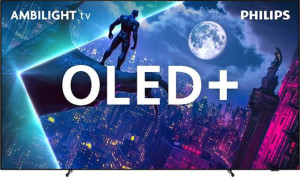
The most consequential difference is panel technology. The Philips uses an OLED/AMOLED panel, which delivers per-pixel light control, true blacks, and near-infinite contrast — qualities no LCD-based screen can replicate. The TCL relies on QLED Mini-LED LCD technology, which offers strong peak brightness through its Mini-LED backlight but is fundamentally limited by backlight blooming around bright objects on dark scenes. In practice, the Philips will produce noticeably superior shadow detail and contrast in dark-room viewing. The TCL′s larger 74.5″ screen versus the Philips′s 65″ gives it a raw size advantage, but the Philips partially offsets this with a higher pixel density (68 ppi vs. 59 ppi), meaning its image is sharper per inch of screen.

The Philips also holds an edge in motion handling with a 144Hz refresh rate against the TCL′s 120Hz, which matters for fast-motion content and gaming. Overall, the Philips 65OLED950/12 has a clear display quality advantage thanks to its OLED panel and higher refresh rate; the TCL 75C6KS counters only with its larger screen size, which may be the deciding factor for viewers who prioritize sheer viewing area over image fidelity.

Connectivity:
Has Bluetooth
HDMI version HDMI 2.1 HDMI 2.1
HDMI ports 4 4
supports Wi-Fi
Wi-Fi version Wi-Fi 4 (802.11n), Wi-Fi 5 (802.11ac) Wi-Fi 4 (802.11n), Wi-Fi 5 (802.11ac)
Bluetooth version 5.2 5.4
USB ports 2 2
RJ45 ports 1 1
supports Miracast
has a socket for a 3.5 mm audio jack
has an external memory slot
has a VGA connector
DVB standards DVB-T, DVB-T2, DVB-C, DVB-S, DVB-S2 DVB-T, DVB-T2, DVB-C, DVB-S, DVB-S2
has a DVI connector

The connectivity profiles of the Philips 65OLED950/12 and the TCL 75C6KS are remarkably similar across almost every dimension. Both offer 4 HDMI 2.1 ports, 2 USB ports, an RJ45 ethernet jack, a 3.5mm audio socket, Miracast support, and identical Wi-Fi coverage (Wi-Fi 4 and Wi-Fi 5). For most users, this means the day-to-day wiring experience — connecting consoles, soundbars, streaming sticks, or a home network — will be essentially identical between the two.

The only spec that separates them is Bluetooth version: the TCL carries Bluetooth 5.4 versus the Philips′s Bluetooth 5.2. In practice, 5.4 brings modest improvements in connection stability and energy efficiency over 5.2, which could marginally benefit wireless headphone or peripheral users, but the real-world difference in everyday TV use is unlikely to be noticeable. Neither TV supports external memory expansion, and both share the same DVB tuner standards (DVB-T/T2/C/S/S2), so broadcast reception capability is identical.

On connectivity, these two televisions are effectively evenly matched. The TCL′s slight Bluetooth version lead is the only differentiator, and it is too minor to constitute a meaningful advantage for the vast majority of use cases.

Audio:
supports Dolby Digital
supports Digital Out
supports Dolby Digital Plus
has SRS TheaterSound HD
has stereo speakers
has Dolby Atmos
has Dolby Audio
supports Dolby Virtual
has a subwoofer
has DTS:X
HDMI ARC / eARC HDMI ARC, HDMI eARC HDMI eARC, HDMI ARC

From a built-in audio standpoint, the two TVs are broadly well-matched. Both include integrated subwoofers, stereo speakers, and support for Dolby Atmos, Dolby Audio, and DTS:X — the three formats most commonly encountered on streaming platforms and physical media. Both also feature full HDMI ARC and eARC support, meaning either can pass high-quality audio to an external soundbar or AV receiver with equal capability.

The sole differentiator is that the TCL 75C6KS supports Dolby Digital Plus, while the Philips 65OLED950/12 does not. Dolby Digital Plus is an enhanced encoding format that carries higher bitrates than standard Dolby Digital and serves as the delivery mechanism for Dolby Atmos on streaming services like Netflix and Disney+. Its absence on the Philips means that, in certain streaming scenarios, the TV may downconvert the audio signal to standard Dolby Digital before passing it to an external audio device — a limitation that is most relevant when using eARC passthrough to a Dolby Atmos-capable soundbar.

For users relying entirely on the TV′s built-in speakers, the real-world gap is negligible. But for those planning to pair the TV with a high-end audio system, the TCL holds a narrow but genuine audio edge thanks to its Dolby Digital Plus support, which ensures a cleaner, full-fidelity Atmos signal chain from streaming sources.

Design:
width 1444 mm 1670 mm
weight 24020 g 23500 g
thickness 65 mm 56.7 mm
height 831 mm 960 mm
volume 77997.66 cm³ 90901.44 cm³
Supports VESA mount
maximum operating temperature 35 °C 35 °C
lowest potential operating temperature 5 °C 5 °C

Size differences are expected given the screen gap between these two TVs, but a few figures stand out. The TCL 75C6KS is naturally larger in footprint — 1670 mm wide versus 1444 mm for the Philips — and its greater volume reflects this. What is more interesting is the thickness comparison: the TCL measures 56.7 mm deep while the Philips comes in at 65 mm, meaning the larger TCL actually sits slimmer against a wall. For wall-mount installations where a low-profile look matters, this is a tangible advantage despite the TCL′s bigger screen.

Weight tells a different story. The Philips 65OLED950/12 weighs 24,020 g versus the TCL′s 23,500 g — making the Philips marginally heavier despite being a significantly smaller television. This is consistent with OLED panel construction, which can carry more weight relative to screen area than LCD-based designs. In practice, both TVs fall into a comparable handling bracket, and neither presents an unusual installation challenge. Both support VESA mounting and share identical operating temperature ranges, so environment suitability is equal.

On design specs, there is no decisive winner — the choice depends on context. The TCL has a slimmer profile, which favors wall mounting aesthetics, while the Philips is more compact overall and slightly easier to fit into tighter spaces. Users prioritizing a sleek wall installation will lean toward the TCL; those with constrained room dimensions will appreciate the Philips′s smaller footprint.

Features:
release date June 2025 March 2025
has AirPlay
has built-in smart TV
compatible with Google Assistant
works with Siri/Apple HomeKit
supports a remote smartphone
has a rechargeable remote control
supports USB recording
standby power consumption 0.5W 0.5W
has a search browser
has a sleep timer
has a child lock
has voice commands

Across every feature in this group, the Philips 65OLED950/12 and the TCL 75C6KS are a perfect match. Both carry built-in smart TV platforms, AirPlay, Google Assistant compatibility, smartphone remote support, USB recording, voice commands, and a browser — covering the full range of features most users actively rely on day to day. Neither supports Apple HomeKit or Siri, so users embedded in the Apple ecosystem will find the same limitation on both sets.

A few of the shared specs are worth contextualizing. USB recording allows users to connect an external drive and record live broadcast content directly — a useful feature that is increasingly absent on budget TVs but present on both of these. The 0.5W standby consumption is equally low on each, which is a responsible figure for always-on smart TV platforms. The absence of a rechargeable remote on both is a minor convenience trade-off, but it is a shared limitation rather than a differentiator.

This group results in a complete tie. Every feature listed is identical across both products, so the Features category offers no basis for choosing one over the other.

Comparison Summary & Verdict

After reviewing all specifications, the right choice between the Philips 65OLED950/12 65″ and the TCL 75C6KS 75″ depends heavily on your priorities. The Philips stands out with its OLED/AMOLED panel, delivering superior pixel density at 68 ppi and a faster 144Hz refresh rate, making it ideal for viewers who demand the finest picture quality and smooth motion in a more compact footprint. The TCL, on the other hand, offers a larger 74.5-inch Mini-LED QLED screen, Dolby Digital Plus support, and a more up-to-date Bluetooth 5.4 — appealing to those who prioritize screen real estate and broader audio format compatibility. Both share strong HDR credentials, identical HDMI 2.1 connectivity, and smart platform features, so neither disappoints on the fundamentals.

Philips 65OLED950/12 65
Buy Philips 65OLED950/12 65" if...

Buy the Philips 65OLED950/12 65″ if you prioritize true OLED picture quality, a higher pixel density, and a faster 144Hz refresh rate for an immersive, sharp viewing experience.

TCL 75C6KS 75
Buy TCL 75C6KS 75" if...

Buy the TCL 75C6KS 75″ if you want a larger 74.5-inch Mini-LED QLED screen, Dolby Digital Plus audio support, and the latest Bluetooth 5.4 connectivity.