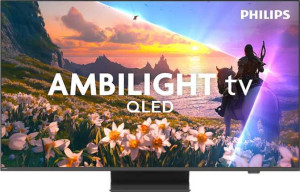
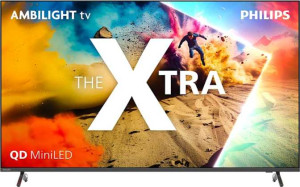
Philips 65PUS8600/12 65"
Philips 75MLED950/12 75"

Philips 65PUS8600/12 65" Philips 75MLED950/12 75"

Overview

Welcome to our in-depth specification comparison between the Philips 65PUS8600/12 65″ and the Philips 75MLED950/12 75″. These two Philips TVs share a strong foundation of 4K QLED picture quality and a rich smart TV feature set, yet they diverge in key areas such as display technology, refresh rate, and audio capabilities. Read on to discover how each model stacks up across every major specification category.

Common Features

  • Both products have a 4K (UHD) display resolution of 3840 x 2160 px.
  • Both products display 1.07 billion colors with a 10-bit color depth.
  • HDR10 support is available on both products.
  • HDR10+ support is available on both products.
  • HLG support is available on both products.
  • An anti-reflection coating is present on both products.
  • Bluetooth is available on both products at version 5.2.
  • Both products support Wi-Fi, including Wi-Fi 4 (802.11n) and Wi-Fi 5 (802.11ac).
  • Both products feature HDMI 2.1 ports.
  • Both products include 2 USB ports and 1 RJ45 port.
  • Miracast support is available on both products.
  • Both products support Digital Out audio.
  • SRS TheaterSound HD is not available on either product.
  • Both products feature stereo speakers.
  • Dolby Atmos and Dolby Audio are supported on both products.
  • Dolby Virtual support is not available on either product.
  • DTS:X support is available on both products.
  • Both products include HDMI ARC and HDMI eARC.
  • Both products support VESA mounting.
  • Chromecast is built into both products.
  • Both products have a built-in smart TV platform compatible with Google Assistant and Alexa.
  • Siri and Apple HomeKit are not supported on either product.
  • Both products support remote smartphone control.
  • A rechargeable remote control is not included with either product.
  • USB recording is supported on both products.

Main Differences

  • The display type is QLED, LED-backlit, LCD on Philips 65PUS8600/12 65″ and QLED, LED-backlit, LCD, Mini-LED on Philips 75MLED950/12 75″.
  • The screen size is 64.5″ on Philips 65PUS8600/12 65″ and 75″ on Philips 75MLED950/12 75″.
  • The pixel density is 68 ppi on Philips 65PUS8600/12 65″ and 59 ppi on Philips 75MLED950/12 75″.
  • The refresh rate is 60Hz on Philips 65PUS8600/12 65″ and 144Hz on Philips 75MLED950/12 75″.
  • The number of HDMI ports is 3 on Philips 65PUS8600/12 65″ and 4 on Philips 75MLED950/12 75″.
  • A built-in subwoofer is not present on Philips 65PUS8600/12 65″ but is included on Philips 75MLED950/12 75″.
  • The width is 1451 mm on Philips 65PUS8600/12 65″ and 1672 mm on Philips 75MLED950/12 75″.
  • The height is 847 mm on Philips 65PUS8600/12 65″ and 962 mm on Philips 75MLED950/12 75″.
  • The thickness is 85 mm on Philips 65PUS8600/12 65″ and 61 mm on Philips 75MLED950/12 75″.
  • The weight is 24240 g on Philips 65PUS8600/12 65″ and 35370 g on Philips 75MLED950/12 75″.
  • The volume is 104464.745 cm³ on Philips 65PUS8600/12 65″ and 98116.304 cm³ on Philips 75MLED950/12 75″.
  • The operating power consumption is 101W on Philips 65PUS8600/12 65″ and 126W on Philips 75MLED950/12 75″.
Specs Comparison
Philips 65PUS8600/12 65"

Philips 65PUS8600/12 65"

Philips 75MLED950/12 75"

Philips 75MLED950/12 75"

Display:
display resolution 4K (UHD) 4K (UHD)
Display type QLED, LED-backlit, LCD QLED, LED-backlit, LCD, Mini-LED
screen size 64.5" 75"
resolution 3840 x 2160 px 3840 x 2160 px
pixel density 68 ppi 59 ppi
display colors 1070 million 1070 million
bit depth 10-bit 10-bit
refresh rate 60Hz 144Hz
supports HDR10
supports HDR10+
supports HLG
has anti-reflection coating
has an ambient light sensor
maximum horizontal viewing angle 178º 178º
maximum vertical viewing angle 178º 178º

Both the Philips 65PUS8600/12 and the Philips 75MLED950/12 share a strong common foundation: identical 4K (3840 x 2160) resolution, 10-bit color depth supporting 1.07 billion colors, full HDR10, HDR10+, and HLG support, plus identical 178° viewing angles in both axes. These shared traits mean neither product is at a disadvantage when it comes to color volume, HDR versatility, or off-axis watchability.

The most impactful differentiator is the 75MLED950/12's use of Mini-LED backlighting combined with a 144Hz refresh rate, versus the 65PUS8600/12's conventional LED-backlit panel running at just 60Hz. In practice, Mini-LED allows for far more precise local dimming zones, which translates to deeper blacks and significantly better contrast handling — a meaningful real-world upgrade over standard edge or direct LED backlighting. The jump from 60Hz to 144Hz is equally consequential: fast-moving content such as sports, gaming, or action sequences will appear noticeably smoother and sharper on the 75MLED950/12. Meanwhile, the 65PUS8600/12's slightly higher pixel density of 68 ppi versus 59 ppi on the larger 75″ model means fine detail is marginally crisper at close viewing distances, though at typical living-room distances this difference is rarely perceptible.

The 75MLED950/12 holds a clear display advantage in this comparison. Its Mini-LED backlighting and 144Hz refresh rate represent meaningful generational improvements over the 65PUS8600/12 in both picture quality and motion handling. The modest pixel density trade-off is an unavoidable consequence of the larger 75″ panel and is unlikely to matter for most users. Unless screen size is a constraint, the 75MLED950/12 is the stronger performer across the display category.

Connectivity:
Has Bluetooth
HDMI version HDMI 2.1 HDMI 2.1
HDMI ports 3 4
supports Wi-Fi
Wi-Fi version Wi-Fi 4 (802.11n), Wi-Fi 5 (802.11ac) Wi-Fi 4 (802.11n), Wi-Fi 5 (802.11ac)
Bluetooth version 5.2 5.2
USB ports 2 2
RJ45 ports 1 1
supports Miracast
has a socket for a 3.5 mm audio jack
has an external memory slot
has a VGA connector
DVB standards DVB-T, DVB-T2, DVB-C, DVB-S, DVB-S2 DVB-T, DVB-T2, DVB-C, DVB-S, DVB-S2
has a DVI connector

Connectivity between the two models is remarkably close. Both share HDMI 2.1, Bluetooth 5.2, dual-band Wi-Fi up to Wi-Fi 5 (802.11ac), 2 USB ports, a LAN port, Miracast support, and a 3.5mm audio jack. The full DVB tuner suite — DVB-T/T2, DVB-C, and DVB-S/S2 — is also identical, meaning both handle terrestrial, cable, and satellite signals equally well.

The single differentiator in this group is the 75MLED950/12's 4 HDMI 2.1 ports versus 3 on the 65PUS8600/12. For users running a full home theater setup — think a games console, a streaming device, a soundbar with ARC, and a Blu-ray player simultaneously — that extra port eliminates the need for an HDMI switch and keeps the setup cleaner. The impact is modest for casual users but genuinely practical for those with multiple 4K or 8K-capable devices, since all ports carry the full HDMI 2.1 bandwidth.

Overall, connectivity is nearly a tie. The 75MLED950/12 earns a slight edge solely due to its additional HDMI port; every other connectivity specification is identical. Neither model offers Wi-Fi 6, which would have been a more meaningful differentiator, so if a dense wireless environment is a concern, a wired RJ45 connection remains the best option on both TVs.

Audio:
supports Digital Out
has SRS TheaterSound HD
has stereo speakers
has Dolby Atmos
has Dolby Audio
supports Dolby Virtual
has a subwoofer
has DTS:X
HDMI ARC / eARC HDMI ARC, HDMI eARC HDMI ARC, HDMI eARC

On the audio format side, both TVs are evenly matched. Dolby Atmos, Dolby Audio, and DTS:X are all present on both models, covering the vast majority of encoded audio tracks found on streaming platforms and physical media. Both also support HDMI ARC and eARC, meaning either TV can pass high-bandwidth lossless audio formats — such as Dolby TrueHD Atmos or DTS-HD Master Audio — to a compatible soundbar or AV receiver without an optical cable.

The one hardware distinction is the 75MLED950/12's built-in subwoofer, which the 65PUS8600/12 lacks. A dedicated subwoofer handles low-frequency reproduction independently from the main drivers, resulting in more pronounced bass response for music, movies, and action content directly from the TV's own speaker system. For users who intend to rely on the TV's internal audio rather than an external soundbar, this is a tangible real-world advantage.

The 75MLED950/12 takes a clear edge in this category. Format support is identical across both models, but the integrated subwoofer means the 75MLED950/12 can deliver a more complete audio experience out of the box — particularly relevant given that its premium positioning makes standalone use without external audio equipment a realistic scenario for many buyers.

Design:
width 1451 mm 1672 mm
weight 24240 g 35370 g
thickness 85 mm 61 mm
height 847 mm 962 mm
volume 104464.745 cm³ 98116.304 cm³
Supports VESA mount

Size differences are expected given the 65″ versus 75″ screen gap, but the physical numbers reveal some interesting trade-offs. The 75MLED950/12 is naturally wider (1672 mm vs 1451 mm) and taller (962 mm vs 847 mm), which has direct implications for furniture and wall space planning — a 75″ TV requires a significantly larger media unit or a wider wall section than most people intuitively expect.

Where the 75MLED950/12 surprises is in its thickness of just 61 mm, compared to 85 mm on the 65PUS8600/12. A 24 mm reduction in depth is meaningful aesthetically, particularly for wall-mount installations where a slimmer profile sits closer to the wall and looks more integrated. Speaking of wall mounting, both models support VESA mounting, so either can be taken off its stand. The weight gap, however, is substantial: the 75MLED950/12 weighs 35,370 g against the 65PUS8600/12's 24,240 g — a difference of over 11 kg. That extra mass makes solo wall installation impractical and may require reinforced wall brackets.

There is no overall winner in this category since each product's design profile suits different priorities. The 65PUS8600/12 is lighter and easier to install or reposition, making it the more practical choice for flexible setups. The 75MLED950/12 offers a sleeker, slimmer chassis that rewards a permanent, well-planned wall-mount installation — provided the wall and installer can handle the additional weight.

Features:
release date February 2025 May 2025
has Chromecast built-in
has built-in smart TV
compatible with Google Assistant
works with Alexa
works with Siri/Apple HomeKit
supports a remote smartphone
has a rechargeable remote control
supports USB recording
operating power consumption 101W 126W
standby power consumption 0.5W 0.5W
has a search browser
has a sleep timer
has a child lock
has voice commands
EU energy label F F

Feature parity between these two models is striking. Both run a full smart TV platform with Chromecast built-in, Google Assistant, and Alexa support, covering the two dominant voice ecosystems. USB recording, smartphone remote control, and the standard suite of usability features like sleep timer and child lock are present on both. Notably, neither model supports Apple HomeKit or Siri, which is worth flagging for users deeply embedded in the Apple ecosystem who might expect it at this price tier.

The only measurable difference in this group is power consumption: the 75MLED950/12 draws 126W during operation versus 101W for the 65PUS8600/12. That 25W gap is a predictable consequence of driving a larger panel with Mini-LED backlighting, and over heavy daily use it will add a modest but non-trivial amount to annual energy costs. Standby consumption is identical at 0.5W on both, and both carry the same EU energy label F — meaning neither holds a regulatory efficiency advantage over the other despite the wattage difference.

This category is effectively a tie in terms of functionality. The smart feature sets are identical, and the power consumption difference reflects panel size rather than any efficiency shortcoming unique to one model. Buyers prioritizing a richer feature set will find no distinction here — the choice between these two comes down to the display and audio differences analyzed in other categories.

Comparison Summary & Verdict

After examining every specification, both TVs deliver a solid 4K QLED experience with broad HDR support and a well-equipped smart platform, but their strengths point toward different buyers. The Philips 65PUS8600/12 65″ is a leaner, lighter set with a higher pixel density of 68 ppi, making it an excellent choice for smaller rooms where sharp detail at close range matters most. The Philips 75MLED950/12 75″, on the other hand, raises the bar with its Mini-LED backlight, a fluid 144Hz refresh rate, a built-in subwoofer, and an extra HDMI port, making it the superior pick for home cinema enthusiasts, sports viewers, and gamers who want the most immersive large-screen experience available.

Philips 65PUS8600/12 65
Buy Philips 65PUS8600/12 65" if...

Buy the Philips 65PUS8600/12 65″ if you want a more compact, lighter TV with a sharper pixel density for a small-to-medium sized room and a lower power consumption.

Philips 75MLED950/12 75
Buy Philips 75MLED950/12 75" if...

Buy the Philips 75MLED950/12 75″ if you want a large-screen experience with a Mini-LED display, a smoother 144Hz refresh rate, a built-in subwoofer, and an extra HDMI port for a premium home cinema or gaming setup.