Philips 77OLED760/12 77"
Philips 85PUS9000/12 85"

Philips 77OLED760/12 77" Philips 85PUS9000/12 85"

Overview

Welcome to our in-depth specification comparison between the Philips 77OLED760/12 77″ and the Philips 85PUS9000/12 85″. These two premium Philips televisions take very different approaches to picture technology, with one relying on a self-emissive OLED panel and the other on a QLED LCD display, making the choice between them far from straightforward. Read on as we examine their display capabilities, audio systems, connectivity options, and physical design side by side.

Common Features

  • Both products have a 4K (UHD) display resolution of 3840 x 2160 px.
  • Both products display 1070 million colors with a 10-bit bit depth.
  • HDR10 support is available on both products.
  • HDR10+ support is available on both products.
  • Dolby Vision support is available on both products.
  • HLG support is available on both products.
  • Both products have Bluetooth 5.2.
  • Both products support Wi-Fi and include Wi-Fi 5 (802.11ac) and Wi-Fi 4 (802.11n).
  • Both products have 4 HDMI 2.1 ports.
  • Both products have 2 USB ports and 1 RJ45 port.
  • Miracast support is available on both products.
  • Dolby Atmos and Dolby Audio are available on both products.
  • DTS:X support is available on both products.
  • Dolby Digital support is available on both products.
  • Digital Out support is available on both products.
  • Both products have stereo speakers.
  • SRS TheaterSound HD is not available on either product.
  • Dolby Virtual is not available on either product.
  • Both products support VESA mounting.
  • Both products operate within a temperature range of 5 °C to 35 °C.
  • AirPlay is available on both products.
  • Both products have a built-in smart TV platform.
  • Both products are compatible with Google Assistant and work with Alexa.
  • Siri/Apple HomeKit support is not available on either product.
  • Remote smartphone control is supported on both products.
  • Neither product has a rechargeable remote control.
  • USB recording is supported on both products.

Main Differences

  • Display type is OLED/AMOLED on Philips 77OLED760/12 77″ and QLED, LED-backlit, LCD on Philips 85PUS9000/12 85″.
  • Screen size is 77″ on Philips 77OLED760/12 77″ and 85″ on Philips 85PUS9000/12 85″.
  • Pixel density is 57 ppi on Philips 77OLED760/12 77″ and 52 ppi on Philips 85PUS9000/12 85″.
  • Refresh rate is 120Hz on Philips 77OLED760/12 77″ and 144Hz on Philips 85PUS9000/12 85″.
  • Adaptive synchronization supports Nvidia G-Sync, AMD FreeSync, and AMD FreeSync Premium on Philips 77OLED760/12 77″, while only AMD FreeSync and AMD FreeSync Premium are supported on Philips 85PUS9000/12 85″.
  • Dolby Digital Plus support is present on Philips 77OLED760/12 77″ but not available on Philips 85PUS9000/12 85″.
  • A built-in subwoofer is present on Philips 85PUS9000/12 85″ but not available on Philips 77OLED760/12 77″.
  • Width is 1773 mm on Philips 77OLED760/12 77″ and 1894 mm on Philips 85PUS9000/12 85″.
  • Weight is 36000 g on Philips 77OLED760/12 77″ and 56000 g on Philips 85PUS9000/12 85″.
  • Thickness is 79 mm on Philips 77OLED760/12 77″ and 96.2 mm on Philips 85PUS9000/12 85″.
  • Height is 991 mm on Philips 77OLED760/12 77″ and 1097 mm on Philips 85PUS9000/12 85″.
  • Volume is 138806.397 cm³ on Philips 77OLED760/12 77″ and 199876.4716 cm³ on Philips 85PUS9000/12 85″.
  • Operating power consumption is 124W on Philips 77OLED760/12 77″ and 129W on Philips 85PUS9000/12 85″.
  • Standby power consumption is 0.5W on Philips 77OLED760/12 77″ and 0.3W on Philips 85PUS9000/12 85″.
  • EU energy label is F on Philips 77OLED760/12 77″ and E on Philips 85PUS9000/12 85″.
Specs Comparison
Philips 77OLED760/12 77"

Philips 77OLED760/12 77"

Philips 85PUS9000/12 85"

Philips 85PUS9000/12 85"

Display:
display resolution 4K (UHD) 4K (UHD)
Display type OLED/AMOLED QLED, LED-backlit, LCD
screen size 77" 85"
resolution 3840 x 2160 px 3840 x 2160 px
pixel density 57 ppi 52 ppi
display colors 1070 million 1070 million
bit depth 10-bit 10-bit
refresh rate 120Hz 144Hz
supports HDR10
supports HDR10+
supports Dolby Vision
supports HLG
Adaptive synchronization Nvidia G-Sync, AMD FreeSync, AMD FreeSync Premium AMD FreeSync, AMD FreeSync Premium
has anti-reflection coating
has an ambient light sensor
maximum horizontal viewing angle 178º 178º
maximum vertical viewing angle 178º 178º

The most fundamental difference between these two displays is their underlying panel technology. The Philips 77OLED760 uses an OLED panel, where each pixel generates its own light and can switch off completely — delivering true blacks, near-infinite contrast, and exceptionally wide viewing angles that are felt rather than just measured. The Philips 85PUS9000, by contrast, uses a QLED LED-backlit LCD panel, which relies on a backlight behind the screen. While QLED improves color volume over standard LED, it cannot match OLED's per-pixel light control, meaning blacks appear as very dark greys rather than absolute black. Both panels share the same 4K (3840 x 2160) resolution, 10-bit color depth, and 1070 million display colors, and both support the full suite of HDR formats — HDR10, HDR10+, Dolby Vision, and HLG — so HDR content will be decoded correctly on either screen.

Where the 85PUS9000 gains ground is in its 144Hz refresh rate versus the 77OLED760's 120Hz. For fast-motion content and gaming, that extra headroom can reduce perceived blur and allow smoother frame interpolation. However, the 77OLED760 counters with broader adaptive sync support: it includes Nvidia G-Sync alongside AMD FreeSync Premium, whereas the 85PUS9000 offers only AMD FreeSync Premium. This makes the OLED the more versatile choice for PC gamers using Nvidia hardware. The larger 85″ screen also yields a slightly lower pixel density of 52 ppi compared to 57 ppi on the 77″ OLED, meaning the OLED's image will appear marginally sharper at the same viewing distance.

Overall, the 77OLED760 holds a clear display quality advantage thanks to its OLED panel technology — superior contrast, true blacks, and better per-pixel precision that no QLED backlit panel can replicate at this price tier. The 85PUS9000 trades picture quality for a significantly larger screen and a higher peak refresh rate, which may appeal to users who prioritize screen real estate or need that extra refresh headroom for gaming. If image fidelity and cinematic quality are the priority, the OLED wins; if raw screen size matters most, the 85PUS9000 delivers.

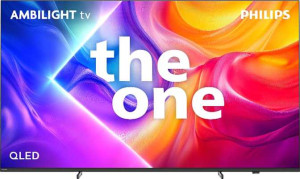
Connectivity:
Has Bluetooth
HDMI version HDMI 2.1 HDMI 2.1
HDMI ports 4 4
supports Wi-Fi
Wi-Fi version Wi-Fi 4 (802.11n), Wi-Fi 5 (802.11ac) Wi-Fi 5 (802.11ac), Wi-Fi 4 (802.11n)
Bluetooth version 5.2 5.2
USB ports 2 2
RJ45 ports 1 1
supports Miracast
has a socket for a 3.5 mm audio jack
has an external memory slot
has a VGA connector
DVB standards DVB-T, DVB-T2, DVB-C, DVB-S, DVB-S2 DVB-T, DVB-T2, DVB-C, DVB-S, DVB-S2
has a DVI connector

Across every connectivity specification provided, the Philips 77OLED760 and Philips 85PUS9000 are a complete mirror image of each other. Both carry 4 HDMI 2.1 ports — the current gold standard for TVs, capable of handling 4K at 120Hz and 48Gbps bandwidth, future-proofing connections for high-end consoles and PC graphics cards. Wireless connectivity is equally matched: both support Wi-Fi 5 (802.11ac) and Wi-Fi 4, alongside Bluetooth 5.2, which offers reliable range and stable multi-device pairing. Neither reaches Wi-Fi 6, but Wi-Fi 5 remains more than sufficient for 4K streaming without congestion in most home environments.

Wired and legacy connections round out an identical picture — a single RJ45 Ethernet port for a stable wired connection, 2 USB ports, a 3.5mm audio jack, Miracast wireless display mirroring, and a full set of DVB tuner standards (DVB-T/T2, DVB-C, DVB-S/S2) covering terrestrial, cable, and satellite reception. Neither model includes an external memory slot, VGA, or DVI, none of which represent practical omissions for modern home theatre use.

In the connectivity category, these two televisions are effectively tied in every measurable way. There is no differentiator here — a buyer choosing between the two can disregard connectivity entirely as a deciding factor and focus their attention on the display and other specification groups instead.

Audio:
supports Dolby Digital
supports Digital Out
supports Dolby Digital Plus
has SRS TheaterSound HD
has stereo speakers
has Dolby Atmos
has Dolby Audio
supports Dolby Virtual
has a subwoofer
has DTS:X
HDMI ARC / eARC HDMI ARC, HDMI eARC HDMI ARC, HDMI eARC

Audio is where these two televisions diverge in an interesting and somewhat symmetrical way — each holds one advantage over the other. The Philips 77OLED760 supports Dolby Digital Plus, an enhanced encoding format that carries higher bitrate audio data compared to standard Dolby Digital, benefiting streaming services that transmit DD+ signals. The Philips 85PUS9000 lacks this, meaning it falls back to core Dolby Digital decoding in those scenarios — a step down in audio fidelity for streaming-heavy users. On the flip side, the 85PUS9000 includes a built-in subwoofer, which the 77OLED760 does not. A dedicated subwoofer adds low-frequency extension directly from the TV's own speaker system, producing more visceral bass for movie explosions, music, and action content without requiring an external soundbar or speaker setup.

Where the two are equal is substantial: both support Dolby Atmos, DTS:X, Dolby Audio, and Dolby Digital, covering the major object-based and surround sound formats used across streaming platforms, Blu-ray, and broadcast. Both also feature HDMI ARC and eARC, with eARC being particularly important as it provides enough bandwidth to pass lossless audio formats like Dolby TrueHD and DTS-HD Master Audio to a connected soundbar or AV receiver.

Declaring a single winner here depends on usage context. For users who rely primarily on the TV's built-in speakers, the 85PUS9000's subwoofer delivers a more complete out-of-the-box sound experience. For those who stream heavily and care about audio codec quality — or plan to connect an external audio system — the 77OLED760's Dolby Digital Plus support gives it the edge. Neither product dominates the audio category outright.

Design:
width 1773 mm 1894 mm
weight 36000 g 56000 g
thickness 79 mm 96.2 mm
height 991 mm 1097 mm
volume 138806.397 cm³ 199876.4716 cm³
Supports VESA mount
maximum operating temperature 35 °C 35 °C
lowest potential operating temperature 5 °C 5 °C

Size differences between these two televisions go well beyond the screen diagonal. The Philips 85PUS9000 is substantially larger in every physical dimension — 1894 mm wide versus 1773 mm for the 77OLED760, and 1097 mm tall versus 991 mm. More meaningfully, the 85PUS9000 is also noticeably thicker at 96.2 mm compared to the OLED's 79 mm, which is consistent with the LED-backlit LCD construction requiring more depth for its backlight assembly. The OLED's slimmer profile makes a real difference in how the set integrates into a room, particularly for wall-mounted installations where depth affects how flush the screen sits against the wall.

Weight is arguably the most practically significant design difference. At 56,000 g (56 kg), the 85PUS9000 is a demanding installation — typically requiring two people and a heavy-duty wall mount rated for that load. The 77OLED760, at 36,000 g (36 kg), is considerably easier to manoeuvre and mount, reducing both installation complexity and the structural requirements of the wall or stand. Both televisions support VESA mounting and share identical operating temperature ranges, so environmental compatibility is equal across the board.

The 77OLED760 has a clear advantage in design practicality — it is lighter, slimmer, and more manageable to install. The 85PUS9000's larger footprint and significantly greater weight are direct consequences of its bigger screen and LCD construction, and buyers should factor installation logistics into their decision before committing to the larger set.

Features:
release date April 2025 January 2025
has AirPlay
has built-in smart TV
compatible with Google Assistant
works with Alexa
works with Siri/Apple HomeKit
supports a remote smartphone
has a rechargeable remote control
supports USB recording
operating power consumption 124W 129W
standby power consumption 0.5W 0.3W
has a search browser
has a sleep timer
has a child lock
has voice commands
EU energy label F E

Smart platform features are essentially identical across both televisions — AirPlay, Google Assistant, Alexa, smartphone remote support, USB recording, voice commands, and a full browser are present on both. Neither supports Apple HomeKit or Siri, and neither ships with a rechargeable remote. For everyday smart TV use, buyers will find no functional difference between the two in this category.

The only meaningful divergence lies in power consumption and energy efficiency. The Philips 85PUS9000 draws slightly more during operation at 129W versus 124W for the 77OLED760, which is a marginal gap unlikely to register on energy bills. More notable is the standby comparison: the 85PUS9000 consumes only 0.3W on standby against the 77OLED760's 0.5W — a reversal of the active-use pattern. Over years of always-on standby, this adds up slightly in the 85PUS9000's favour. The EU energy label, however, tells the broader story: the 85PUS9000 is rated label E while the 77OLED760 achieves label F, meaning the larger LCD set is formally classified as more energy efficient overall despite its bigger screen — a reflection of how the EU label factors in screen size relative to consumption.

On balance, the 85PUS9000 holds a narrow edge in this category purely on energy efficiency grounds — its better EU label and lower standby draw give it a marginal real-world advantage. Smart feature parity is complete, so energy consumption is the only basis for differentiation here.

Comparison Summary & Verdict

After examining every specification, it is clear that both TVs serve distinct audiences. The Philips 77OLED760/12 77″ is the stronger pick for dedicated home cinema enthusiasts and gamers who value the natural advantages of OLED picture quality, a slimmer and lighter build, and broader adaptive sync support including Nvidia G-Sync. Its support for Dolby Digital Plus also adds an audio edge. The Philips 85PUS9000/12 85″, on the other hand, suits those who want a larger 85-inch screen, a higher 144Hz refresh rate, a built-in subwoofer for fuller sound, and a better EU energy rating. If screen size and audio impact are your priorities, the 85PUS9000 delivers; if picture depth, form factor, and gaming versatility matter most, the 77OLED760 is the more compelling choice.

Philips 77OLED760/12 77
Buy Philips 77OLED760/12 77" if...

Buy the Philips 77OLED760/12 77″ if you want an OLED display with a slimmer, lighter design, Nvidia G-Sync support, and Dolby Digital Plus audio for a premium home cinema or gaming setup.

Philips 85PUS9000/12 85
Buy Philips 85PUS9000/12 85" if...

Buy the Philips 85PUS9000/12 85″ if you prioritize a larger 85-inch screen, a higher 144Hz refresh rate, a built-in subwoofer, and a more favorable EU energy efficiency rating.