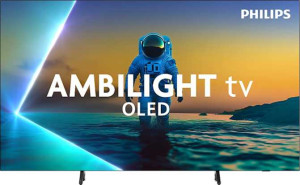
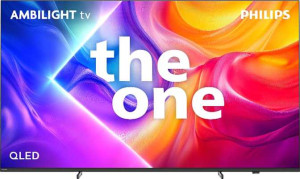
The most consequential difference in this group is panel technology. The Philips 77OLED810 uses an OLED/AMOLED panel, where each pixel produces its own light and can switch off completely, delivering true blacks and virtually infinite contrast. The Philips 85PUS9000 relies on QLED LED-backlit LCD technology, which depends on a backlight that cannot be fully eliminated per-pixel, resulting in less precise black levels. For dark-room viewing or cinematic content, this distinction is significant in practice, even though both panels share the same 4K resolution of 3840 x 2160 px, 10-bit color depth, and a wide 1070 million color palette.
The 85PUS9000 does offer a larger 85″ screen versus the OLED810′s 77″, which translates to a more immersive experience at typical living-room distances. However, the OLED810 compensates with a slightly higher pixel density of 57 ppi (versus 52 ppi), meaning individual pixels are less discernible up close. Both panels share a 144Hz refresh rate and identical 178° horizontal and vertical viewing angles, HDR support across all major formats (HDR10, HDR10+, Dolby Vision, HLG), anti-reflection coating, and an ambient light sensor — making these areas a genuine tie.
One additional edge for the OLED810 lies in adaptive sync: it supports Nvidia G-Sync alongside AMD FreeSync Premium, while the 85PUS9000 is limited to AMD FreeSync Premium only. For gamers with Nvidia GPUs, this matters for tear-free performance. Overall, the 77OLED810 holds a clear display advantage in picture quality depth and gaming versatility, while the 85PUS9000 appeals primarily to those who prioritize raw screen real estate over panel technology.