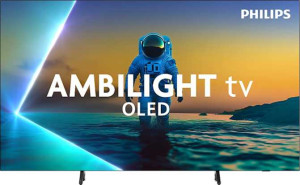
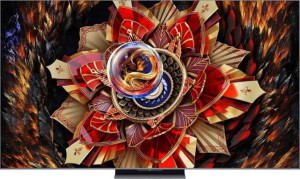
The most consequential difference in this group comes down to panel technology. The Philips 77OLED810/12 uses an OLED panel, where each pixel generates its own light and can switch off completely, delivering true blacks, infinite contrast, and near-instantaneous pixel response. The TCL 75C9K relies on QLED Mini-LED LCD technology, which uses a dense backlight array with quantum dot color enhancement. Mini-LED narrows the contrast gap with OLED significantly compared to traditional LCD, but it still cannot fully eliminate blooming around bright objects on dark backgrounds the way OLED can. For dark-room cinematic viewing, the Philips holds a structural advantage that no spec number fully captures.
Where the two TVs converge is striking: both offer 4K 3840×2160 resolution, a 144Hz refresh rate, 10-bit color depth, and support for every major HDR format — HDR10, HDR10+, Dolby Vision, and HLG. Pixel density is virtually identical (57 ppi vs 59 ppi), and both share 178° viewing angles in both axes, anti-reflection coatings, and ambient light sensors. On paper, the feature checklist is nearly a dead heat. One notable distinction in gaming connectivity: the Philips adds Nvidia G-Sync compatibility alongside AMD FreeSync Premium, while the TCL counters with AMD FreeSync Premium Pro — a higher tier that adds low-framerate compensation. Nvidia GPU owners will prefer the Philips; AMD GPU owners may lean toward the TCL.
Overall, the Philips 77OLED810/12 holds the display edge for picture quality purists, primarily due to its OLED panel's contrast and black-level superiority, compounded by its larger 77″ screen. The TCL 75C9K is a strong alternative whose Mini-LED backlight can be exceptionally bright — potentially an advantage in well-lit rooms — but based solely on the provided specs, the Philips has the more premium display foundation.