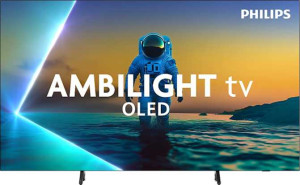
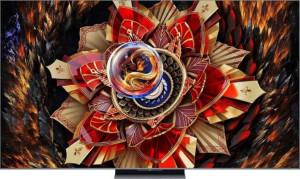
The most fundamental difference here is panel technology. The Philips 77OLED810/12 uses an OLED panel, where each pixel produces its own light and can switch off entirely, delivering true blacks and effectively infinite contrast. The TCL 85C9K relies on QLED Mini-LED LCD technology, which uses a dense array of small LEDs behind an LCD layer to dramatically improve local dimming over conventional LED screens — it gets brighter and avoids the faint glow (blooming) of older LCD sets, but it still cannot match OLED's pixel-level precision. In a dark room, the Philips will look more cinematic; in a bright living room, the TCL's higher potential peak brightness (a characteristic of Mini-LED panels) can hold its own.
Both screens share the same 3840 x 2160 (4K UHD) resolution, 144Hz refresh rate, 10-bit color depth, and full HDR suite (HDR10, HDR10+, Dolby Vision, HLG), so neither has an edge on those fronts. The Philips does land a slightly higher pixel density of 57 ppi versus the TCL's 52 ppi — a direct consequence of fitting the same resolution into a smaller 77″ panel versus an 85″ one. Up close, the Philips image will appear marginally sharper, though at typical viewing distances both are effectively indistinguishable. The TCL's larger screen compensates by offering more visual real estate, which matters for immersive viewing in a spacious room.
For gaming, the Philips adds Nvidia G-Sync compatibility on top of AMD FreeSync Premium, making it a more versatile adaptive-sync option for PC gamers regardless of their GPU brand. The TCL counters with AMD FreeSync Premium Pro, which adds low-framerate compensation and HDR support for variable refresh rate scenarios — useful, but only for AMD GPU users. Overall, the Philips 77OLED810/12 holds a clear display-quality edge thanks to its OLED panel and broader GPU sync support, while the TCL 85C9K is the stronger pick for those who prioritize screen size and brightness in well-lit environments.