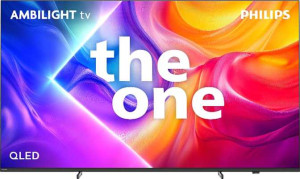
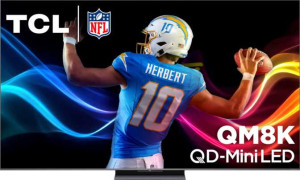
Both the Philips 85PUS9000/12 and the TCL 98QM8K share the same 4K (3840 x 2160) resolution, 144Hz refresh rate, 10-bit color depth, and full HDR format support — covering HDR10, HDR10+, Dolby Vision, and HLG. At a glance, these two televisions appear nearly identical on paper, but the real differences lie in screen size, backlighting technology, and pixel density.
The most impactful hardware distinction is the TCL's use of Mini-LED backlighting, which the Philips lacks. Mini-LED allows for far more granular local dimming zones, translating to deeper blacks, higher peak brightness, and better contrast in HDR content — a meaningful real-world advantage for dark-room viewing. On the other hand, the Philips' smaller 85″ panel yields a noticeably higher pixel density of 52 ppi versus the TCL's 45 ppi at 97.5″. At typical living-room viewing distances this gap is unlikely to be visible, but up close the Philips will appear marginally sharper. The TCL also adds AMD FreeSync Premium Pro to its adaptive sync stack — a tier above the FreeSync Premium supported by both — which enables low-latency HDR gaming, a notable plus for console and PC gamers.
Overall, the TCL 98QM8K holds a display-technology edge thanks to its Mini-LED panel and broader FreeSync support, while the Philips offers a more pixel-dense image in a more manageable screen size. If sheer picture quality and immersive scale are the priority, the TCL's advantages are hard to ignore; if space constraints or sharper pixel structure matter more, the Philips is the sensible choice.