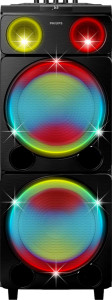
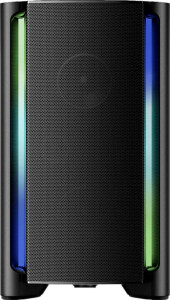
The most defining design difference between these two speakers is their sheer physical scale. The Philips TAX5509 is a compact unit measuring 110.5 × 40 × 34.5 mm and weighing just 1,900 g, whereas the TCL TP200K is an imposing floor-standing speaker at 652.3 × 371.5 × 357.5 mm and 14,300 g. This translates to a volume difference that is not marginal — the TP200K displaces roughly 86,632 cm³ compared to the TAX5509's 152 cm³. These are fundamentally different product categories masquerading in the same comparison: one is a portable or desktop unit, the other is a large stationary loudspeaker designed to anchor a room.
Beyond size, a few practical design features set them apart. The TAX5509 adds RGB lighting and a remote control, which enhance its appeal in entertainment or gaming setups where ambiance and convenience matter. The TP200K, despite its size, omits both — users must interact directly with its on-device control panel. On the other hand, the TP200K offers sweat resistance, a nod toward active or outdoor-adjacent use, while the TAX5509 carries no water or sweat protection at all. Both share a detachable cable design, which is a useful serviceability feature on either form factor.
In terms of Design, the clear edge depends entirely on use case — but taken purely as physical and ergonomic attributes, the TAX5509 holds an advantage in portability, added features (remote, RGB), and ease of placement. The TP200K's design is intentionally large and stationary, which is appropriate for its category but limits flexibility. If compactness and feature richness per unit size are the criteria, the TAX5509 has the design edge; the TP200K's bulk is a deliberate trade-off, not a flaw, but it is a significant constraint.