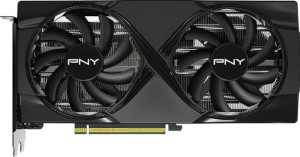
PNY GeForce RTX 5060 Ti Dual Fan 16GB
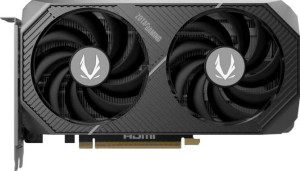
Zotac Gaming GeForce RTX 5060 Ti AMP 16GB

PNY GeForce RTX 5060 Ti Dual Fan 16GB Zotac Gaming GeForce RTX 5060 Ti AMP 16GB

Overview

Choosing between the PNY GeForce RTX 5060 Ti Dual Fan 16GB and the Zotac Gaming GeForce RTX 5060 Ti AMP 16GB is no simple task — both cards are built on the same Blackwell architecture and share identical memory configurations, port layouts, and power envelopes. The real question comes down to differences in GPU boost clocks, compute throughput, and physical dimensions. Read on as we break down every specification to help you find the right fit for your build.

Common Features

  • Both cards share a base GPU clock speed of 2407 MHz.
  • Both cards have a GPU memory speed of 1750 MHz.
  • Both cards feature 4608 shading units.
  • Both cards include 144 texture mapping units (TMUs).
  • Both cards have 48 render output units (ROPs).
  • Double Precision Floating Point (DPFP) is supported on both cards.
  • Both cards have an effective memory speed of 28000 MHz.
  • Both cards offer a maximum memory bandwidth of 448 GB/s.
  • Both cards come with 16GB of VRAM.
  • Both cards use GDDR7 memory.
  • Both cards feature a 128-bit memory bus width.
  • ECC memory is supported on both cards.
  • Both cards support DirectX 12 Ultimate.
  • Both cards support OpenGL version 4.6.
  • Both cards support OpenCL version 3.
  • Multi-display technology is supported on both cards.
  • Ray tracing is supported on both cards.
  • 3D support is available on both cards.
  • DLSS is supported on both cards.
  • XeSS (XMX) is not available on either card.
  • Both cards have one HDMI output using HDMI version 2.1b.
  • Both cards include three DisplayPort outputs.
  • Neither card has USB-C ports, DVI outputs, or mini DisplayPort outputs.
  • Both cards are based on the Blackwell GPU architecture.
  • Both cards have a Thermal Design Power (TDP) of 180W.
  • Both cards use PCIe version 5.
  • Both cards are manufactured on a 5 nm semiconductor process.
  • Both cards contain 21,900 million transistors.
  • Air-water cooling is not available on either card.

Main Differences

  • GPU turbo clock speed is 2572 MHz on the PNY GeForce RTX 5060 Ti Dual Fan 16GB and 2632 MHz on the Zotac Gaming GeForce RTX 5060 Ti AMP 16GB.
  • Pixel rate is 123.5 GPixel/s on the PNY GeForce RTX 5060 Ti Dual Fan 16GB and 126.3 GPixel/s on the Zotac Gaming GeForce RTX 5060 Ti AMP 16GB.
  • Floating-point performance is 23.7 TFLOPS on the PNY GeForce RTX 5060 Ti Dual Fan 16GB and 24.26 TFLOPS on the Zotac Gaming GeForce RTX 5060 Ti AMP 16GB.
  • Texture rate is 370.4 GTexels/s on the PNY GeForce RTX 5060 Ti Dual Fan 16GB and 379 GTexels/s on the Zotac Gaming GeForce RTX 5060 Ti AMP 16GB.
  • Card width is 245 mm on the PNY GeForce RTX 5060 Ti Dual Fan 16GB and 220.5 mm on the Zotac Gaming GeForce RTX 5060 Ti AMP 16GB.
  • Card height is 120 mm on the PNY GeForce RTX 5060 Ti Dual Fan 16GB and 120.3 mm on the Zotac Gaming GeForce RTX 5060 Ti AMP 16GB.
Specs Comparison
PNY GeForce RTX 5060 Ti Dual Fan 16GB

PNY GeForce RTX 5060 Ti Dual Fan 16GB

Zotac Gaming GeForce RTX 5060 Ti AMP 16GB

Zotac Gaming GeForce RTX 5060 Ti AMP 16GB

Performance:
GPU clock speed 2407 MHz 2407 MHz
GPU turbo 2572 MHz 2632 MHz
pixel rate 123.5 GPixel/s 126.3 GPixel/s
floating-point performance 23.7 TFLOPS 24.26 TFLOPS
texture rate 370.4 GTexels/s 379 GTexels/s
GPU memory speed 1750 MHz 1750 MHz
shading units 4608 4608
texture mapping units (TMUs) 144 144
render output units (ROPs) 48 48
Has Double Precision Floating Point (DPFP)

At their foundation, both the PNY RTX 5060 Ti and the Zotac Gaming RTX 5060 Ti AMP are built on identical silicon: the same 4608 shading units, 144 TMUs, 48 ROPs, and a matching base clock of 2407 MHz with memory running at 1750 MHz. This means any difference in real-world throughput comes down entirely to how aggressively each card boosts under load.

That is where the Zotac AMP pulls ahead. Its GPU turbo of 2632 MHz outpaces the PNY's 2572 MHz by 60 MHz — a modest but consistent gap that flows directly into every derived throughput metric. The Zotac delivers 24.26 TFLOPS of floating-point performance versus 23.7 TFLOPS on the PNY, a roughly 2.4% advantage. Similarly, its texture rate of 379 GTexels/s edges out the PNY's 370.4 GTexels/s, and its pixel fill rate of 126.3 GPixel/s versus 123.5 GPixel/s translates to a marginally sharper ceiling in rasterization-heavy workloads. In practice, these differences map to a small but real advantage in sustained compute tasks, shader-heavy scenes, and GPU-accelerated workloads.

The edge here belongs to the Zotac Gaming RTX 5060 Ti AMP. While the gap is not transformative — both cards will land in the same performance tier in games — the Zotac's higher boost clock gives it a consistent, measurable lead across all compute and graphics throughput metrics. For users prioritizing peak performance within this GPU class, the Zotac is the stronger choice on paper.

Memory:
effective memory speed 28000 MHz 28000 MHz
maximum memory bandwidth 448 GB/s 448 GB/s
VRAM 16GB 16GB
GDDR version GDDR7 GDDR7
memory bus width 128-bit 128-bit
Supports ECC memory

Memory is one area where these two cards are completely inseparable. Both carry 16GB of GDDR7 VRAM across a 128-bit bus, running at an effective 28000 MHz to deliver 448 GB/s of bandwidth. Every single memory specification is shared — there is nothing in the data to distinguish one from the other.

That said, the specs themselves tell an important story about what this generation of mid-range GPU offers. GDDR7 is a significant leap over the GDDR6X found on previous-generation cards, and the 448 GB/s bandwidth figure punches well above what a 128-bit bus could achieve in prior generations. In real-world terms, this translates to smoother handling of high-resolution textures, less stuttering in VRAM-heavy scenes, and headroom for tasks like AI inference and content creation that are increasingly memory-bound. The 16GB capacity, once reserved for flagship cards, is now enough to handle 4K gaming texture packs and large generative AI models without running into allocation limits. ECC memory support on both cards is a bonus for creators and prosumers who need error-corrected compute workloads.

This group is a definitive tie. Neither the PNY nor the Zotac AMP holds any memory advantage — buyers can make their decision entirely on other factors such as performance headroom or cooling.

Features:
DirectX version DirectX 12 Ultimate DirectX 12 Ultimate
OpenGL version 4.6 4.6
OpenCL version 3 3
Supports multi-display technology
supports ray tracing
Supports 3D
supports DLSS
has XeSS (XMX)
AMD SAM / Intel Resizable BAR Intel Resizable BAR Intel Resizable BAR
has LHR
has RGB lighting
supported displays 4 4

Feature parity is total between these two cards. Both support DirectX 12 Ultimate — the most current and comprehensive DirectX tier, enabling hardware-accelerated ray tracing, mesh shaders, and variable rate shading in supported titles. Paired with DLSS support, users get access to AI-driven upscaling that can dramatically boost frame rates at high resolutions with minimal visual cost, which remains one of the most practically impactful features a GeForce card can offer today.

On the connectivity side, each card drives up to 4 simultaneous displays and supports Intel Resizable BAR, which allows the CPU to access the full GPU frame buffer at once rather than in smaller chunks — a low-effort performance gain in many modern game titles that requires no user configuration beyond a compatible motherboard. Neither card carries LHR restrictions or XeSS support, and neither includes RGB lighting, keeping aesthetics straightforward for builds where that matters.

With every feature — from API support to display count to upscaling technology — landing identically on both cards, this group is a clean tie. Prospective buyers will find no functional differentiation here whatsoever; the decision between the PNY and the Zotac AMP should rest entirely on performance headroom, cooling, or pricing.

Ports:
has an HDMI output
HDMI ports 1 1
HDMI version HDMI 2.1b HDMI 2.1b
DisplayPort outputs 3 3
USB-C ports 0 0
DVI outputs 0 0
mini DisplayPort outputs 0 0

Port configuration is identical across both cards: one HDMI 2.1b output and three DisplayPort outputs, totaling four display connections — which aligns with the four-display maximum noted in the Features group. HDMI 2.1b is the most current HDMI specification, capable of handling 4K at high refresh rates and 8K output, making it well-suited for both gaming monitors and modern TVs without any adapters or bandwidth compromises.

The absence of USB-C is worth noting for users who rely on that connector for display output to certain ultrawide or portable monitors, though neither card is disadvantaged relative to the other since both omit it equally. The three DisplayPort outputs give multi-monitor users plenty of flexibility for high-refresh setups, and the combination of DisplayPort and HDMI 2.1b covers virtually every current display on the market.

This group is another tie — port layout, connector types, and versions are a perfect match. Display connectivity plays no role in differentiating these two cards.

General info:
GPU architecture Blackwell Blackwell
release date April 2025 April 2025
Thermal Design Power (TDP) 180W 180W
PCI Express (PCIe) version 5 5
semiconductor size 5 nm 5 nm
number of transistors 21900 million 21900 million
Has air-water cooling
width 245 mm 220.5 mm
height 120 mm 120.3 mm

Underneath the heatsinks, these two cards are built on the same foundation: the Blackwell architecture fabricated on a 5nm process with 21.9 billion transistors, running over a PCIe 5.0 interface with a shared 180W TDP. The power envelope is particularly relevant — 180W is a relatively conservative figure for a card at this performance tier, meaning neither will demand exotic power delivery or push thermal limits in a well-ventilated mid-tower case.

The one tangible difference in this group is physical size. The PNY measures 245mm in length, while the Zotac AMP comes in at 220.5mm — a gap of roughly 24.5mm. That difference is meaningful in compact or micro-ATX builds where clearance between the GPU and front panel or storage components can be tight. Both cards share the same 120mm height, so slot and bracket fit is equivalent, but the shorter Zotac gives it a practical installation advantage in space-constrained cases.

For users building in full-size ATX cases, the length difference is inconsequential and this group is effectively a tie on all meaningful specs. However, in smaller form-factor builds, the Zotac Gaming RTX 5060 Ti AMP holds a clear edge simply by being the more physically accommodating card.

Comparison Summary & Verdict

Both the PNY GeForce RTX 5060 Ti Dual Fan 16GB and the Zotac Gaming GeForce RTX 5060 Ti AMP 16GB deliver the same core experience: Blackwell architecture, 16GB of GDDR7 memory at 448 GB/s bandwidth, a 180W TDP, and an identical feature set including ray tracing and DLSS. Where they diverge is in peak performance and physical size. The Zotac holds a clear edge with a higher GPU turbo clock of 2632 MHz, a stronger floating-point output of 24.26 TFLOPS, and better pixel and texture rates — advantages worth considering for performance-focused users. Meanwhile, the PNY is the wider card at 245 mm versus the more compact 220.5 mm Zotac, a factor that may influence case compatibility. Choose the Zotac if maximizing GPU throughput is your goal; opt for the PNY if clock differences are secondary to your build priorities.

PNY GeForce RTX 5060 Ti Dual Fan 16GB
Buy PNY GeForce RTX 5060 Ti Dual Fan 16GB if...

Buy the PNY GeForce RTX 5060 Ti Dual Fan 16GB if the slight difference in boost clock and compute performance is not a deciding factor for you and your case can comfortably fit its 245 mm card width.

Zotac Gaming GeForce RTX 5060 Ti AMP 16GB
Buy Zotac Gaming GeForce RTX 5060 Ti AMP 16GB if...

Buy the Zotac Gaming GeForce RTX 5060 Ti AMP 16GB if you want the higher boost clock of 2632 MHz, better floating-point performance, and a more compact 220.5 mm form factor that suits space-constrained builds.