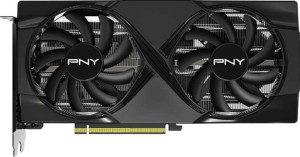
PNY GeForce RTX 5060 Ti OC Dual Fan 16GB
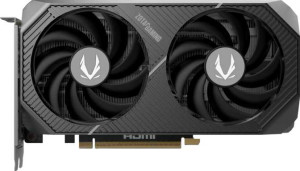
Zotac Gaming GeForce RTX 5060 Ti Twin Edge OC 16GB

PNY GeForce RTX 5060 Ti OC Dual Fan 16GB Zotac Gaming GeForce RTX 5060 Ti Twin Edge OC 16GB

Overview

Welcome to our detailed spec comparison between the PNY GeForce RTX 5060 Ti OC Dual Fan 16GB and the Zotac Gaming GeForce RTX 5060 Ti Twin Edge OC 16GB. Both cards share the same Blackwell architecture and 16GB of GDDR7 memory, yet they diverge in key areas such as GPU turbo clock speed, raw compute throughput, and physical dimensions. Read on to see exactly how these two mid-range contenders stack up across every measurable specification.

Common Features

  • Both cards have a base GPU clock speed of 2407 MHz.
  • Both cards have a GPU memory speed of 1750 MHz.
  • Both cards feature 4608 shading units.
  • Both cards include 144 texture mapping units (TMUs).
  • Both cards have 48 render output units (ROPs).
  • Double Precision Floating Point (DPFP) is supported on both cards.
  • Both cards have an effective memory speed of 28000 MHz.
  • Both cards offer a maximum memory bandwidth of 448 GB/s.
  • Both cards come with 16GB of VRAM.
  • Both cards use GDDR7 memory.
  • Both cards have a 128-bit memory bus width.
  • ECC memory is supported on both cards.
  • Both cards support DirectX 12 Ultimate.
  • Both cards support OpenGL version 4.6.
  • Both cards support OpenCL version 3.
  • Multi-display technology is supported on both cards.
  • Ray tracing is supported on both cards.
  • 3D technology is supported on both cards.
  • DLSS is supported on both cards.
  • XeSS (XMX) is not available on either card.
  • Both cards include one HDMI 2.1b output.
  • Both cards include 3 DisplayPort outputs.
  • Neither card has a USB-C port, DVI output, or mini DisplayPort output.
  • Both cards are built on the Blackwell GPU architecture.
  • Both cards have a Thermal Design Power (TDP) of 180W.
  • Both cards use PCIe version 5.
  • Both cards are manufactured on a 5 nm semiconductor process.
  • Both cards contain 21,900 million transistors.
  • Neither card uses air-water cooling.

Main Differences

  • GPU turbo clock speed is 2692 MHz on the PNY GeForce RTX 5060 Ti OC Dual Fan 16GB and 2602 MHz on the Zotac Gaming GeForce RTX 5060 Ti Twin Edge OC 16GB.
  • Pixel rate is 129.2 GPixel/s on the PNY GeForce RTX 5060 Ti OC Dual Fan 16GB and 124.9 GPixel/s on the Zotac Gaming GeForce RTX 5060 Ti Twin Edge OC 16GB.
  • Floating-point performance is 24.81 TFLOPS on the PNY GeForce RTX 5060 Ti OC Dual Fan 16GB and 23.98 TFLOPS on the Zotac Gaming GeForce RTX 5060 Ti Twin Edge OC 16GB.
  • Texture rate is 387.6 GTexels/s on the PNY GeForce RTX 5060 Ti OC Dual Fan 16GB and 374.7 GTexels/s on the Zotac Gaming GeForce RTX 5060 Ti Twin Edge OC 16GB.
  • Card width is 245 mm on the PNY GeForce RTX 5060 Ti OC Dual Fan 16GB and 220.5 mm on the Zotac Gaming GeForce RTX 5060 Ti Twin Edge OC 16GB.
  • Card height is 120 mm on the PNY GeForce RTX 5060 Ti OC Dual Fan 16GB and 120.3 mm on the Zotac Gaming GeForce RTX 5060 Ti Twin Edge OC 16GB.
Specs Comparison
PNY GeForce RTX 5060 Ti OC Dual Fan 16GB

PNY GeForce RTX 5060 Ti OC Dual Fan 16GB

Zotac Gaming GeForce RTX 5060 Ti Twin Edge OC 16GB

Zotac Gaming GeForce RTX 5060 Ti Twin Edge OC 16GB

Performance:
GPU clock speed 2407 MHz 2407 MHz
GPU turbo 2692 MHz 2602 MHz
pixel rate 129.2 GPixel/s 124.9 GPixel/s
floating-point performance 24.81 TFLOPS 23.98 TFLOPS
texture rate 387.6 GTexels/s 374.7 GTexels/s
GPU memory speed 1750 MHz 1750 MHz
shading units 4608 4608
texture mapping units (TMUs) 144 144
render output units (ROPs) 48 48
Has Double Precision Floating Point (DPFP)

At their core, both cards share the same fundamental GPU architecture: identical base clocks of 2407 MHz, the same 4608 shading units, 144 TMUs, 48 ROPs, and matching memory speeds of 1750 MHz. This means their out-of-the-box, day-to-day GPU pipeline throughput starts from the same baseline, and neither card has a structural hardware advantage in terms of execution resources.

The meaningful separation comes down to boost clock behavior. The PNY GeForce RTX 5060 Ti OC Dual Fan sustains a GPU turbo of 2692 MHz, while the Zotac Gaming Twin Edge OC peaks at 2602 MHz — a difference of 90 MHz, or roughly 3.5%. That gap cascades directly into every derived throughput metric: the PNY leads in floating-point performance at 24.81 TFLOPS versus 23.98 TFLOPS, in texture rate at 387.6 vs. 374.7 GTexels/s, and in pixel rate at 129.2 vs. 124.9 GPixel/s. In practice, a ~3–4% clock advantage rarely translates into dramatic frame-rate differences in GPU-limited scenarios, but it does represent a consistently higher performance ceiling under sustained loads.

Based strictly on the provided specs, the PNY RTX 5060 Ti OC Dual Fan holds a clear, if modest, performance edge in this group, driven entirely by its higher boost clock. The Zotac Twin Edge OC is not meaningfully slower for most users, but if peak theoretical throughput is the deciding factor, the PNY is the stronger performer of the two.

Memory:
effective memory speed 28000 MHz 28000 MHz
maximum memory bandwidth 448 GB/s 448 GB/s
VRAM 16GB 16GB
GDDR version GDDR7 GDDR7
memory bus width 128-bit 128-bit
Supports ECC memory

Every memory specification here is a perfect match. Both cards carry 16GB of GDDR7 VRAM across a 128-bit bus, running at an effective speed of 28000 MHz for a peak bandwidth of 448 GB/s. That bandwidth figure deserves some context: GDDR7 extracts significantly more throughput from a 128-bit bus than GDDR6X could, closing much of the gap that once existed between narrow-bus mid-range cards and their wider-bus counterparts.

The 16GB VRAM capacity is the other headline. At this tier, it comfortably handles high-resolution texture packs, large AI model workloads, and demanding titles at 1440p without the memory pressure that plagued 8GB cards in the same class. ECC memory support is also shared by both, which is a minor but welcome addition for creators or prosumers who occasionally run compute workloads where data integrity matters.

This group is a complete tie. There is no differentiator between the PNY RTX 5060 Ti OC Dual Fan and the Zotac Gaming Twin Edge OC in memory configuration — buyers can set this category aside entirely and let other spec groups drive their decision.

Features:
DirectX version DirectX 12 Ultimate DirectX 12 Ultimate
OpenGL version 4.6 4.6
OpenCL version 3 3
Supports multi-display technology
supports ray tracing
Supports 3D
supports DLSS
has XeSS (XMX)
AMD SAM / Intel Resizable BAR Intel Resizable BAR Intel Resizable BAR
has LHR
has RGB lighting
supported displays 4 4

Feature parity is total here. Both cards run under DirectX 12 Ultimate, which is the relevant ceiling for modern gaming — it unlocks hardware-accelerated ray tracing, mesh shaders, and variable-rate shading in supported titles. Alongside that, DLSS support is a practically significant checkbox: it allows the GPU's dedicated Tensor cores to reconstruct frames at higher resolutions from lower internal render targets, directly offsetting the performance cost of ray tracing in games that support it.

A few other shared traits are worth noting for specific buyers. Support for up to 4 simultaneous displays makes either card a reasonable choice for multi-monitor productivity setups. Intel Resizable BAR support enables the CPU to access the full VRAM pool at once rather than in fixed 256MB segments, which can yield modest but real performance gains in titles optimized for it. Neither card carries LHR restrictions or RGB lighting, the latter being a non-issue functionally but relevant for users building aesthetics-conscious systems.

With every single feature spec identical across both products, this group is an unambiguous tie. No feature-based argument can be made for choosing one over the other — the decision remains entirely in the hands of the performance and physical design categories.

Ports:
has an HDMI output
HDMI ports 1 1
HDMI version HDMI 2.1b HDMI 2.1b
DisplayPort outputs 3 3
USB-C ports 0 0
DVI outputs 0 0
mini DisplayPort outputs 0 0

The port layout is identical on both cards: one HDMI 2.1b output and three DisplayPorts, totaling four display outputs — consistent with the four-display support noted in the features group. HDMI 2.1b is the current-generation standard, capable of driving 4K at high refresh rates or 8K displays, making it future-resistant for most monitor and TV configurations available today.

The three DisplayPort outputs give multi-monitor users plenty of flexibility without adapters, and the combination of one HDMI and three DisplayPorts is a practical layout that covers virtually every modern display type. The absence of USB-C and legacy DVI outputs is unremarkable at this tier — neither omission represents a real-world limitation for the target audience of these cards.

This group is another complete tie. Both the PNY RTX 5060 Ti OC Dual Fan and the Zotac Gaming Twin Edge OC offer an identical port selection, so connectivity requirements alone cannot differentiate them.

General info:
GPU architecture Blackwell Blackwell
release date April 2025 April 2025
Thermal Design Power (TDP) 180W 180W
PCI Express (PCIe) version 5 5
semiconductor size 5 nm 5 nm
number of transistors 21900 million 21900 million
Has air-water cooling
width 245 mm 220.5 mm
height 120 mm 120.3 mm

Underneath the branding, these two cards are built on the same silicon: the Blackwell architecture on a 5nm process with 21.9 billion transistors, drawing 180W TDP and communicating over PCIe 5.0. The shared TDP is particularly relevant — it means both cards impose the same power delivery and cooling demands on a system, so neither requires a more robust PSU or case airflow setup than the other.

The one concrete differentiator in this group is physical size. The PNY RTX 5060 Ti OC Dual Fan measures 245 mm in length, while the Zotac Gaming Twin Edge OC comes in at 220.5 mm — a 24.5mm difference that is meaningful in compact or mini-ITX builds where clearance between the GPU end and the case wall can be tight. Both cards share the same 120mm height, so slot and bracket compatibility is equal; length is the only variable.

For users building in a standard mid-tower, the size gap is a non-issue. In smaller enclosures, however, the Zotac Twin Edge OC holds a practical advantage purely by virtue of its shorter footprint, making it the safer choice when GPU length clearance is constrained.

Comparison Summary & Verdict

After examining every specification, it is clear that both cards are closely matched siblings built on the same foundation: identical 16GB GDDR7 memory, a shared 180W TDP, the same port layout, and full support for ray tracing and DLSS. The distinction comes down to clock speeds and size. The PNY GeForce RTX 5060 Ti OC Dual Fan 16GB holds a consistent lead in GPU turbo speed (2692 MHz vs 2602 MHz), floating-point performance (24.81 vs 23.98 TFLOPS), and texture rate, making it the stronger choice for users who want every last drop of performance. However, it is also the wider card at 245 mm. The Zotac Gaming GeForce RTX 5060 Ti Twin Edge OC 16GB, at a more compact 220.5 mm width, is the better fit for smaller cases where clearance is a concern, with only a modest performance trade-off.

PNY GeForce RTX 5060 Ti OC Dual Fan 16GB
Buy PNY GeForce RTX 5060 Ti OC Dual Fan 16GB if...

Buy the PNY GeForce RTX 5060 Ti OC Dual Fan 16GB if you want the higher GPU turbo clock speed, greater floating-point performance, and faster texture rate, and your case can accommodate its wider 245 mm footprint.

Zotac Gaming GeForce RTX 5060 Ti Twin Edge OC 16GB
Buy Zotac Gaming GeForce RTX 5060 Ti Twin Edge OC 16GB if...

Buy the Zotac Gaming GeForce RTX 5060 Ti Twin Edge OC 16GB if you have a compact build where the smaller 220.5 mm card width is essential, and you are comfortable with a slight reduction in peak clock speed and compute throughput.